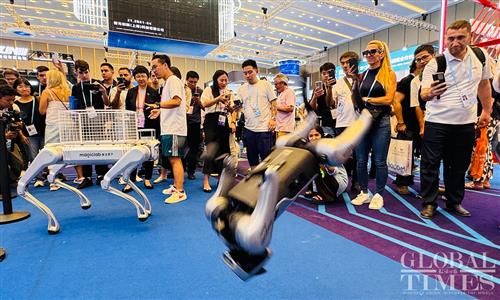
Robots, AI and innovative items shine at 138th Canton Fair, reflecting China’s technological advances
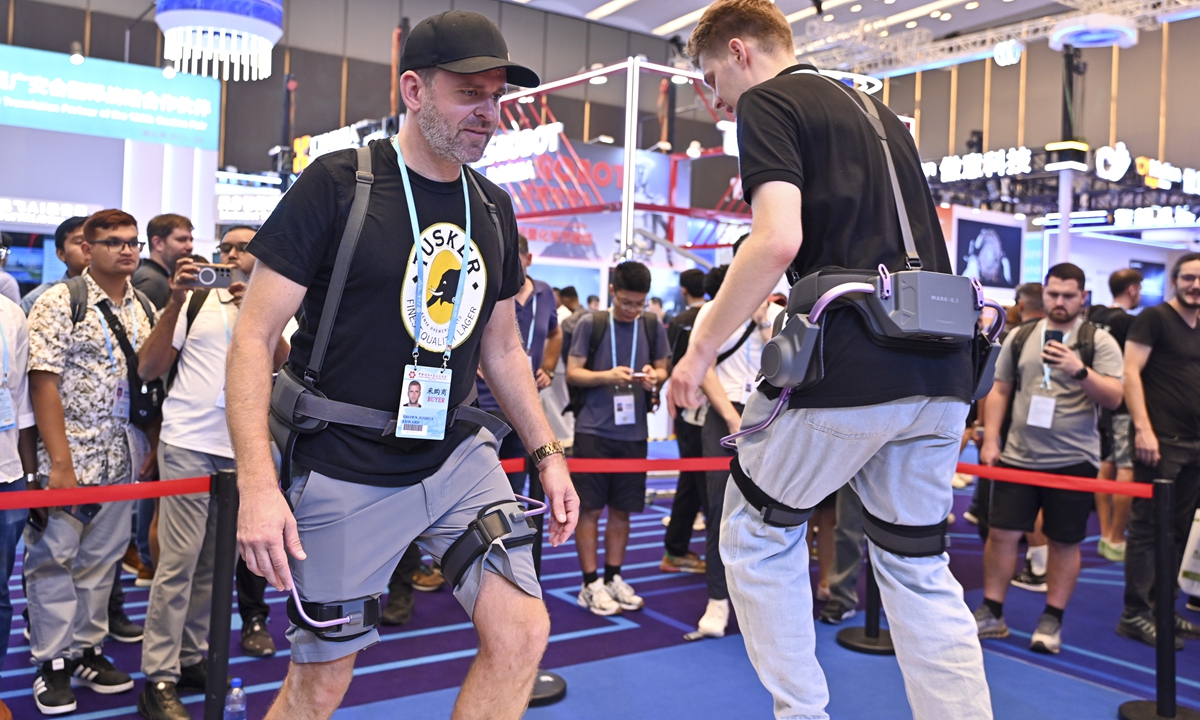
Buyers try out exoskeleton assistance devices at the 138th Canton Fair in Guangzhou, South China's Guangdong Province on October 17, 2025. Photo: VCG
The 138th Canton Fair is becoming a stage for a breathtaking prologue to the future with innovative and cutting-edge products such as robots and artificial intelligence (AI)-empowered items. From humanoid robots that interact with you to AI companions for your pets at home, these "Made in China" innovations are becoming indispensable in industrial production and daily life across countries, exhibitors said. Global buyers are gathering at the fair not just to place orders but to witness and help shape the lifestyles of tomorrow.
The 138th Canton Fair, currently underway in Guangzhou, South China's Guangdong Province, continues to feature a dedicated service robots zone, where 46 companies showcased their latest products, garnering significant attention from foreign buyers. The debut of several cutting-edge products not only packed the exhibition area with enthusiastic crowds but also drove on-site transactions.
On the fair's opening day on Wednesday, robot companies reported promising deals. Fan Yiwen, Marketing Director of Sichuan TLIBOT Co. Ltd, told the Global Times on Thursday that a Canadian client bought the only sample of the company's ultra-lightweight collaborative robot on the first day.
"Additionally, a Brazilian buyer purchased the only sample of a collaborative robot palletizing station showcased at our booth," Fan said.
For Guangzhou Inbot Technology Ltd., three deals of purchase of its PadBot robots were realized soon after the 138th Canton Fair opened.
Shu Xuqiong, Deputy General Manager of Inbot Technology, told the Global Times that a buyer from Brazil paid cash on the spot for a singing and dancing robot, with plans to visit the company for further inspection, potentially leading to more orders.
Yuanhua Robotics, Perception and AI Technologies Ltd. at the Canton Fair showcased KUNWU Robotic Surgical System, which is China's first such system covering replacements of hip, knee, and unicompartmental joint, having completed 5,000 clinical validations.
"From core software algorithms to precision mechanics and intelligent control systems, the KUNWU surgical robot is 100 percent independently developed," Meng Li Aili, Chairman of Yuanhua Robotics, Perception and AI Technologies Ltd., told the Global Times, calling the Canton Fair a vital bridge for "Made in China" to reach the world stage.
Dobot Technology unveiled several new products, including an AI-powered moxibustion robot, realizing precise laser acupuncture and temperature control without human intervention; and a massage robot using AI to target human fascia for accurate therapy, Li Jiaxian, Brand Manager of Dobot Technology, told the Global Times.
Lingdu Intel-tech Development Co., Ltd. (X-Human) launched an obstacle-crossing curtain wall cleaning robot Y3. "Traditional flat high building cleaning robots struggle with aluminum frames with a width of 3-5 centimeters or bar obstacles, severely limiting their applications," Huang Jian, COO of X-Human, told the Global Times at the Canton Fair.
The new Y3 robot can overcome obstacles up to 20 centimeters, expanding its application scenarios by about 40 percent, offering a flexible solution for the high building cleaning industry, said Huang.
The attractiveness of Chinese robotic products highlighted the industry's rapid innovation, through leveraging technical advancements, cost-effectiveness, and robust supply chain advantages, exhibitors said.
Beyond service robots, the fair also showcases remarkable advancements. According to statistics from the Canton Fair organizer, over 1 million new products, nearly 1.1 million items with independent intellectual property, and 353,000 smart exhibits are on display at the 138th edition.
In addition to the Canton Fair, the three-day WESEMiBAY Semiconductor Ecosystem Expo 2025 concluded on Friday in Shenzhen, South China's Guangdong Province, having gathered over 600 exhibitors, with some showcasing their latest breakthroughs.
For instance, Wuhan Qiyunfang Technology Co., LTD. unveiled two sets of domestically produced electronic engineering electronic design automation (EDA) software with completely independent intellectual property rights, according to media reports.
EDA design software with full independent intellectual property has filled the gap in domestic high-end electronic design industrial software, Zhang Xiaorong, director of the Beijing-based Cutting-Edge Technology Research Institute, told the Global Times on Friday.
New 'new trio'
The innovative, high-tech products led to a robust surge of revenue from international business for Chinese high-tech enterprises. Multiple Canton Fair exhibitors reported impressive growth in international business, with X-Human projecting over 40 percent revenue growth from exports in 2025.
Li of Dobot Technology said their collaborative robots have reached over 100 countries and regions, leading China's exports of such products for eight consecutive years. With nearly 100,000 robots deployed globally - topping China's rankings - overseas revenue now accounts for 52.4 percent of their total income.
These vivid examples collectively mark the progress of "Made in China" evolving into "created in China," and to "intelligent manufacturing in China."
Some analysts pointed out that robots, together with AI and innovative medicines, are becoming the new "new trio," which is an update to China's "new trio" products, namely, electric vehicles, solar batteries and lithium-ion batteries.
Taking the robotics industry as an example. China's industrial robot export market share rose to second place globally in 2024, with a 61.5 percent export growth in the first half of this year, according to statistics from the General Administration of Customs.
Currently, China holds over 190,000 valid patents related to robotics, accounting for approximately two-thirds of the global total.
Data showed that China's AI-related patents account for 60 percent of the global total, with its computing power ranking second worldwide, and its innovation index remains in the top tier globally, according to media reports.
As for innovative medicines, the total value of outward licensing transactions in the first half of 2025 reached nearly $66 billion, surpassing the full-year total of $51.9 billion in 2024, according to data from the National Medical Products Administration.
The explosive popularity of service robots at the Canton Fair is, at its core, a microcosm of China's manufacturing industry's transition from "scale expansion" to "value creation", Wang Peng, a research fellow at the Beijing Academy of Social Sciences, told the Global Times on Friday.
"The traditional manufacturing model, reliant on labor and cost advantages, is gradually fading, while service robots, as representatives of high-tech products, require the integration of AI, precision manufacturing, materials science, and other fields in their R&D and production. This directly reflects the rising technological density of China's manufacturing sector," said Wang.
New quality productive forces
What does the transition from the "new trio" to the new "new trio" mean in terms of China's exports and its industrial development? Tian Xuan, a deputy to the National People's Congress and the president of the National Institute of Financial Research at Tsinghua University, said that this shift is not only an intrinsic requirement for optimizing China's industrial structure and fostering new quality productive forces, but also a strategic initiative to enhance national comprehensive strength, ensure national security, and improve people's well-being.
Together, these three - robots, AI and innovative medicines - form the core strategic pillars of China's future development, said Tian, according to media reports.
The recent breakthroughs at major fairs or expos reflected China's progress in new quality productive forces, said Zhang.
"These breakthroughs lie in conquering key technologies, building innovative ecosystems, and deep integration with regional economies. Technological advances were realized in core equipment and tools that were once monopolized overseas," said Zhang.
The upcoming 15th Five-Year Plan (2026-30) is expected to center on building up new quality productive forces, analysts noted, as modern manufacturing cannot thrive without technological empowerment.
The contribution of China's new quality productive forces to the global stage lies in using technological innovation to solve development challenges and building a win-win ecosystem through open cooperation. With the implementation of the 15th Five-Year Plan, China's new quality productive forces will continue to provide sustained momentum for global high-quality development, Wang said.
RELATED ARTICLES