Illustration: Xia Qing/GT
The 22nd China International Agricultural Trade Fair, held in Tianjin from October 17 to 19, has offered a crucial window to observe the transformation and upgrading of Chinese agriculture. Far more than a marketplace for high-quality agricultural products, the event has also served as a platform for showcasing the latest achievements in agricultural technology, vividly illustrating how innovation is being deeply integrated into the entire agricultural chain and becoming a key driving force for promoting the modernization of China's agriculture.This year's fair showcased the latest applications for technologies like the Internet of Things, cloud computing, big data, and artificial intelligence (AI) in agriculture. Many companies also unveiled smart agricultural research results.
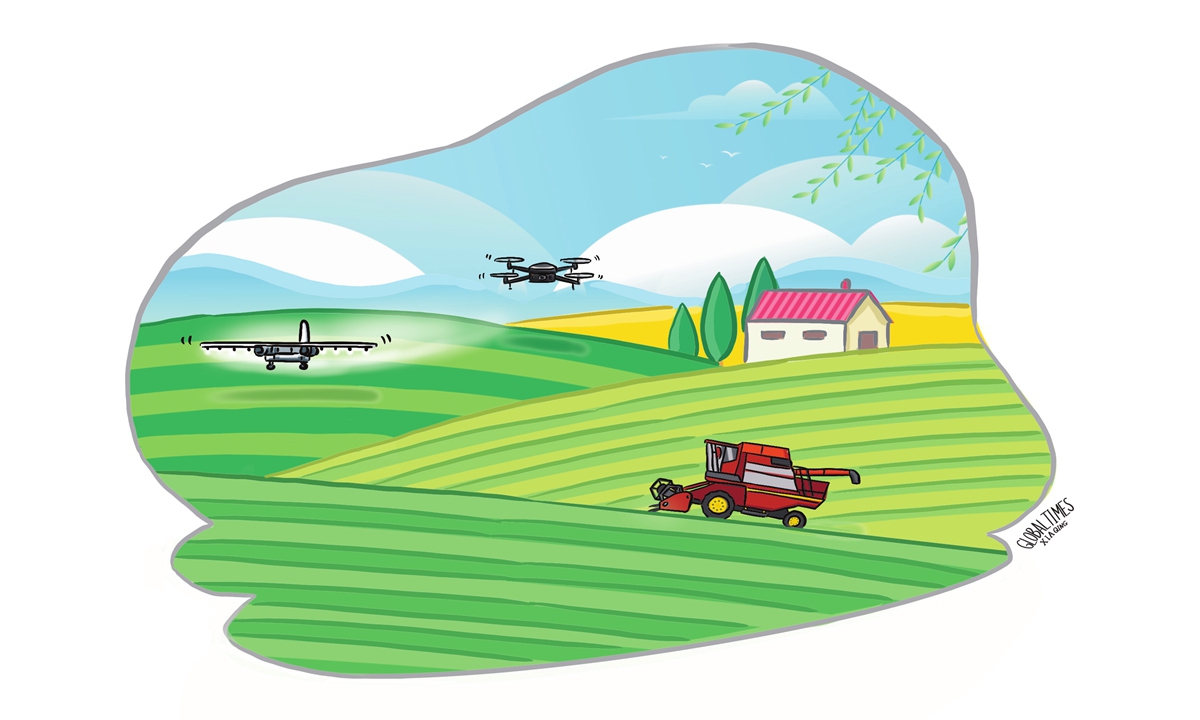
For instance, the T100 agricultural unmanned aircraft launched by DJI from Shenzhen supports multiple agricultural and forestry applications such as spraying, sowing, and hoisting, enabling the switch between autonomous route flight and manual flight, which greatly improves the efficiency of tasks such as sowing and harvesting.
Also, some companies exhibited intelligent aquaculture systems that can monitor key data like water temperature and pH value in real time, enabling online-controlled feeding that reduces labor while offering professional breeding advice. These are practical tools already driving a revolution in agricultural production methods.
The value of these technologies is most immediately evident at the production level. Advanced agricultural equipment has improved the efficiency of processes such as sowing and harvesting, while digital technologies, particularly big data, are fundamentally reshaping production methods. Traditional agriculture often relied heavily on intensive labor and material inputs, but smart management now enables optimal resource allocation through information technology.
For consumers, the establishment of technological traceability systems is building greater trust and assurance in food safety. This transparent information flow not only enhances consumer confidence but also promotes the healthy development of agricultural markets. A prime example highlighted at the fair was the Jilin Animal Husbandry Special Zone's traceability platform, which allows consumers to check the authenticity of products by scanning codes on-site.
This technological empowerment, from production to consumption, is precisely the key to the transformation and upgrading of China's agriculture. It enhances the efficiency and profitability of farming while meeting consumer demand for high-quality produce, thereby injecting new vitality into rural revitalization. Underpinning this upgrade is the continuous development of new quality productive forces in agriculture.
The process of technology-driven agricultural transformation and upgrading is responding to the needs of national food security and rural revitalization. In the context of rising income levels and the continuous transformation of dietary structures among urban and rural residents, the demand for high-quality staple grains, meat, eggs, milk, and other agricultural products is constantly expanding, while constraints on natural resources such as arable land are becoming increasingly prominent.
Against this backdrop, the integration of agricultural technology has opened up a new path to break through resource and environmental bottlenecks. It has driven agriculture to shift from traditional production relying on natural conditions to a modern industry relying on data-driven and intelligent decision-making. Through technologies such as precision irrigation and AI-based breeding, we can ensure stable agricultural production and continuously improve the quality and added value of agricultural products.
The journey of upgrading Chinese agriculture will continue. More scientific and technological achievements will continue to play a leading and driving role, providing a continuous stream of momentum for this transformation. These advances will offer solid support for building a strong agricultural nation and promoting rural revitalization, while also contributing China's wisdom to global agricultural modernization.
RELATED ARTICLES