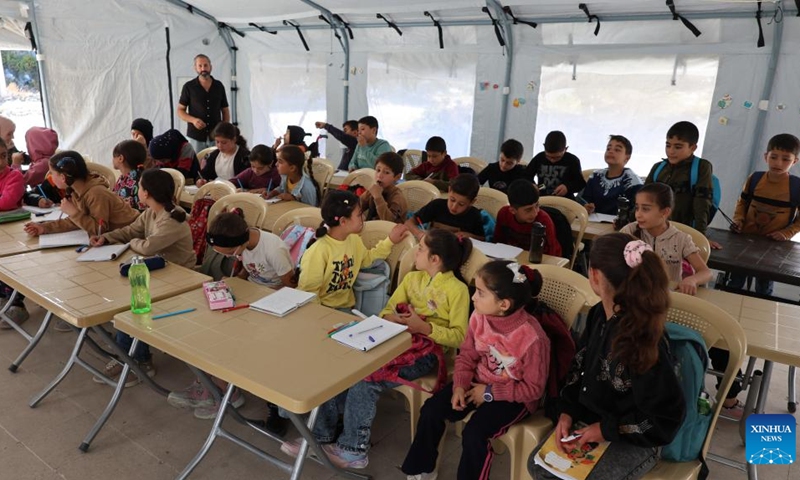
Children take a class at a temporary learning center in Salma, Latakia province, Syria, Oct. 13, 2025. (Photo: Xinhua)
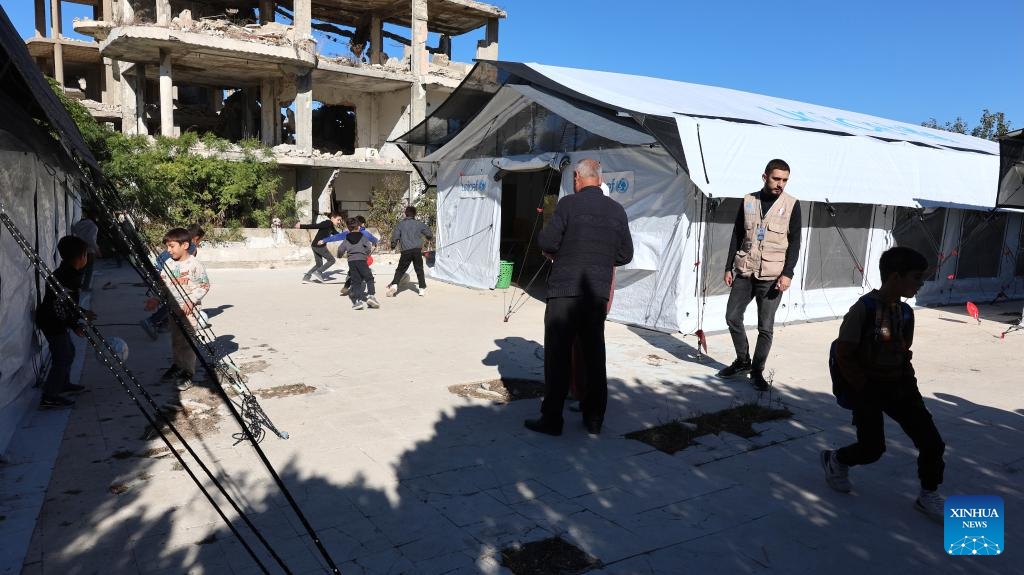
Children play at a temporary learning center in Salma, Latakia province, Syria, Oct. 13, 2025. (Photo: Xinhua)
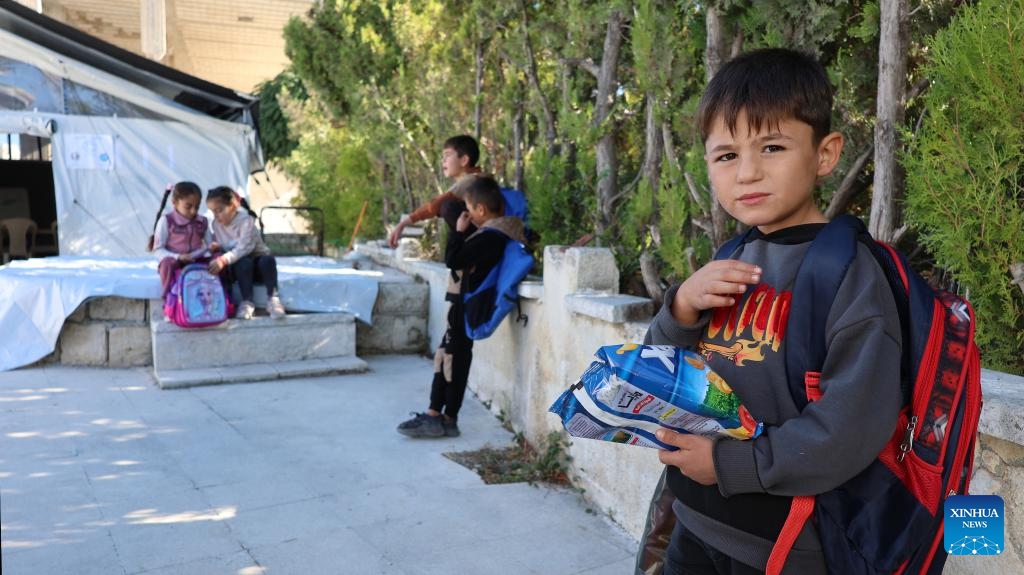
Children have a break at a temporary learning center in Salma, Latakia province, Syria, Oct. 13, 2025. (Photo: Xinhua)
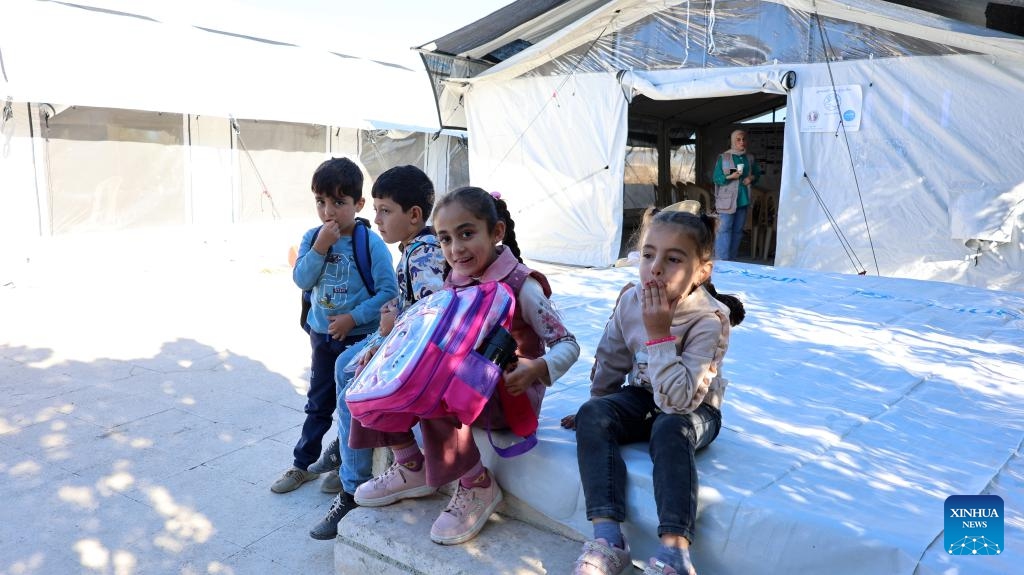
Children have a break at a temporary learning center in Salma, Latakia province, Syria, Oct. 13, 2025. (Photo: Xinhua)
Every weekday morning in the mountainous countryside of northern Latakia, a coastal province of Syria, third-grader Taher Arab Taha, who recently returned to the small town of Salma from al-Baraa camp in Idlib, clings to his grandfather's side along with his siblings on a small motorcycle to reach school.
Balancing three young grandchildren, the grandfather navigates winding dirt paths toward the makeshift school nestled among ruins where homes and classroom buildings once stood. Some students still walk long distances on foot, their heavy bags swaying with every step.
Pitched between olive groves and the skeletons of destroyed buildings, the white tents serving as schools offer little shelter from the cold mountain air. Inside, plastic tables replace wooden desks, yet the scratch of pencils on paper resonates like the heartbeat of a town slowly coming back to life.
Salma, once a hot zone during Syria's prolonged war, is slowly seeing families return despite finding their homes and schools in ruins. In one of the tents, Taha proudly opens his worn notebook. "We came back to school and to learning," he told Xinhua. "I came to study with my friends, and I never want to go back to the camp again."
Across the dusty yard, 11-year-old Mustafa Omari, a fifth-grader who fled Hanbushiyeh camp in Idlib countryside, straightened his back and said, "Even if the school is just a tent, we must keep learning. I hope my friends in the camps come back so we can study together again."
According to Manar Sobhi, the center's director, roughly 120 students attend the temporary learning center set up by the Mosaic Association for Relief and Development in cooperation with UNICEF and the Latakia Education Directorate. The school consists of four large tents serving grades one to five, catering to returnee children from displacement camps and Türkiye, many of whom missed years of formal education.
Months before the new school year, work began to set up educational tents in Salma, Sobhi said. "This was done to compensate for the learning loss of students returning from Idlib or Türkiye, especially those who could neither read nor write Arabic. Every day, more families register their children when they hear the school is working again."
The challenge remains immense; dozens of schools in northern Latakia are still in ruins. "There is sadness, yes," Sobhi said, "but what gives us hope is that education is back, and so are the people. They've come home. Even if the classrooms are tents, they are on their own land again."
Official figures from the Latakia education authorities show that 27 schools in the Turkmen Mountains sustained partial damage and are repairable, while 56 schools in the Kurdish Mountains were hit, including 19 that were destroyed. The widespread destruction has delayed the reopening of public schools, especially for families returning from displacement in Idlib and other northern areas.
Teacher Reem Yassin al-Sabbah, who fled to Latakia city during the war, returned as soon as the tent school opened this month. "We're doing our best to make this a model school," she said. "Many students were placed in lower grades so we can rebuild their foundation properly. We still lack resources, but the determination is there."
Project manager Rania Qali'a emphasized that the tents are a temporary bridge until the schools are rebuilt, a process expected to take about three months. "A child's natural place is in school, not at home or in the street," she said. "With UNICEF's support, we created these classrooms so that no child loses a school year. When they go back to their real schools, they can continue without disruption."
UNICEF estimates that more than 2.45 million children remain out of school in Syria, with over one million more at risk of dropping out. Thousands of schools were damaged or destroyed, while many teachers work with little pay and limited materials.
"Every girl and boy has the right to learn in a safe, inclusive classroom, a place to regain routine, confidence, and hope," UNICEF Syria Deputy Representative Zeinab Adam told Xinhua. She added that the humanitarian crisis has left children struggling not only with disrupted education but also with displacement, poverty, and limited access to basic services. "Our collective responsibility is to remove these barriers and keep classroom doors open for every child."
