ARTS / CULTURE & LEISURE
22 new sites listed as wetlands of national importance, total number expanded to 80
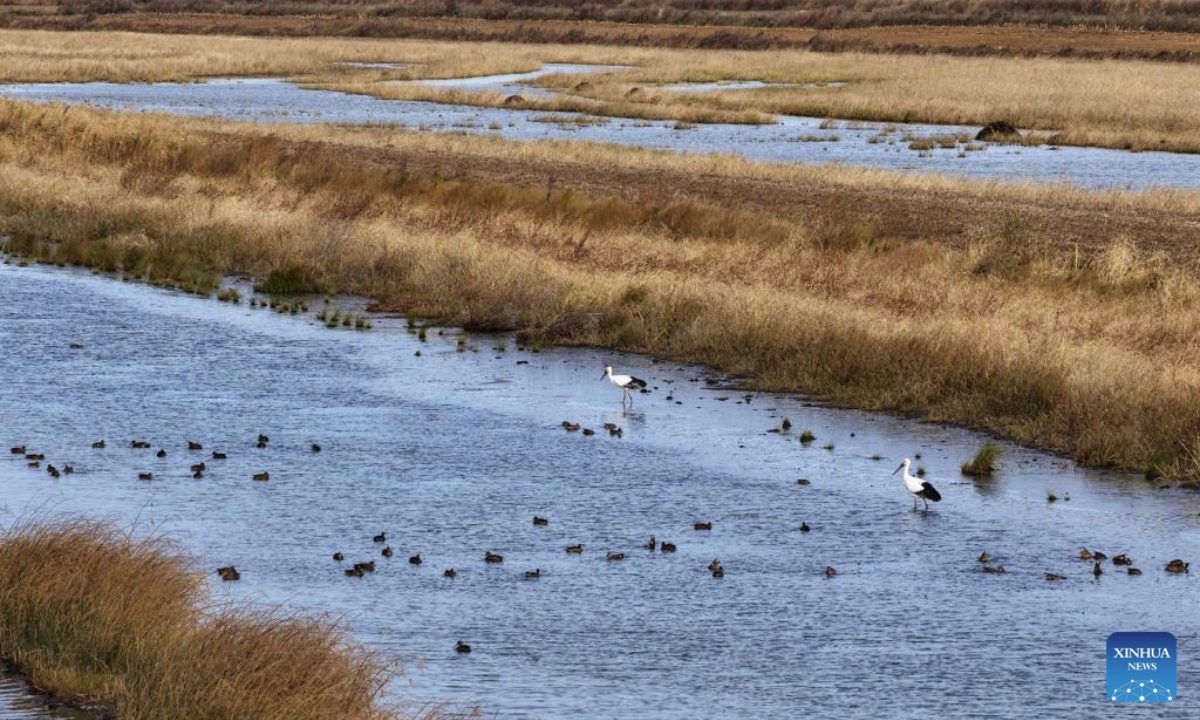
Photo: Xinhua
China has designated 22 additional wetlands as nationally important wetlands, bringing the total number to 80, the National Forestry and Grassland Administration of China announced on its official website on Monday.The move marks another step in strengthening the country's multi-tiered wetland conservation system and implementing its Wetland Protection Law, Zhang Mingxiang, a professor at Beijing Forestry University, told the Global Times on Monday.
China's first legislation dedicated to wetlands, the Wetland Protection Law, which went into effect in June 2022, provides a comprehensive legal framework for wetland conservation, restoration, management and sustainable use, according to the Xinhua News Agency.
"This addition improves the graded protection system for wetlands in China and helps advance the implementation of the Wetland Protection Law," said Zhang. "It's not only about conserving natural habitats, but also about effective, on-the-ground protection."
Wetlands, dubbed "the kidneys of the Earth," are some of the top stores of carbon, as such their existence contributes to global efforts to reduce carbon emissions.
In recent years, China has significantly expanded its efforts to restore and protect wetlands nationwide. More than 3,700 wetland restoration projects have been launched, adding or rehabilitating more than 1 million hectares of wetlands. China now boasts 82 internationally recognized wetlands, and 22 international wetland cities, and has established 1,205 provincially important wetlands in addition to the 80 at the national level.
The country's mangrove conservation efforts provide a striking example of wetland progress. China's mangrove coverage has reached 454,500 mu (about 30,300 hectares), an increase of 124,500 mu since the beginning of the century. In 2024, China launched the International Mangrove Center in the southern city of Shenzhen, Guangdong Province to promote global mangrove conservation, sustainable use and international cooperation.
"China is now among the few countries in the world to have achieved a net gain in mangrove area," Zhang told the Global Times.
According to Zhang, the newly listed wetlands span major river basins, including the Yellow River Basin, Yangtze River Basin, and Songliao Basin, covering some critical stopovers along migratory bird routes. The expansion will enhance the ecological connectivity of these water systems and strengthen biodiversity corridors.
Looking ahead, the National Forestry and Grassland Administration will continue to implement the Wetland Protection Law, focusing on strengthening the establishment of the systems for wetland conservation and restoration, investigation and monitoring, and protection and supervision, while continuously improving the quality and stability of wetland ecosystems.
China's wetlands face increasing challenges from climate change, as well as the need to strike a balance between protection and sustainable use, said Zhang, adding that the Wetland Protection Law already provides comprehensive coverage across sectors and regions. Beyond legislation, he noted, developing and managing national wetland parks can also serve as an effective strategy to protect critical ecosystems while allowing for appropriate public access and education.
China's wetlands face increasing challenges from climate change, as well as the need to strike a balance between protection and sustainable use, said Zhang, adding that the Wetland Protection Law already provides comprehensive coverage across sectors and regions. Beyond legislation, he noted, developing and managing national wetland parks can also serve as an effective strategy to protect critical ecosystems while allowing for appropriate public access and education.
The country has established 903 national wetland parks over the past two decades, protecting 2.4 million hectares of wetlands and providing vital habitats for endangered species such as the black stork and Chinese merganser. Over 90 percent of these parks are free to the public, promoting eco-tourism, cultural activities and environmental education, according to Xinhua.
"Protecting wetlands isn't just about fencing them off," Zhang added. "We must innovate public education and create opportunities for people to experience the beauty of wetlands. When the public participates, understands, and benefits, the awareness and motivation to protect these ecosystems will continue to grow."
RELATED ARTICLES