ARTS / CULTURE & LEISURE
When psychology meets the night market: warmth of China’s social services
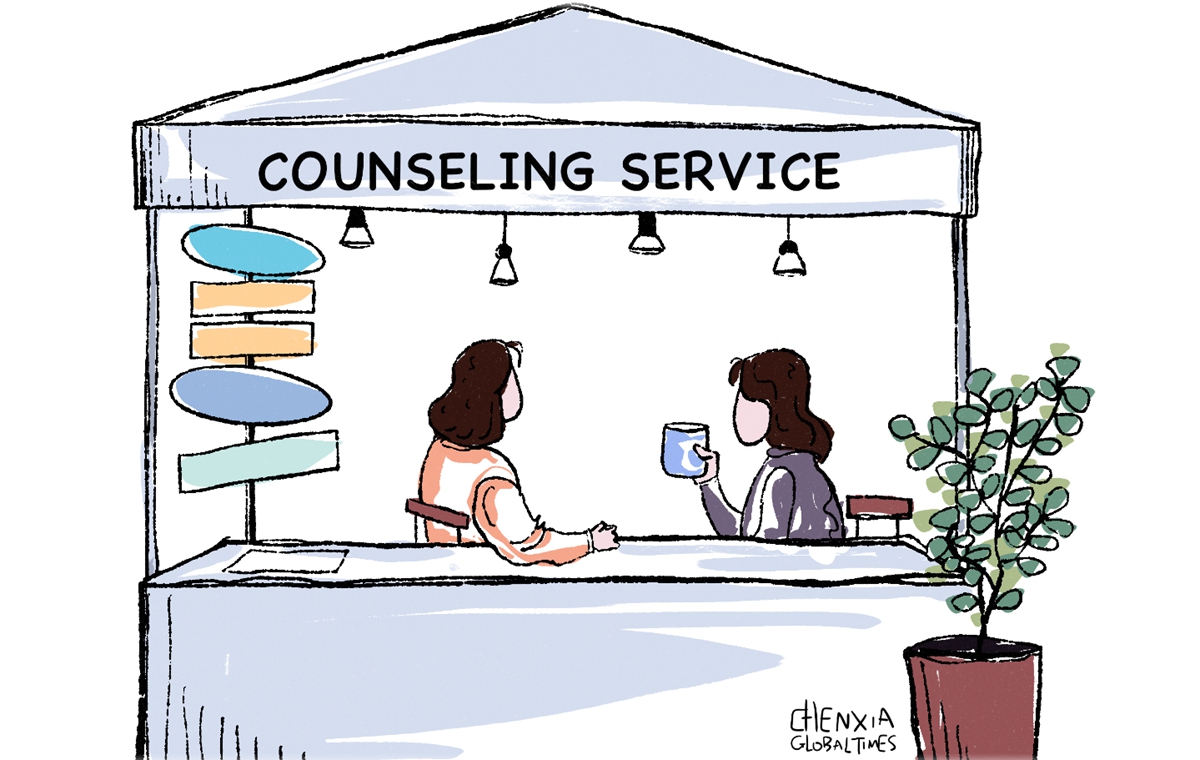
Illustration: Chen Xia/GT
At the bustling night market near the West Lake in Hangzhou, East China's Zhejiang Province, residents can do more than purchasing snacks and souvenirs; they can also "search for peace of mind." While making sachets, painting masks, or weaving yarn flowers, visitors chatted casually with professional counselors about their worries and stress. The initiative highlights the warm touch of China's social services, observers told the Global Times.Led by professor Hong Fang from the Department of Psychology at Zhejiang Sci-Tech University, a professional team has set up a "psychology stall" at the market, offering free, no-appointment counseling sessions to visitors. The effort has drawn steady queues of residents since its recent launch.
The night market, a symbol of a city's vitality and community spirit, has become an unexpected setting for mental health support. By moving counseling services from clinics to open-air markets, local professionals are expanding both the time and space of mental health care.
Guo Fei, a Beijing-based psychological counselor, told the Global Times on Monday that the biggest strength of this new initiative lies in its accessibility. Traditional psychological counseling frameworks can be intimidating for many people. Residents who might hesitate to visit a formal counseling center can now seek help in a relaxed, familiar environment after work hours.
"In the cultural context, people often feel pressure or embarrassment when they have to see a counselor. By setting up counseling booths in night markets - open, lively, and familiar public spaces - this barrier is greatly reduced. Visitors can engage naturally in conversation while making crafts, without the formality or tension of a clinical setting," Guo said.
Similar efforts have also appeared elsewhere. Celebrating the 34th World Mental Health Day, a counseling service event named "Mind Encounter" was held in Chongming, Shanghai, on October 9. The event combined games and psychological consultation to bring mental health services closer to everyday life. Another interactive counseling event previously took place in Binzhou, East China's Shandong Province.
Wang Peng, an associate researcher at the Beijing Academy of Social Sciences, told the Global Times on Monday that providing psychological services in the lively and informal setting of night markets is an innovative and meaningful experiment.
Psychological services have brought new elements to night markets, integrating with traditional cultural activities such as handicraft making. This not only promotes the interaction between psychology and folk traditions, but also helps spread awareness of mental health, Wang noted.
According to data from the World Health Organization, 75 percent of people with mental disorders worldwide have not received professional treatment. As an informal support system, night market counseling can reach groups that are often difficult to engage through traditional channels.
Guo noted that it allows counselors and participants to build rapport faster - almost like opening a door to healing from the very first moment.
The handcraft process itself carries therapeutic value. The simple, tactile act of creating something provides emotional release, while trained professionals use counseling techniques to guide conversations toward deeper understanding. This combination, Guo said, enhances the overall effectiveness of psychological support.
"It makes psychological care close, visible, and readily available," she added. "When people realize that mental wellness service is something they can access easily in their community, it helps normalize the idea of seeking help, and that's the first step toward a healthier society."
By presenting psychological knowledge in a vivid and accessible way, it encourages the public to value emotional well-being and fosters a social atmosphere that respects and supports mental health needs, said Wang.
These efforts highlight a broader shift in China's urban management and social services, which are placing greater emphasis on warmth and public engagement in emotional support.
Professor Hong told Chao News, a media outlet under Zhejiang Daily, that her team has been exploring how to provide psychological services in ways that resonate with the Chinese public.
"Our night market-based psychological services are one such approach," Hong said. "We hope that by adopting diverse and engaging formats, more people will feel comfortable opening up and talking about their worries with us."
This integration of vibrant city life and psychological care reflects a practical understanding: Mental well-being is not only a medical issue but also a matter of daily companionship and social connection.
The success of these night market projects suggests a new model for building community-based psychological support networks. By blending professional services with everyday leisure spaces, cities can make mental health care more approachable, inclusive, and sustainable.
For the psychological services sector, this new model offers a new direction for development. It encourages the industry to become more diverse and community-oriented, while enhancing its overall professionalism and social impact, Wang added.
The author is a reporter with the Global Times. life@globaltimes.com.cn
RELATED ARTICLES