ARTS / CULTURE & LEISURE
Indoor and outdoor slopes fuel China’s year-round ski surge
Early snow boosts skiing season
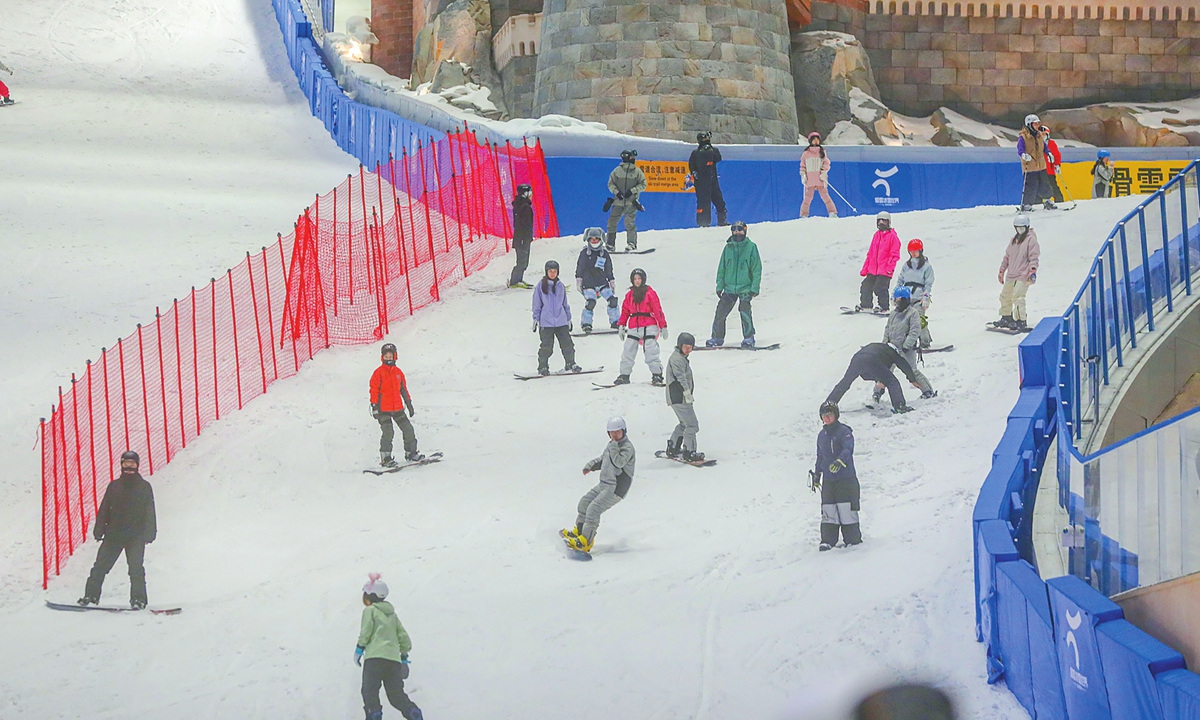
Ski enthusiasts enjoy their time at an indoor snow center in Shanghai. Photos on this page: IC
The latest cold snap across North China has caught many city residents off guard, but it has also presented a golden opportunity for ski resorts. Wanlong ski resort in Chongli, North China's Hebei Province, started its ski season on Tuesday, the earliest opening in the resort's 23-year history.Several other ski resorts in Chongli, such as Fulong, Yunding, and Thaiwoo, have also started artificial snow-making to prepare for respective ski seasons, which are expected to kick off in late October. The Chongli region is just less than two hours from Beijing by high-speed rail.
In Northwest China's Xinjiang Uygur Autonomous Region, the Koktokay ski resort is the earliest starter as it opened the ski season mid-October.
Yabuli ski resort in Northeast China's Heilongjiang Province, the ski competition venue for the 2025 Harbin Asian Winter Games, will also join the ski season in November. In Tianjin, the night skiing activities at the Jizhou International ski resort also attracted many visitors.
From the northern reaches of Heilongjiang to Xinjiang in the northwest, China's ski resorts are opening their seasons earlier than ever, signaling both climatic advantage and rising demand.
Recent years have seen the growing enthusiasm toward skiing, especially after Beijing hosted the 2022 Winter Olympics. The longer winter season this year means more ski days, more tourism revenue for towns and hotels, more gear sales for equipment makers, and a longer window for promoting winter sports as part of daily lifestyle, not just annual vacation.
Ski resorts across China recorded 26.05 million skier visits from May 2024 to April this year, according to the latest China Ski Industry White Paper, representing a 12.9 percent increase from 23.08 million the previous season.
Wu Bin, vice president of the Beijing Ski Association and chief author of the white paper, told the Global Times recently at the Winter Sport Expo in Beijing that most domestic ski resorts remain small in scale.
"The last snow season China recorded historic high visitors, however, most domestic ski resorts remain small in scale, with only 181 equipped with cable cars and similar facilities, which indicates that there is still a gap in infrastructure compared with leading nations," Wu told the Global Times.
But he also noted that the fast development of indoor ski resorts in southern part of China where snow is rare, has also boosted the growing of skiing.
Among the world's top 10 indoor ski resorts by snow area, seven are located in China, and all of the top five largest indoor ski resorts are in China.
"The explosive growth of indoor ski resorts, alongside the increasing concentration of outdoor ski facilities, has become a defining feature of China's current ski market," Wu said.
Winter Olympics boost
Since Beijing won the Winter Olympics bid in 2015, the development of the skiing industry in China has been put on a fast track.
According to the latest National Sports Venue Statistics Survey published earlier this year by the General Administration of Sport of China, as of December 31, 2024, there were 2,678 ice and snow sports venues nationwide, including 914 ski resorts.
By hosting the Beijing 2022 Winter Olympics, China has turned a vision of having 300 million people participating in ice and snow sports that was initiated in 2013 into reality. With the Milan Cortina 2026 Winter Olympics looming, it is the right time to see the long-term effect of such vision.
Zhang Bin, a Beijing-based sports commentator, told the Global Times on Tuesday that the benefit of hosting the 2022 Winter Olympics does not stop when the Games concluded.
"The legacy of the Beijing 2022 Winter Olympics helped ignite public interest in skiing and other winter sports, and the arrival of the Harbin Asian Winter Games earlier this year also gave the industry further fuel," Zhang told the Global Times.
He noted that though another Winter Olympics being hosted overseas is unlikely to boost domestic winter sports development like Beijing 2022, the long-term effects of Beijing Games will continue to bear fruit.
The 2022 Olympics inspired many to try and even develop a love for winter sports, especially the younger generation at the time.
As they grow older and share their enthusiasm by word of mouth, the ripple effect is expected to be significant," Zhang noted.
According to the recently released China Ice and Snow Industry Development Research Report, the scale of China's ice and snow industry is expected to surpass the 1 trillion-yuan mark in 2025.
Year-round sport
Zhang Abo, an indoor ski instructor based in Hangzhou, East China's Zhejiang Province, told the Global Times that nowadays the public interest toward skiing has extended far beyond traditional hubs.
"Public enthusiasm for skiing has surged, extending far beyond traditional hubs," Zhang Abo told the Global Times. "Demand is no longer confined to the north. Indoor snow venues in southern China have proliferated, making skiing and snowboarding accessible to people who live in warmer regions."
He noted that thanks to the industry's continued development in the past decade, skiing could be a year-round sport in China.
"China now produces a comprehensive range of winter sports equipment, from personal gear to high-end snow-making machines," Zhang Abo said.
"Thanks to indoor and artificial-snow technology, skiing could now be available year-round in China."
Hannan Gillani contributed to the story
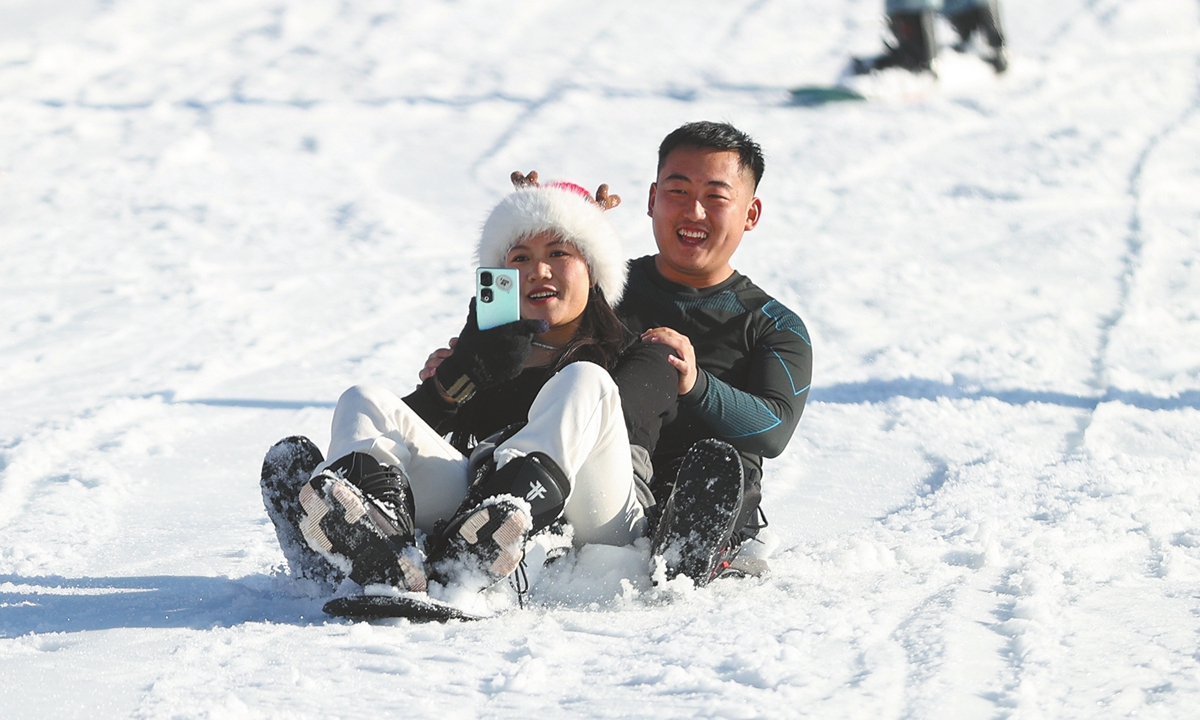
Visitors take selfies at the Yunding ski resort in Hebei Province.
RELATED ARTICLES