ARTS / CULTURE & LEISURE
Fading marathon fever a momentary pause before next chapter

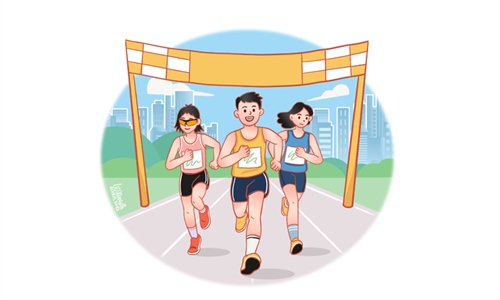
Illustration: Liu Xiangya/GT
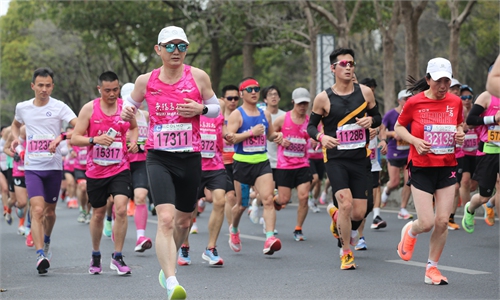
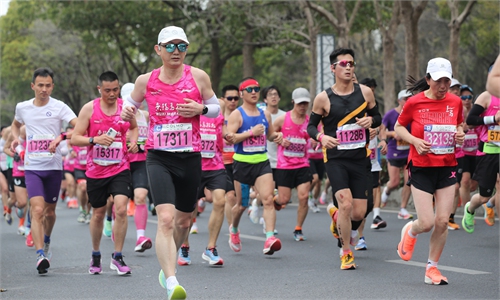
When the klaxon for the national marathon season should have been ringing loud and clear this October, it faded into a reticent whisper instead. According to incomplete statistics, in 2025, more than 100 marathon events in China have been canceled or postponed. However, what appears to be a sudden retreat of the "mass-marathon" movement is in fact a welcome recalibration: a shift from frenetic participation to a more considered, higher-quality return to the sport.No doubt marathons once became one of the marquee ways for cities to show off their image in China, as the large-scale race is a symbol of the event economy. According to the Xinhua News Agency, in 2024 alone, some 749 road-running events were held nationwide, drawing a total field of 7.0486 million participants. Yet the ebbing enthusiasm behind these events signals more than fatigue, and it reflects a deeper misalignment between the mass fitness narrative and the reality of what a marathon demands.
To put it simply, over the past five years, marathons grew out of the "everybody runs" wave, but they always had a threshold. Without the requisite endurance training, runners risk injury, and even worse, the professional integrity of a marathon itself begins to degrade. As Liu Min, the female champion of last year's Beijing Marathon, observed, participation by runners lacking a long-term base not only carries higher risks, but also dilutes the event's professional status.
In March, a boy who just turned 12 ran a half-marathon in Zunyi, Guizhou Province, in 1:17.41 in clear breach of the age rules set by the Chinese Athletics Association.
"Marathons are mainly for grown-up adults, and ordinary runners without regular 10-kilometer training are not suited for long-term, intensive participation in marathon events," Liu told the Global Times.
Meanwhile, Liu noted that local organizers chasing the quick reward of event economy branding often overshot their capacity: inadequate logistics, safety loopholes and weak medical support started to show.
During the Jinan Marathon, some pacers ignored marathon regulations by serving as pacers in two races within the same week, while in the Hengqin Marathon, runners claimed they could buy other participants' photographs and video footage through a third-party platform. These are not just isolated oddities, as they point to the broader weak under-belly of event management, where participant experience, safety standards and competitive legitimacy are being compromised.
The current tightening of marathon policy should not be read as a contraction but as a correction. The Chinese Athletics Association's new regulations released on September 30 emphasize stricter competition organization, clarifying rules including strengthening event organization, enhancing training and promoting safety awareness.
Another widely circulated regulation among runners and organizers likely to go into effect in November shows that from November onward, the number of C-level county marathons will be limited, and marathon events will raise the ratio of amateur participants and prohibit the commissioning of foreign elite athletes in non-standard events.
At first glance the policy seems to raise the barrier to entry, yet this is precisely a pivot from quantity to quality, from ceremony to substance. For local governments, marathons are no longer a city-marketing tool, and they must return to what they truly are, a sport with safety, legitimacy and participant experience at the center.
So what does this mean for the future of group running culture in China? For one thing, it means the standard, large-scale marathon may become less dominant.
Instead, new types of grassroots running will emerge: shorter-distance runs, community fun-runs, trail races that fuse cultural and natural heritage, even parent-child runs and running-club leagues. The 2025 Lijiang ancient city ultra trail run is now recruiting, and 2025 Lingjiu Mountain Ancient Trail just announced its launch on Monday.
"For me, these running events will become a sustainable, meaningful part of the social and urban fabric for amateur runners. And with fewer high-quality marathons, thoughtfully organized, responsibly managed and lasting marathon events might actually be a sign of the movement maturing," Zhou Bingchang, an amateur runner who just got his cancellation message from the Taixing Marathon, told the Global Times.
"But still, these events need a qualification process, and I strongly recommend every amateur runner to run according to their abilities," Liu said.
In this sense, the cancellations can be interpreted as a momentary pause, a collective drawing of breath before the next chapter. The sheen may have lost some of its glow, but behind that is the hard graft of substance. If running becomes less about spectacle and more about experience, less about mass numbers and more about meaningful participation, then what we are witnessing is not retreat.
As we witness marathon changes, we prefer one that prizes calm, considered growth over unchecked expansion. It is now for all stakeholders, including athletes and organizers, to resist the allure of big numbers and instead focus on what really matters: well run, safe races, inclusive but legitimate entry systems, and routes and experiences that embody the character of their places and people.
It's time for marathons to stop being a badge of city ambition, and instead become an activity in which running culture breathes, evolves and endures.
The author is a reporter with the Global Times. life@globaltimes.com.cn
RELATED ARTICLES