ARTS / CULTURE & LEISURE
Study reveals secrets of timber use in Qin Dynasty
Offering insights into ancient construction practices
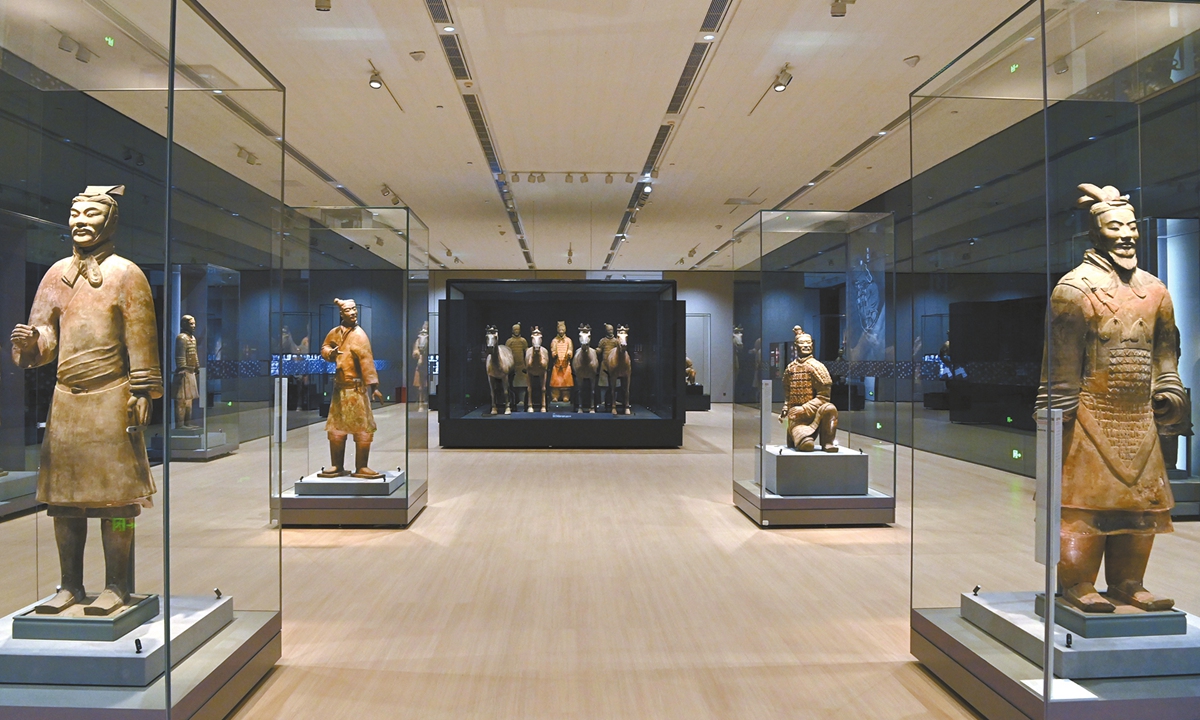
Terracotta warriors are on display at the exhibition in Xi'an to commemorate the 50th anniversary of the discovery of the Terracotta Warriors. Photo: Courtesy of Emperor Qinshihuang's Mausoleum Site Museum
Chinese and UK researchers have completed the first systematic research on wooden architectural remains unearthed from Emperor Qinshihuang's Mausoleum. These carbonized wooden relics have provided critical clues to understanding how timber resources were used during the Qin Dynasty (221BC-206BC), offering insights into the resource mobilization, labor organization, and construction practices of the time, the Global Times learned from the Emperor Qinshihuang's Mausoleum Site Museum on Wednesday.The study examined 657 samples of carbonized wooden components collected from several of the mausoleum's auxiliary pits, including the famous Terracotta Warriors Pits 1 and 2, the acrobat pit, and the stone armor pit. The samples represent a range of architectural elements including beams, posts, and flooring timbers that once supported vast wooden structures buried alongside Emperor Qinshihuang, China's first emperor.
According to the researchers, most of the timber used in these structures came from dark coniferous species such as fir, spruce, and hemlock, all belonging to the pine family. Smaller quantities of wood from cypress, pine, cedar, and camphor trees were also identified. The composition of timber species varied among different pits: The stone armor pit featured a higher proportion of cypress wood, while the acrobat pit was dominated by fir and spruce. In contrast, the Terracotta Warriors pits contained almost exclusively fir, spruce, and hemlock.
Interestingly, no significant correlation was found between the types of timber and the architectural functions of the components, suggesting that the variation in species among pits was not the result of construction differences or preservation conditions, nor could the differences be easily explained through symbolic or ritual meanings.
A researcher from the museum told the Global Times that these dark coniferous trees typically grow in high-altitude mountain areas. The dominance of fir wood, in particular, suggests that much of the timber came from mountainous regions at considerable elevations.
"The nearby Lishan Mountain does not provide suitable conditions for these species," the researcher noted. "Given the topography, the higher peaks of the eastern Qinling Mountains may have been more accessible sources. However, actual timber mobilization depended on transport logistics and cost."
In contrast, cypress trees, which grow at lower elevations, appeared more frequently in later construction phases. Archaeological evidence indicates that as the massive burial complex expanded, the timber sources gradually shifted toward higher altitudes. This trend suggests that wood was increasingly harvested from concentrated mountain forests, reflecting both the environmental impact of large-scale resource extraction and the changing vegetation patterns of the Qin era.
Liu Zheng, a member of the Chinese Society of Cultural Relics, told the Global Times that the timber selection reflected regional availability. He also noted that the later literary work Ode to the Epang Palace, a poem critiquing the oppressive rule of the Qin and the abuse of public resources by describing the opulence of the palace in great detail, can act as indirect evidence of the deforestation that had taken place since the Qin Dynasty.
In fact, the soil erosion that later plagued the Loess Plateau can be traced back, at least in part, to massive deforestation from projects like the mausoleum and palace construction.
Liu added that fir, pine, and cypress are structurally strong. "These temperate conifers grow slowly, producing dense and durable wood, qualities that make them ideal for monumental architecture."
As for the possible reflection of social hierarchy in wood choice mentioned in historical records, Liu said such ritual distinctions may have evolved over time. "By the Western Han Dynasty [206BC-AD25], the use of cypress had become an established norm, and it's plausible that this tradition originated in the late Warring States Period [475BC-221BC] or the Qin Dynasty," he noted, though historical records remain limited.
The joint study represents the first comprehensive analysis of all accessible wooden remains from the mausoleum's excavated pits. By expanding beyond earlier small-sample studies, it refines scholars' understanding of timber selection within the complex. The findings shed light not only on the architectural logistics of one of ancient China's most ambitious construction projects, but also on the broader environmental, economic, and cultural dynamics that shaped the Qin Empire, according to researchers.
Building on this foundation, further research is expected to explore how wood resource management during the Qin Dynasty intersected with issues of ecology, economy, and state power, offering a rare window into the material world that underpinned China's first imperial civilization.
RELATED ARTICLES