ARTS / CULTURE & LEISURE
British Museum’s ‘Pink Ball’: Commercial exploitation betrays sanctity of civilization
By Published: Oct 23, 2025 04:46 PM

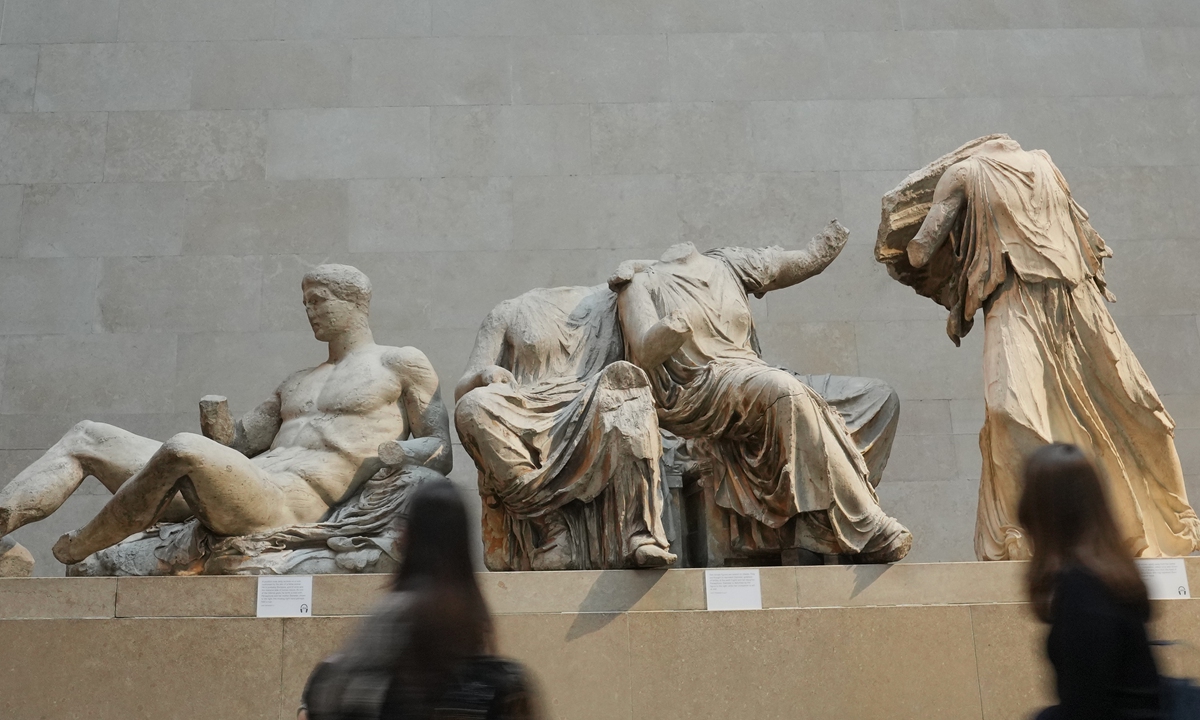
Visitors walk past sculptures that are part of the Parthenon Marbles at the British Museum in London, the UK. Photo: VCG
In an act that Greek Culture Minister Lina Mendoni condemned as "provocative indifference," the British Museum has hosted a lavish fundraiser at 2,000 pounds ($2,668) per ticket, dubbed the "Pink Ball," in the room housing the Parthenon Marbles, igniting fierce criticism and reviving long-standing debates over cultural ethics and colonial restitution.
The British Museum hosted a high-profile fundraising dinner in the Parthenon Marbles room, featuring 800 A-list guests, including rock legend Mick Jagger and supermodel Naomi Campbell, on Saturday, The Times reported.
This event triggered fierce protests from Greece, with Culture Minister Lina Mendoni denouncing it as "provocative indifference" toward the integrity and moral value of priceless cultural relics.
The uproar underscores a deeper crisis - the museum's mission to safeguard humanity's shared legacy is being systematically undermined by commercial greed and colonial-era double standards. Such commercial exploitation has surely betrayed the sanctity of civilization.
As one of the world's oldest and most revered public institutions, the British Museum claims its mission is to preserve human history for future generations. Yet its decision to transform a space holding ancient Greek sculptures into a backdrop for champagne toasts and celebrity photos reveals a troubling departure from that very purpose.
Mendoni's statement highlighted the core issue: "The safety, integrity, and ethics of the monuments should be the main concern of the British Museum… Such actions are offensive to cultural assets and endanger the exhibits themselves."
Her criticism echoes a broader consensus among archaeologists and heritage experts: When artifacts are treated as party decor, their dignity is stripped, and their physical safety is at risk.
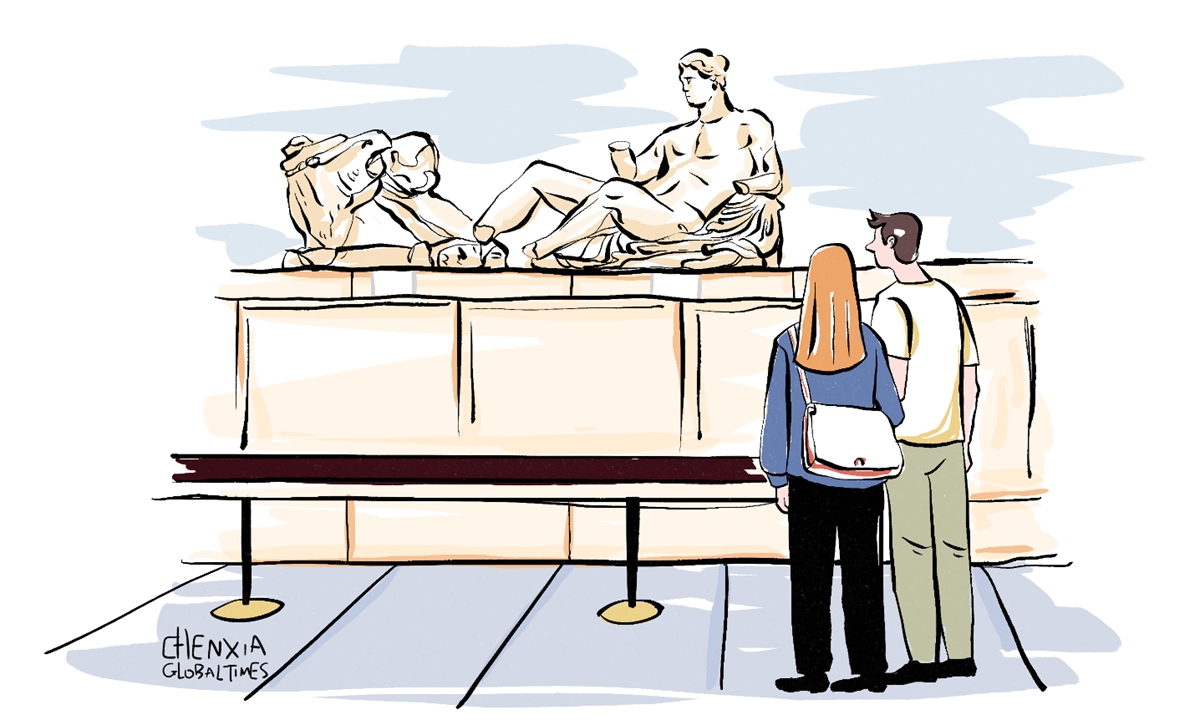
Illustration: Chen Xia/GT
This is not the first time that the museum has blurred the line between culture and commerce. In 2024, the same room was used for a fashion show, drawing similar protests from Greece. Each such event reinforces the perception that the museum's leadership views its collections, particularly those acquired under colonial contexts, as assets to monetize rather than heritage to protect.Greece's case is not unique. China, Egypt and Nigeria, among others, have long demanded the return of their stolen heritage.
Egyptian archaeologist and Egypt's former minister of state for antiquities affairs, Zahi Hawass, who is leading a petition for the return of the country's priceless Rosetta Stone from the British Museum, has highlighted the psychological trauma of seeing national icons displayed in former colonizers' museums. These narratives expose a colonial-era hierarchy in which Western institutions dictate cultural ownership, perpetuating historical injustice.
The British Museum has exhibited the Parthenon marbles since their acquisition from Lord Elgin in 1816.
Due to the 1963 British Museum Act, the law prevents the museum from returning any of its collection permanently except in very limited circumstances. However, legal hurdles are not insurmountable, especially when there is political and moral will.
For example, in 2024, more than 200 ancient pre-Hispanic artifacts ranging from ceramics to important works of indigenous art were successfully reclaimed by Peru from collectors and institutions around the world.
What the Pink Ball reveals is that the real obstacle may not be the law, but an attitude. If the British Museum is serious about being a world museum for the world, it should stop treating world heritage as its private party venue.
In fact, the tide is shifting. Recent years have seen growing momentum for relic repatriation.
In 2022, Germany returned 22 artifacts looted in the 19th century to Nigeria. In 2025, Egypt successfully retrieved 25 smuggled artifacts from the US, demonstrating that international cooperation works.
China, as a leader in cultural heritage advocacy, has repatriated more than 2,000 artifacts since 2012, including the Zidanku Silk Manuscripts from the US in 2025.
Such cases inspire Greece, which proposed a cultural partnership to fill the British Museum's Greek galleries if the marbles are returned.
Professor Huo Zhengxin from the China University of Political Science and Law told the Global Times that there is no longer any substantial gap between China's ability to conduct cultural relic protection, restoration and research and that of Western countries.
The British Museum, however, has been hit by a series of scandals involving stolen cultural relics in recent years and cannot even guarantee the safety of its collected cultural relics.
Therefore, if countries with lost cultural relics, especially those in the Global South, can coordinate their positions and speak with a unified voice under international multilateral mechanisms, they can promote the further improvement and implementation of international rules.
Stamatios Boyatzis, a professor from the University of West Attica in Greece, also echoed that since Greece is now fully capable of safeguarding its own cultural relics, the British Museum should return them rather than using so-called conventions as an excuse.
He once told the Global Times during the 2025 Sanxingdui Forum that under the current international landscape, it is hoped that Greece, China and other more source countries of cultural relics can join hands to make their voices heard on the global stage.
In summary, the Parthenon Marbles controversy is a referendum on the ethics of cultural ownership. The British Museum's commercialization of these artifacts is a moral abdication, symptomatic of a broader crisis in how Western institutions wield power over global heritage.
As Greek Culture Minister Mendoni stated, the British Museum's actions "endanger the exhibits themselves," both physically and symbolically. It is time for the museum to listen, not just to the clinking of glasses, but to the voices of those whose history it holds.
The author is a reporter with the Global Times. life@globaltimes.com.cn
RELATED ARTICLES