ARTS / CULTURE & LEISURE
Digang’s harmony with nature shines on global tourism map
Ecological wisdom
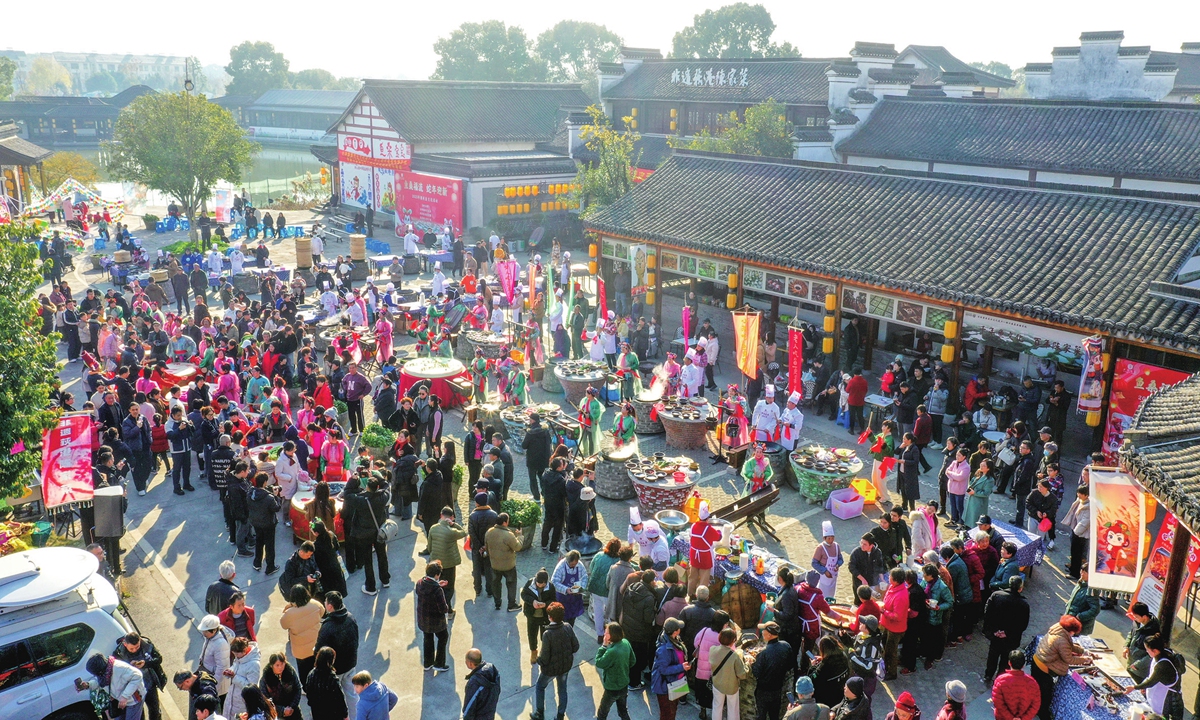
A fishery event kicks off the New Year celebrations at Digang village in Huzhou, East China's Zhejiang Province, on January 1, 2025. Photos: VCG
Digang village in East China's Zhejiang Province was recently selected as one of the 2025 "Best Tourism Villages" by the United Nations World Tourism Organization (UNWTO).The village provides an excellent example of ecological wisdom through its nature-based practices: planting mulberry trees on the dike, feeding silkworms with mulberry leaves, feeding fish with silkworm droppings, fertilizing ponds with fish waste, and enriching mulberry trees with pond mud.
Digang was joined by Huanggang village in Southwest China's Guizhou Province, Jikayi village in Southwest China's Sichuan Province, and Dongluo village in East China's Jiangsu Province in being awarded the title by the UN, the Ministry of Culture and Tourism (MCT) told the Global Times during an awarding ceremony held in Zhejiang on October 17.
With these additions, a total of 19 Chinese villages have now been recognized as "Best Tourism Villages." Meanwhile, totally 52 villages from 29 countries around the world were selected for the title this year, the MCT said.
Ranging from southwestern mountains and highland gorges to the river towns of the region south of the Yangtze River (or Jiangnan), these four villages boast distinctive features in terms of natural landscape, cultural identity, and development path.
Together, they illustrate diverse approaches of rural development under different ecological conditions and reveal the rich and multifaceted evolution of rural tourism in China, according to MCT.
Sandra Carvao, director of Tourism Market Intelligence and Competitiveness at the UNWTO, told the Global Times that the recognition of Chinese villages reflects their significant efforts to preserve both local ecosystem and traditional livelihoods.
Carvao also noted that China's commitment to using tourism as a tool for shared prosperity and rural development is commendable and it brings new opportunities to rural communities.
"By connecting it with tourism, we are not only generating more resources for local communities, but also creating opportunities for visitors to learn about and support the preservation of traditional practices," Carvao said.
To promote rural tourism, UNWTO launched the Best Tourism Villages initiative in 2021 to promote rural travel by recognizing villages worldwide that excel in nurturing local communities and preserving landscapes, cultural diversity, local values and culinary traditions.

An aerial view of Digang village in Huzhou, East China's Zhejiang Province, where the Grand Canal passes through an agricultural heritage site of mulberry dykes and fishponds, on July 21, 2025.
Water management wonderRecognized as one of the Globally Important Agricultural Heritage Systems (GIAHS) by the UN, the "mulberry-dike and fishpond system" in Digang, Huzhou dates back to the Spring and Autumn Period (770BC-476BC).
Faced with floods and low-lying wetlands, the ancestors of Digang did not choose to flee or resist. Instead, they "made peace with the land."
By digging ponds and raising dikes, they turned flood-prone terrain into fertile land and created the remarkable mulberry-dyke fishpond system.
Lou Lijing, secretary-general of Huzhou South Taihu Lake Agricultural Heritage Conservation and Development Research Center, told the Global Times on Tuesday that the system in Huzhou is the largest and best-preserved example of this traditional agricultural model in China.
Each winter, the silt cleared from fishponds is transported to the surrounding dikes as fertilizer for the mulberry trees. This practice helps boost the yield of mulberry leaves and silkworm cocoons, and ensures that the ponds remain deep and the dikes solid over the centuries.
Meanwhile, silkworm pupae and droppings serve as fish feed, reducing aquaculture costs and creating a mutually beneficial, ecologically sustainable system between sericulture and fish farming, Lou said.
Mulberry trees feed silkworms, providing us with fine silk; fishponds cultivate fish, making the region one of China's major freshwater aquaculture bases. Today, the ecosystem supports over 1,000 species, with biodiversity continuing to flourish, she said.
Leveraging the 1,000 mu (66.7 hectares) of mulberry-dike fishponds and sericulture, the area has been developed into an integrated agri-tourism complex that combines leisure, ecological agriculture, cultural creativity, and experiential education. Lou said she expects more young people to join hands and help revitalize the traditional mulberry-dike fishpond system through modern tools such as digital technology, AI, and livestreaming.
After the awarding ceremony, Mo Haiping, Party secretary of Digang, said that "Zhejiang already has four villages recognized as 'Best Tourism Villages.' We hope to use this title to partner with distinctive rural destinations abroad and carry out more exchanges and collaborations."
New starting point
Also listed as a GIAHS and a World Irrigation Engineering Heritage site, Dongluo boasts over 600 years of continuous cultivation and cultural inheritance.
From a cultural perspective, the living heritage of the Dong ethnic group's Grand Song in Huanggang, the agrarian traditions of Dongluo, the vibrant Tibetan folk customs of Jikayi, and the ecological cultivation wisdom behind the "mulberry-dyke and fishpond system" of Digang together showcase the depth and vitality of Chinese culture.
Covering 2,300 mu (about 153 hectares) of terraced fields, 374 wooden homes, five drum towers, and more than 400 granaries, Huanggang is hailed as a "living architectural legend." Meanwhile, the highland of Jikayi features 22 towers, reflecting yin-yang symmetry and matrilineal heritage, now on UNESCO's Tentative World Heritage List.
Sporting traditional festival attire of the Dong ethnic group, Wu Longbao, Party secretary of Huanggang, said that receiving the award was a starting point for the people of Huanggang to pursue a better life.
"Many peers have shared new insights with me at the ceremony," Wu said. "One of them suggested using Dong ethnic fabric to make cultural blind boxes or small souvenirs for tourists, which really gave me a new idea."
Through the "Best Tourism Villages" platform, Chinese villages are sharing their wisdom and solutions with the world, showcasing the country's unique charm, and offering models for sustainable rural development worldwide.
Michael Oduro contributed to this story.
RELATED ARTICLES