ARTS / CULTURE & LEISURE
Ming Dynasty wall design, modern conservation create ecological marvel, drawing crowds of visitors
Ancient city wall becomes living terrarium
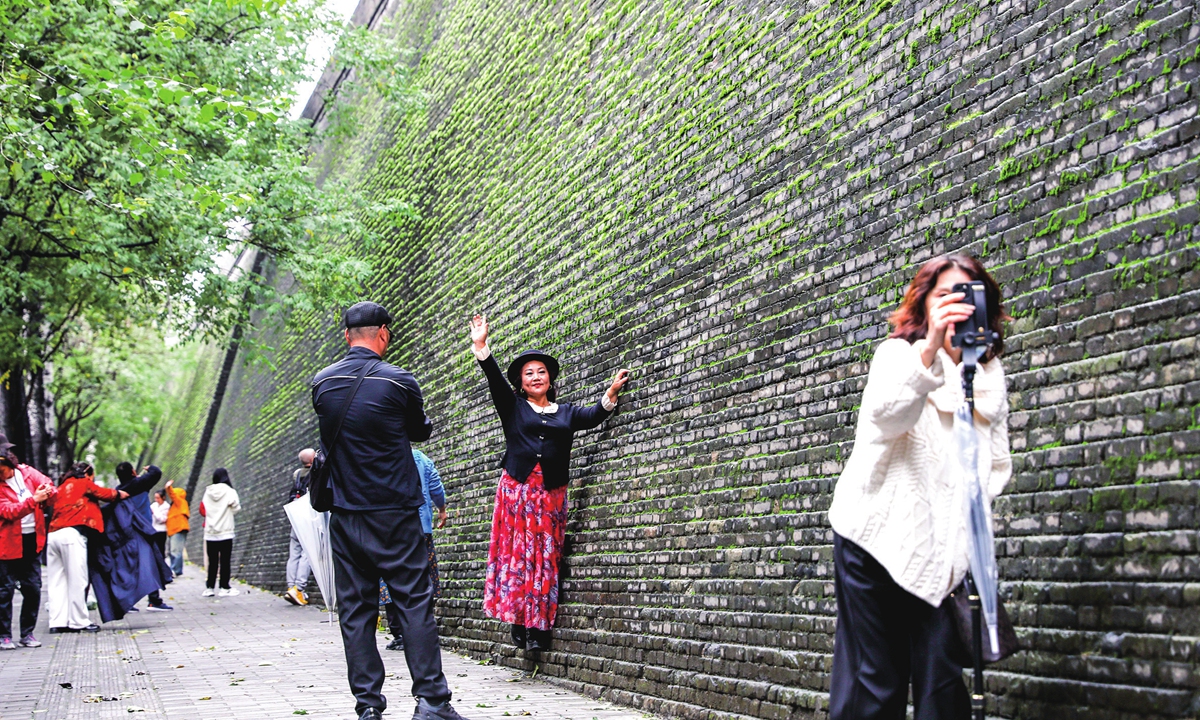
Visitors to the Xi'an city wall take pictures in Xi'an, capital of Shaanxi Province, on October 17, 2025. Photos: VCG
After more than a month of persistent autumn rain, the gray bricks of Xi'an's Ming Dynasty (1368-1644) city wall have taken on a soft green sheen. Spreading moss covers the centuries-old stones like velvet, while tiny succulents poke through the cracks, leading the ancient walls, built nearly 650 years ago as a formidable military fortress, to unexpectedly become an internet sensation that people are calling a "giant ecological terrarium.""Especially around the moss-covered sections, you can see tourists taking photos everywhere," He Yuqian, a Xi'an-based photographer who has been documenting the city wall since 2008, told Global Times.
"To be honest, the greenness on the Xi'an city walls isn't a new phenomenon, but this year, the green is more vivid than ever," He said. "People even found mushrooms growing out of the wall, forming little umbrellas under which snails hide. It's quite a sight."
In fact, experts reveal that this "giant terrarium" is not a coincidence, but the result of climate, architecture, and time working in harmony.
"It's an ecosystem formed naturally through the centuries," Xue Jianyang, dean of the School of Civil Engineering at Xi'an University of Architecture and Technology, told Global Times. "Its ability to sustain and regulate itself surpasses that of many man-made ecological installations. What we see today reflects both ancient wisdom and modern conservation."
Natural spectacle
Stretching 13.74 kilometers, Xi'an's city wall is the oldest, largest, and best-preserved ancient city wall in China. First built during the Sui (581-618) and Tang (618-907) dynasties and expanded in the Ming era, its endurance speaks to the brilliance of traditional construction methods.
Xue noted that the Ming Dynasty city wall's lime mortar, which was mixed with glutinous rice, has a porosity of about 15 percent, creating an ideal bed for moss spores.
The result is a vertical ecosystem: short, velvety moss clings to the lower surfaces, crustose lichens form dark green patches higher up, while succulents and wildflowers sprout where moisture accumulates. "Insects and bats inhabit the cracks, birds nest in the crevices, and micro-organisms decompose organic matter to recycle nutrients," Xue said. "Together, they form a complete ecological chain that maintains its own balance."
The wall's porous structure also absorbs moisture and dust from the air. When it rains, some of the water seeps through the cracks to nourish vegetation, while the rest flows out through an ancient drainage system that prevents corrosion. The process creates a natural cycle of precipitation, absorption, percolation and drainage, turning rainfall into a life-giving force.
The phenomenon is not unique to Xi'an. Moss and lichen have appeared on walls at the Summer Palace and the ancient fortifications of Jingzhou, while sections of the Great Wall covered by biological layers have even shown enhanced preservation.
A 2023 study from China Agricultural University found that such bio-covered segments of the Great Wall were less porous and more resistant to mechanical erosion.
Still, the conditions that led to Xi'an's "green wall" are exceptional. In 2025, the city experienced its heaviest continuous rainfall since 1961, with precipitation 1.6 times above average and humidity staying above 80 percent for weeks.
The damp air awakened dormant plant spores, allowing moss to grow at a remarkable 0.3 millimeters per day. Over the long term, Xi'an's temperate monsoon climate with an annual rainfall around 600 millimeters provides a stable foundation for such life to nourish. But popularity has brought unintended consequences. "I did see tourists trying to pick the plants to take home," He said. "Staff members stopped them. It kind of shows how much people are drawn to this living wall. Every day, there are crowds taking pictures."
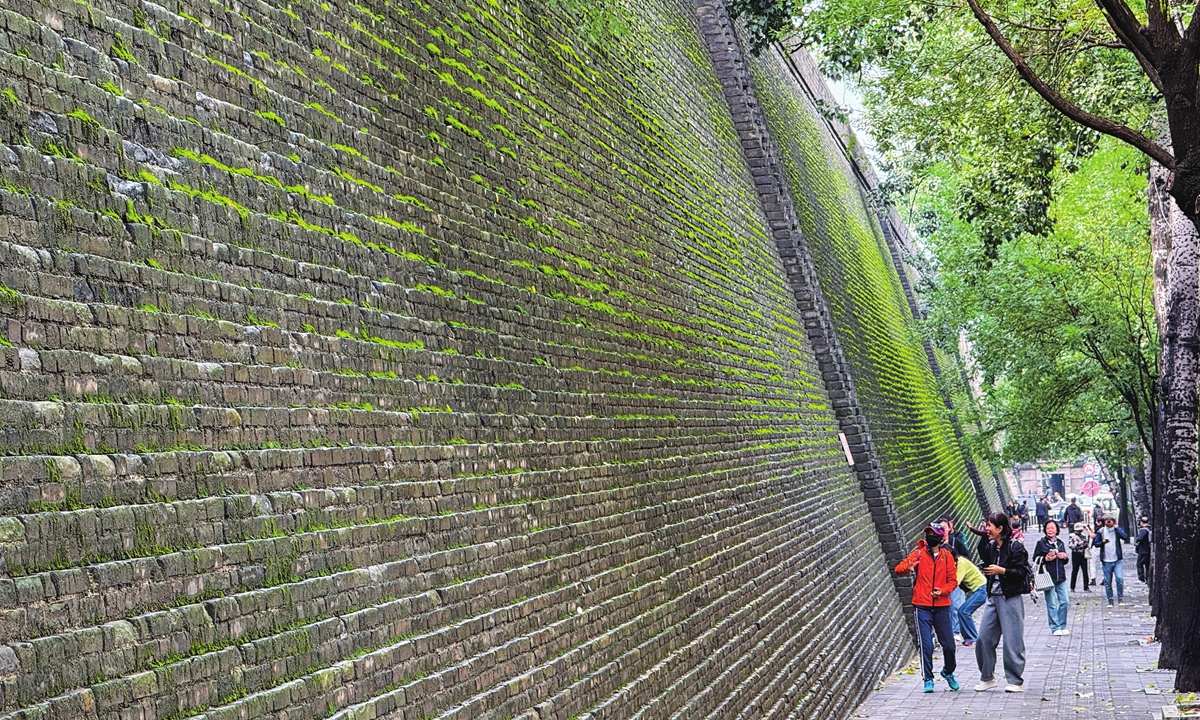
People visit the moss-covered Hepingmen to Jianguomen section of the Xi'an city wall on October 15, 2025.
Intelligent preservationThe lush spectacle has delighted visitors, but it also poses new challenges for conservation. Vegetation can shield the wall from erosion, yet excessive root growth risks damaging the bricks beneath, Xue noted.
To safeguard the 13.74-kilometer structure, Xi'an's preservation team has embraced a blend of tradition and technology.
Between 2023 and 2024, they carried out a comprehensive "health check" using more than 10 non-invasive methods, including geological radar, high-precision surface-wave detection, and 3D laser scanning. The data produced an ultra-detailed digital twin of the entire wall.
"The results surprised even us," Zhao Bin, director of the Xi'an city wall preservation team's digital innovation center, told the Global Times. "The 'digital cabin' identified over 1,300 hidden cavities and more than 800 loose sections. Before, we could only rely on visual inspections and experience."
An AI-based predictive system now monitors the wall 24 hours a day, integrating real-time rainfall forecasts, historical hydrological data, sensor readings, and moat water levels. "It allows us to predict flood risks faster than the rain itself," Zhao said.
The protection network also operates under the "wall steward system," combining digital monitoring, intelligent sensors, and roving inspection teams. Every meter of the ancient structure is now under watch, ensuring early detection and timely intervention.
Yet conservation here goes beyond mere preservation, it's also about revitalization. At Yongning Gate, a digital sand table projects Tang Dynasty scenes, bringing ancient Chang'an to life.
At the Xi'an Tang Hanguang Gate Museum, multimedia displays reveal the water engineering brilliance of the Tang era, showing how the city once managed its rivers and drains with remarkable sophistication.
The digital model has also opened new frontiers for cultural tourism. With mixed-reality headsets, visitors can experience the city wall through the eyes of ancient soldiers amid sword flashes and the sound of drums.
And now, the wall's newfound fame as a "living terrarium" is inspiring creativity beyond its stones. "I've heard they're developing miniature moss terrarium souvenirs modeled after the wall's greenery," He said.
"It's a wonderful idea, as people can take a piece of that vitality home without harming the real thing, and the beloved Xi'an city wall will always stand as a living dialogue between past and present."
RELATED ARTICLES