Companies ramp up efforts to lift SAF usage, though hurdles remain
By Published: Oct 24, 2025 07:45 PM

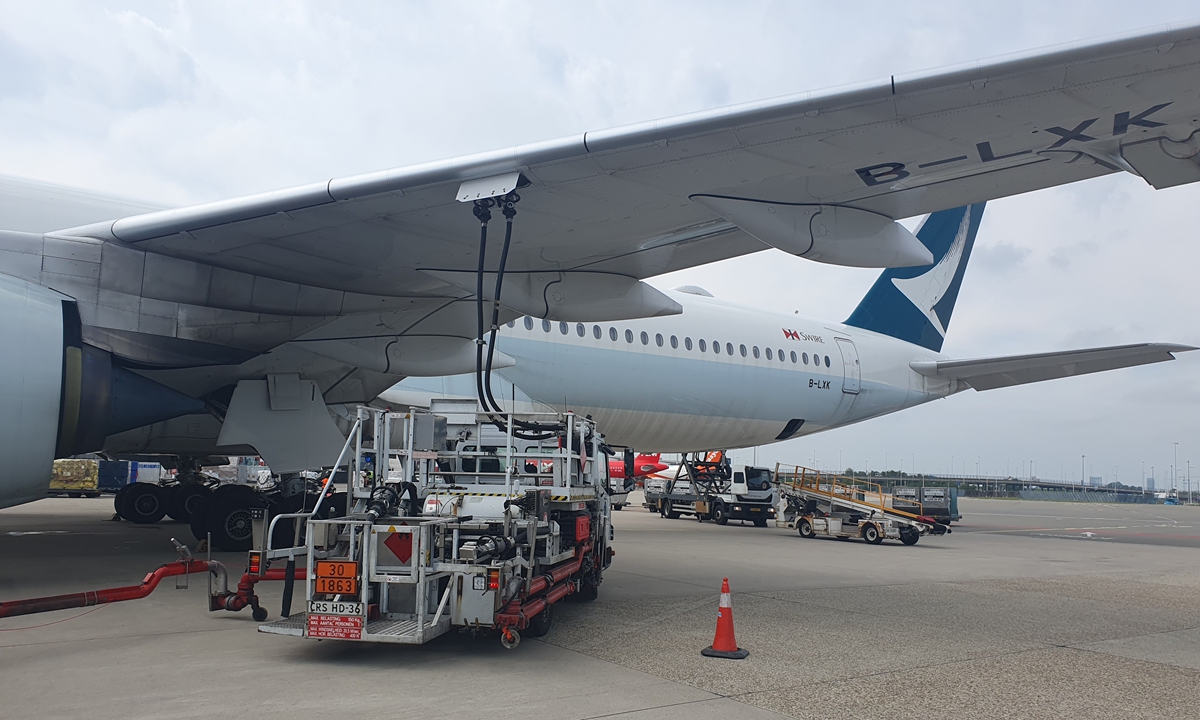
An aircraft from Cathay Pacific conducts SAF uplifts at Amsterdam Schiphol Airport in May of 2024. Photo: Courtesy of Cathay Pacific
Seen as the most viable near-term solution for decarbonizing civil aviation, the Sustainable Aviation Fuel (SAF) now faces a critical challenge: despite broad industry consensus and high expectations, widespread replacement of conventional fossil fuel remains distant, hindered by scaling difficulties and cost barriers.
According to statistics, there are currently 16 sustainable aviation fuel (SAF) projects in Chinese mainland, with eight already operational. Global SAF production capacity should reach 1 million tons in 2025 and 2 million tons in 2026, Xie Xingquan, regional vice president for North Asia with the International Air Transport Association (IATA).
"Although the capacity is doubling, it can only meet a very small portion of the airlines' demand," Xie warned.
The remarks were made at the World Safety & Operations Conference held in Xiamen, East China's Fujian Province earlier this month.
SAF is a liquid aviation fuel alternative to traditional jet fuel. Made from renewable materials, it can reduce carbon emissions by up to 80 percent over the fuel's life cycle compared to conventional jet fuel.
A study released by IATA, in partnership with Worley Consulting in September, demonstrating that sufficient SAF feedstock exists to enable the airline industry to achieve net zero CO2 emissions by 2050. All feedstocks considered meet stringent sustainability criteria and do not lead to changes in land use.
While, the study identified significant barriers in using that feedstock for SAF production, including the slow pace of technology rollout that would enable SAF to be produced from varied sources.
Airlines will need 500 million tons of SAF to achieve net zero carbon emissions by 2050, as outlined in the IATA Net Zero Roadmaps.
To maximize SAF output, it will be essential to improve conversion efficiencies, accelerate technology roll-out, enhance feedstock logistics, and invest in better infrastructure required to scale up commercial facilities across all regions.
"Currently, HEFA-SAF (Hydro-processed Esters and Fatty Acids-based SAF), which relies on oils and waste fats, accounts for the majority of the market share, with costs approximately 3-4 times that of conventional jet fuel, according to news outlet China Times, citing IATA's Director of Energy Transition.
The IATA believes that utilizing existing feedstocks for SAF production faces a series of obstacles. One of the biggest issues is the slow progress in technology promotion, which restricts the development of producing SAF through multiple feedstock pathways.
As decarbonization becomes a core agenda across various industries, the demand for SAF is not solely coming from the aviation transport sector. Available biomass feedstocks also face competition from other industries.
On Tuesday, the Cathay Group and Airbus announced a joint investment agreement of up to $70 million to accelerate the development of SAF production in Asia and globally.
Under the terms of the partnership, the two companies will work to identify, evaluate and invest in projects that support the scaling of SAF production toward 2030 and beyond. Projects will be assessed based on their commercial viability, technological maturity, and potential for long-term offtake.
From IATA's perspective, policies must prioritize allocating feedstocks to hard-to-abate sectors like aviation. As outlined in IATA's Net Zero Carbon Emissions Roadmap, airlines will need 500 million tons of SAF to achieve net-zero carbon emissions by 2050.
One direct consequence of production capacity constraints is the persistently high cost of usage. For the aviation transportation industry, which generally operates on low profit margins, this is one of the main reasons why airlines are not very proactive in scaling up the use of SAF.
To break the "deadlock" the aviation industry faces regarding SAF, international industry organizations like IATA have been actively engaging with various stakeholders, including regulatory bodies, the aviation and energy sectors, and research institutions.
In IATA's latest report, North America, Brazil, Europe, India, China, and ASEAN have been identified as the key regions for global SAF production.
"We now have unequivocal evidence that if SAF production is prioritized then feedstock availability is not a barrier in the industry's path to decarbonization. There is enough potential feedstock from sustainable sources to reach net zero carbon emissions in 2050. However, this will only be accomplished with a major acceleration of the SAF industry's growth. We need shovels in the ground now," said Willie Walsh, IATA's Director General.
RELATED ARTICLES