ARTS / CULTURE & LEISURE
Youth lead a new dialogue between civilizations
By Published: Oct 26, 2025 10:36 PM
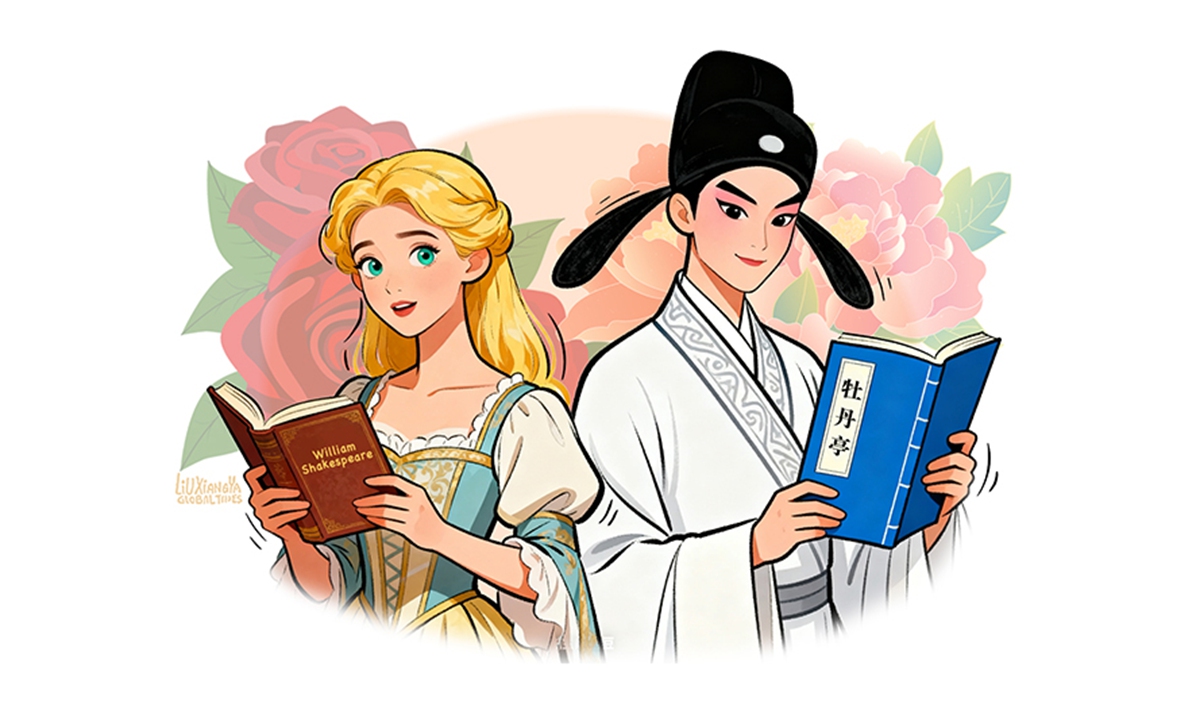
Illustration: Liu Xiangya/GT
A remarkable theatrical dialogue unfolded in Fuzhou, East China's Jiangxi Province on Saturday, as the English-language version of The Peony Pavilion, adapted by the University of Birmingham's Shakespeare Institute, staged its China debut.
This marked the first full-length performance of the English version of Chinese playwright Tang Xianzu's masterpiece on an Asian stage, a historic moment that wove together the threads of Eastern and Western literary traditions. As British students breathed life into the timeless line, "Love once begun, will never end," Tang's emotions, penned over four centuries ago, found a vibrant new voice.
This premiere, part of the Tang Xianzu International Drama Exchange Month commemorating the 475th anniversary of the writer's birth, was not merely a performance but a profound act of cultural communion.
Simultaneously, A Midsummer Night's Dream and The Nankeji (The Dream of Nanke) shared the same stage, creating a trans-temporal and spatial dialogue that illuminated the shared humanity of Tang Xianzu (1550-1616) and William Shakespeare (1564-1616).
These literary giants, contemporaries who both passed in 1616, never met, yet their works resonate with striking parallels. Over 6,000 kilometers apart, while Shakespeare crafted sonnets with a quill, Tang wielded a brush to weave tales of love and longing. Their shared exploration of universal themes - love, destiny and human spirit - transcends geography and time, offering a spiritual resonance that continues to inspire.
This resonance was vividly captured at a gala hosted by China's state television, CCTV, in Fuzhou. In the drama Tang & Shakespeare, directed by Kunqu opera master Ke Jun and British director Leon Rubin, The Peony Pavilion and Romeo and Juliet converged on a single stage. British actor Matthew Giles Grey as Shakespeare and Chinese actor Ren Zhihong as Tang Xianzu embodied this cross-cultural dialogue, bringing to life the "ultimate emotion" of the East and the "devoted love" of the West. Their performance was a testament to the enduring power of art to bridge civilizations, transforming abstract cultural exchange into a tangible, living practice.
The English-language Peony Pavilion is a triumph of cross-cultural innovation. Translating the intricate vocal melodies and rhythms of Kunqu opera into a form accessible to English-speaking audiences required more than linguistic substitution - it demanded a reimagining of cultural context.
The production's diverse cast, featuring a Chinese actress as Du Liniang, an Irish actor as Liu Mengmei, and a US actor as Du Bao, embodied this fusion. By employing iambic pentameter, the dialogue echoed Shakespeare's cadence, while movement, dance and music wove together Western and Chinese theatrical traditions, as reported by chinanews.com.cn. This was not mere translation but a profound cultural dialogue, in which the spiritual core of Chinese opera harmonized with Western expressive forms.
At its heart, the success of such cross-cultural theater lies in its ability to uncover universal emotional truths. Tang's Du Liniang, whose love defies death with the declaration, "Love, arising from nowhere, deepens with devotion; it can defy death and restore life," offers an Eastern echo to Shakespeare's existential query, "To be, or not to be."
Both explore the depths of human feeling, revealing that the pursuit of love and meaning transcends cultural boundaries. This shared insight forms the bedrock of contemporary cultural exchange, proving that art can unite where differences might divide.
The city of Fuzhou, Tang's hometown, and Stratford-upon-Avon, Shakespeare's birthplace, have been sister cities since 2016, fostering people-to-people connections through their shared literary heritage. The Tang Xianzu International Drama Exchange Month, running through November, exemplifies this bond.
A highlight of the event was the "Tang-Shakespeare Legacy: Youth Dialogue," which united young theatrical talent from China and the UK. As one British actor noted, collaborating with Chinese peers broadened horizons and dismantled stereotypes, underscoring the pivotal role of youth in cultural exchange. These young artists are not merely inheritors of tradition but pioneers of innovation, breathing new life into classic works.
Through the lens of youth, The Peony Pavilion and Shakespeare's plays become more than historical artifacts; they transform into vibrant contemporary art. These young performers ensure that cultural heritage evolves into a living, breathing dialogue. Their work reminds us that cultural differences are not barriers but bridges, inviting mutual understanding and inspiration.
In Stratford-upon-Avon's garden, a statue of Shakespeare and Tang Xianzu stands as a quiet sentinel, witnessing the passage of time and the enduring dialogue between their legacies. This image resonates with an actor's poignant reflection: "Over 400 years ago, Tang Xianzu and Shakespeare created under the same sky, gazing upon the same moon - that is truly beautiful."
Their shared celestial view mirrors the universal aspirations their works capture, reminding us that art, in its highest form, speaks a language that transcends time and space.
The premiere of The Peony Pavilion in English is more than a theatrical milestone; it is a vibrant footnote in the ongoing story of global cultural exchange. By blending the emotional depth of Tang's opera with the expressive power of Shakespearean theater, this production illustrates that true cultural dialogue does not erase differences but celebrates them, weaving a richer tapestry of human experience.
As we witness this exchange, we are reminded that the legacy of Tang and Shakespeare is not confined to their era but lives on in every performance, every shared story, and every heart it touches.
The author is a reporter with the Global Times. life@globaltimes.com.cn
RELATED ARTICLES