US think tank survey finds more than half of Americans say US should undertake friendly cooperation and engagement with China, a sharp reversal from 2024
By Published: Oct 29, 2025 09:56 AM Updated: Oct 29, 2025 01:05 PM

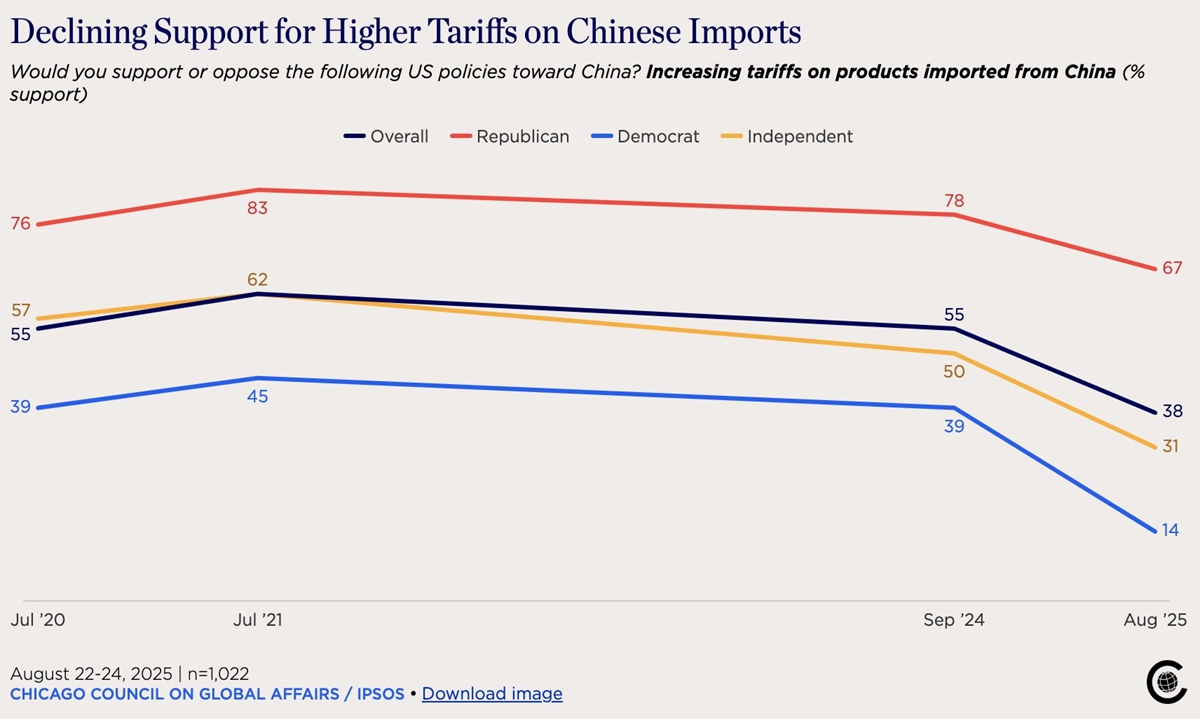
A screenshot from a survey released by the Chicago Council on Global Affairs on October 28, 2025.
More than half of Americans now favor a policy of cooperation and engagement with China, oppose higher tariffs, and oppose cuts to bilateral trade, according to a survey released Tuesday by the Chicago Council on Global Affairs, an American international affairs think tank.
The 2025 Chicago Council Survey, fielded July 18 to 30, finds that the bipartisan embrace of US-China competition no longer holds among the public, with partisan differences in perceived threats from China and disagreements on current US-China trade policy, according to results published on the Chicago Council on Global Affairs website.
The survey showed that in a sharp reversal from 2024, "a majority of Americans (53 percent)" now say the US should undertake friendly cooperation and engagement with China, while 44 percent prefer a policy of actively limiting the growth of China's power.
"This is the first time since 2019 that a majority of Americans have preferred a policy of cooperation and engagement with China," according to the survey.
According to its website, the Chicago Council Survey has tracked US public opinion on foreign policy issues since 1974. Established in 1922 amid a period of growing American isolationism, the Council sought to promote public discussion of international affairs in Chicago. Surveys released on its website cover a wide range of US foreign policy topics, including relations with China.
The 2025 Chicago Council Survey was conducted July 18-30, 2025, by Ipsos using its large-scale, nationwide, online research panel in English and Spanish among a weighted national sample of 2,148 adults 18 or older living in all 50 US states and the District of Columbia.
"The report reveals a clear shift in American public attitudes toward China — one that is more positive, rational, and even constructive," Zhu Feng, dean of school of international studies at Nanjing University, told the Global Times on Wednesday.
This change is significant and closely linked to the series of US domestic and foreign policies. Deep divisions within US society have sparked widespread debate and reflection on the government's direction, especially as the public increasingly feels the real impact of trade wars, tariffs, and the broader confrontational approach toward China, said Zhu.
The survey also noted that public support for policies aimed at decoupling the US and China—whether via trade, technology, or people-to-people ties—has declined in recent years. Today, a majority of Americans oppose greater reductions on trade, higher tariffs, or restrictions on Chinese students.
Despite widespread disagreements between partisans on the threat posed by China, how to approach US-China relations, and specific US-China policies, Americans remain united in their top priorities: avoiding conflict and maintaining the US edge in high technology, according to the survey.
Also in an April poll by the Pew Research Center, most Americans expressed skepticism about the impact of higher tariffs on China. About half said the tariffs would harm the US economy, and a similar share believed they would personally be worse off. The survey was conducted after US imposed additional tariffs on China in February and early March, according to the Pew report.
Zhu said that the results of the survey showed that in an era of deep global interdependence, trying to "decouple" from China is both unrealistic and harmful to ordinary Americans. "Rising prices, supply shortages, and growing economic uncertainty have only deepened the sense of anxiety across US society," he said.
Moreover, the Chicago Council on Global Affairs' survey also finds that Americans are less likely to view China's development as a world power to pose a critical threat to the US today than in 2023.
"This report sends two clear messages that as the world's two largest economies, the direction of China-US relations carries enormous significance. A confrontational policy driven by US self-interest — even at the expense of international norms — reflects the agenda of political elites and vested interests, not the will of ordinary Americans," said Zhu.
The expert noted that the survey data are revealing. Despite the US government claims of strengthening the US economy, many people in the US remain skeptical about its prospects. The controversies surrounding its domestic and foreign policies have also shaped public attitudes, with more Americans now questioning the wisdom of confrontation and leaning toward a more cooperative approach with China.
The survey also concluded that since 2017, US-China relations have been dominated by the framework of great power competition. But today, that bipartisan consensus no longer seems to hold among the American public. Republicans and Democrats now hold distinctly different views on a range of China-related questions.
"This shift in public attitudes may disquiet some Democrats in Congress, especially those who have focused on competition with China as a key part of their political agenda, and may boost support for those who have argued for a more diplomacy-forward approach to Beijing," according to the survey.
RELATED ARTICLES