ARTS / CULTURE & LEISURE
New winds blow at China's conference on social civility in rural areas
Down with old customs, up with cultural spirit
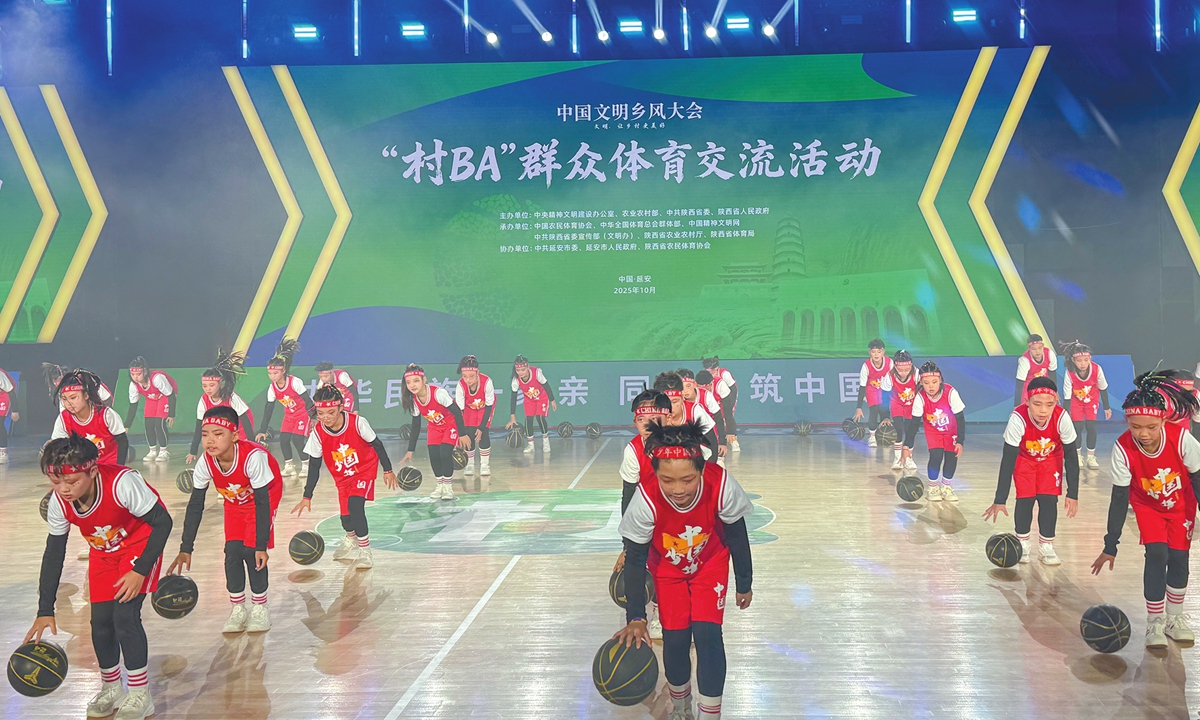
A basketball show performed by rural youth Photo: Li Yuche/ GT
"The 388,000 Yuan Bride Price" is a short drama co-created by Jing Chang'an, a villager in Yan'an, Northwest China's Shaanxi Province, with his neighbors. It portrays how a young rural couple and their families rejected a hefty bride price and decided to build a life together from scratch. In the show, the huge bride price of 388,000 yuan is ultimately reduced to 1,001 yuan, a metaphor for the young couple being each other's "one and only."
Although the characters are fictional, the drama draws on the increasing movement in Chinese villages to cut bride prices as "its real-life blueprint," Jing told the Global Times. As the director, his inspiration, however, came from people's personal stories shared at rural galas. "Whether it's tales of apple farming success or scenes of the locals discussing 'new village rules,' they all drive me to share our rural narratives online," said the director.
Though small in production scale, the series mirrors the changing living customs among ordinary Chinese villagers while also showing how cultural events like the "village gala" can inspire rural areas to form and express their social civility.
"Civility Makes Rural Life Better" is not just the inspiration for a village drama but is, more significantly, the theme of the ongoing national conference on promoting social civility in rural areas. Li Shulei, a member of the Political Bureau of the CPC Central Committee and head of the Publicity Department of the CPC Central Committee, attended the event. The conference is jointly hosted by the Central Office of Cultural and Ethical Progress, the Ministry of Agriculture and Rural Affairs, and the authorities of Shaanxi Province.

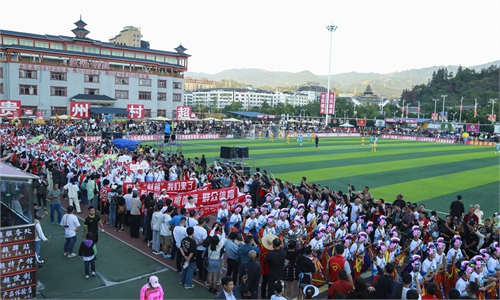
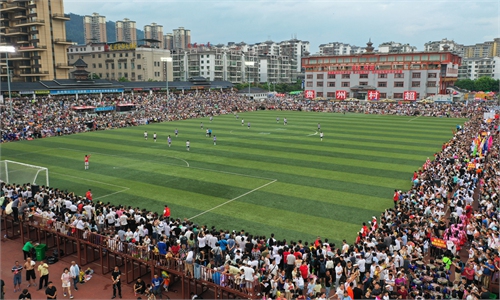
Players compete in a "Village BA" basketball match in Yan'an, Shaanxi province, on October 28, 2025. Photo: Li Yuche/GT
'Sense of significance'Running from Wednesday to October 30 in Yan'an, the event is joined by grassroots rural workers and villagers across the country. It features a diverse agenda, comprising a main venue as part of the official schedule, complemented by four parallel sessions focusing on topics such as "reforming outdated village customs" and "developing local cultural and sports programs."
Meanwhile, a cultural and artistic performance will also be held featuring works that exemplify the transformation of traditional customs and creative community efforts in China. As a prelude to the event, a "Village BA" rural basketball match was also launched, showcasing the vibrant development of cultural and sports activities in rural China.
At the main venue session, a report revealed that in 2024, nationwide rural areas hosted over 2.2 million cultural and sports events, with participation rates among rural residents exceeding 70 percent. "Village BA" matches, "Village dance" and "Village galas," such village-featured rural activities became the most vibrant highlights across the Chinese countryside in 2024. According to the report, they span 24 distinct categories.
Among the groups contributing to this figure was rural cultural worker Pu Chunmei and her team, "shixian taibai," a dance crew named after the Chinese poet Li Bai. The team is rooted in Mianyang, Sichuan Province, but now it's touring around the country with nearly 200 dancers.
Showing the Global Times pictures of what she calls "the apple of her eye," Pu said that at the very beginning, villagers were "timid and hesitant" about joining. Yet, as word spread, more villagers got involved, including solitary seniors and even men who had "a talent for art as much as they had a knack for farm work."
"You may find it hard to believe, but since we started regular training, many male villagers have given up card games and drinking parties," said Pu. She also added that these village seniors seem to have found their "sense of significance" through rural cultural events.
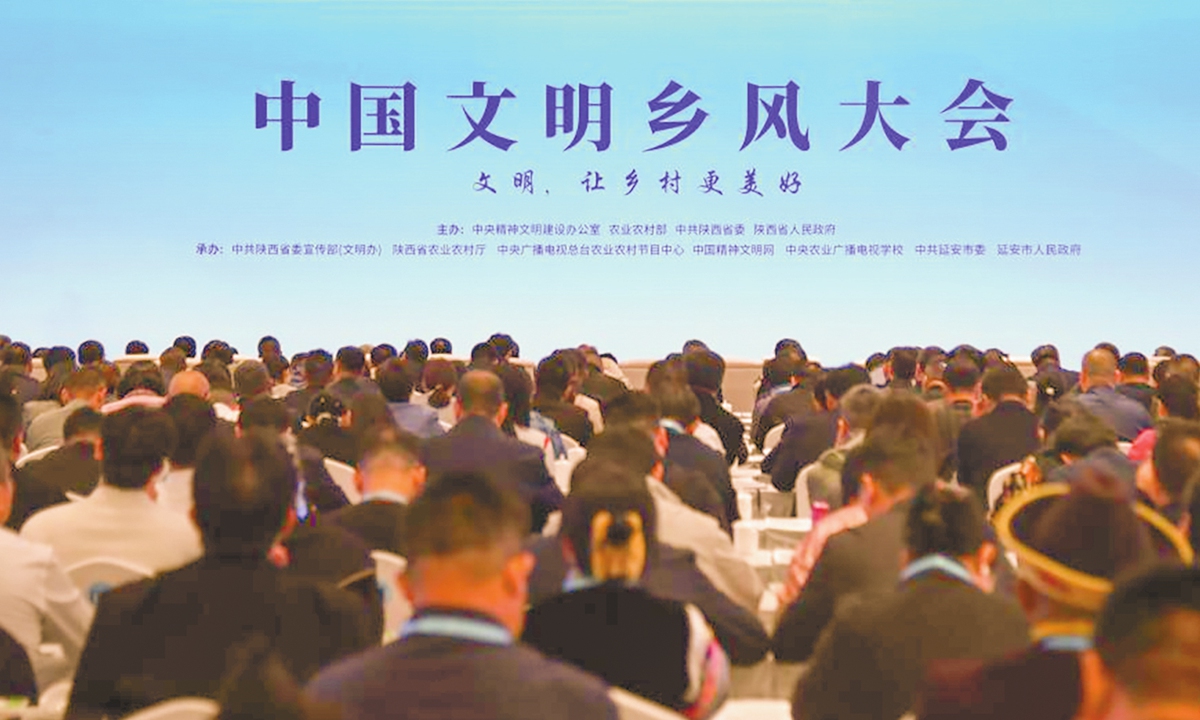
Audiences at the main venue event of China's national conference on social civility in rural areas. Photo: Courtesy of Zhang Bowen from Xinhua News Agency
Old scenes renewedIt's not just those village dancers. Wu Yuangen, a young basketball amateur from a rural village in Foshan who competed at the event's "Village BA" game, told the Global Times that to him, basketball has evolved from a hobby into a source of confidence. "'Village BA' is providing young people in rural areas with a platform to showcase their self-worth," Zheng Haixia, a legendary Chinese center and a long-time supporter of rural sport events, told the Global Times.
Be it the confidence seen in Wu or the self-worth found by village dancers, cultural activities in rural China have transcended mere entertainment, subtly nourishing people's inner worlds. At the main venue session, representatives said enhancing cultural cultivation is key to further advancing rural culture.
Coming from different walks of life, grassroots workers from provinces such as Yunnan and Sichuan exchanged stories at the conference, with the transformation of old village traditions being the key topic. Among them was He Maogen, a rural worker from China's Naxi ethnic group in Yunnan Province.
He is the leader of Puji village in Yunnan, a place of beautiful scenery that once struggled with poor upkeep and distant community relationships. Inspired by his military background, He introduced the "Four-Haves" initiative to the village. Such new rules encourage villagers to clarify cleaning responsibilities and organize cultural galas on important dates.
He told the Global Times that while the villagers initially took part "tentatively," they gradually developed a sense of responsibility and began to plan activities themselves. Many of these activities contained distinct characteristics of Naxi culture. For example, a music band was spontaneously organized by the villagers to perform songs related to the Torch Festival.
"We need to change the old customs in our villages through creative methods that are closely connected to the villagers themselves," He said. Such an approach of empowering villagers to transform their own customs has been extended to other communities. For example, at Tongxin county in China's Ningxia Hui Autonomous Region, 160 villagers voluntarily formed a "community spokespersons" team to tackle the local 'high bride prices' conundrum.
Perhaps in the future, Tongxin county's "community spokespersons" team may create their own stories similar to "The 388,000 Yuan Bride Price." Yet even without such dramatic stories, it is evident that rural Chinese life and customs are diverse and continuously modernizing.
RELATED ARTICLES