ARTS / CULTURE & LEISURE
Literature helps promote understanding between China, S.Korea
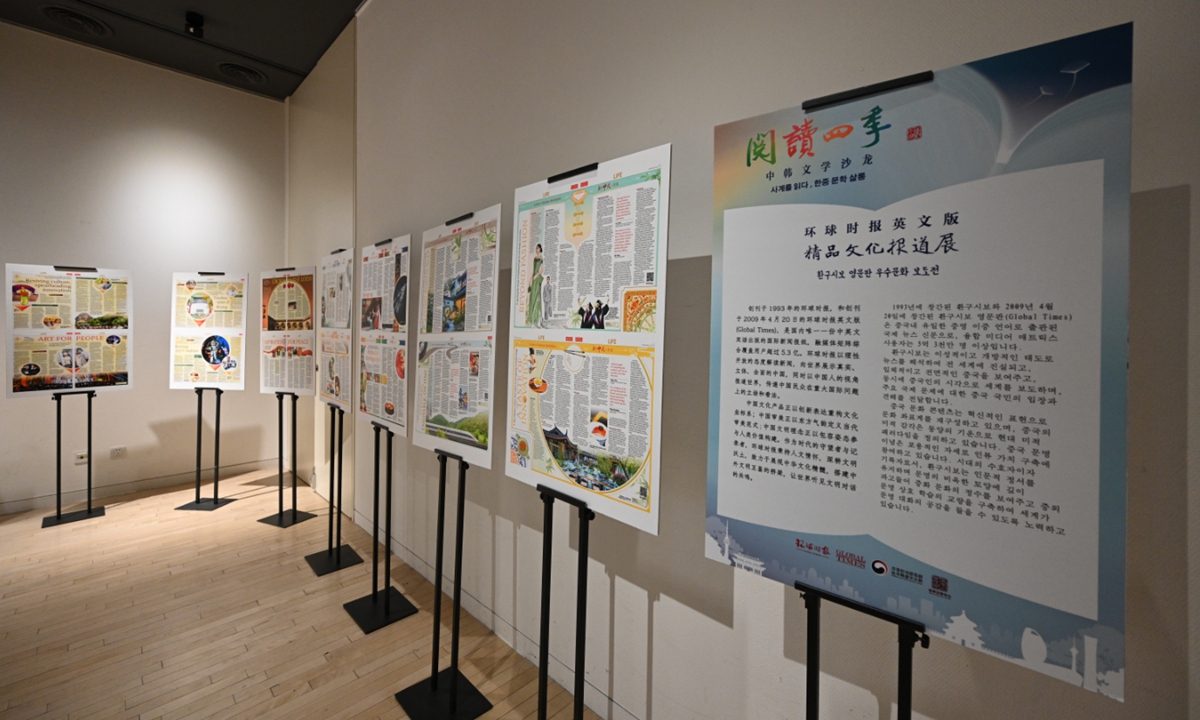
A scene at the Global Times "Reading Through the Seasons" China-South Korea Literature Salon at the Korean Cultural Center, China Photo: Chen Tao/GT
Editor's Note:
Aiming to build a new platform for cultural exchange between China and South Korea through literary dialogue, the Global Times "Reading Through the Seasons" China-South Korea Literature Salon was held on Wednesday at the Korean Cultural Center, China. During the event, Kim Tae-sung, a South Korean translator and winner of the 10th Special Book Awards of China, discussed how shared cultural roots between the two countries have influenced the reception of Chinese mainland literature in South Korea, and how translation has been its most important means.
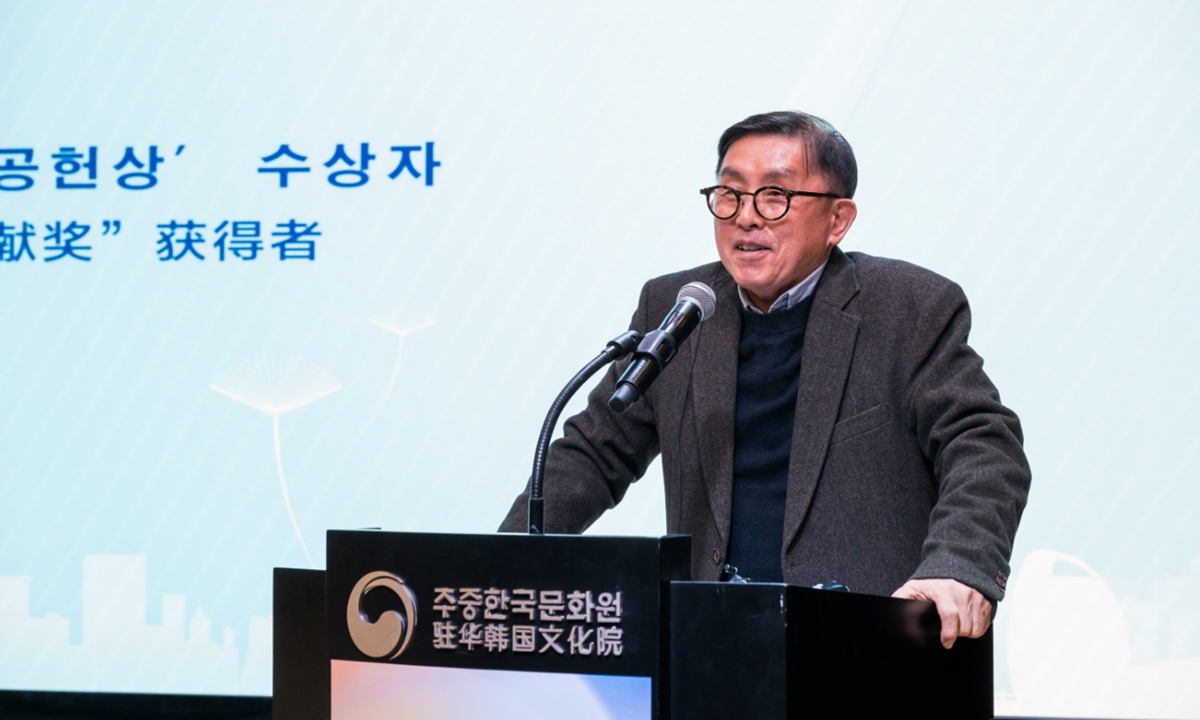
Kim Tae-sung, South Korean translator, winner of the 10th Special Book Awards of China Photo: Chen Tao/GT
I think China and South Korea share cultural roots to a certain extent, which I'd like to define as "shared roots." Based on my personal experience, I would like to discuss how such shared cultural roots have influenced the reception of Chinese mainland literature in South Korea, and how translation has been its most important means.
The Book of Songs, China's earliest collection of poetry, is said to have been compiled by Confucius himself. It consists of 305 poems that circulated in the Central Plains approximately 3,000 years ago.
Take "Guan Ju," the first poem in The Book of Songs, many typical words and phrases such as Wumei (waking and sleeping), Zhanzhuan Fance (toss all night long), Yaotiao Shunü (maiden fair) have been included in Korean dictionaries and utilized as Korean vocabulary.
Even though some meanings of these words and phrases have changed slightly, the basic meanings remain the same. My generation began learning Chinese characters and classical Chinese in elementary school. Excerpts from The Analects of Confucius and Mencius and poems by Du Fu were selected for our high school textbooks.
Part of the Korean language is based on classical Chinese. Most of those Chinese characters in Korean are of the same origin just with different pronunciations. So called four-character idioms are an important part of Korean rhetoric.
Of course, Korean uses a phonetic script, and its system differs from that of Chinese. However, we cannot and should not deny its certain degree of acceptance and inheritance from classical Chinese. In short, because Korean is based on classical Chinese, it cannot avoid its influence.
What's more, historically, Korean dynasties embraced Chinese cultural heritage, especially during the Joseon Dynasty (1392-1897), which absorbed Chinese culture and social systems to the greatest extent possible over five centuries.
Language is a vessel that carries culture. Therefore, these "shared roots" of language applies to the entire culture. I think the frequent claims by South Koreans that the Dragon Boat Festival originated in South Korea and that Confucius was South Korean stem from misunderstandings arising from this long-term cultural interweaving. The claim that the Dragon Boat Festival originated in South Korea is probably due to ignorance of Chinese folk customs.
To dispel these misunderstandings, enhancing mutual understanding is crucial. South Korea is one of the countries that has received the most Chinese cultural influences, and what I mean by shared cultural roots is precisely the structural factor supporting this phenomenon.
Suppose we go to a large bookstore in Seoul right now. How many books related to China would there be? At least 1,000. Why's that? This is probably because South Korea and China are close neighboring countries with a long history of cultural exchange. South Korea has an urgent need to understand and learn about China. Against this backdrop, for the past 25 years, I have been focusing on translating Chinese literature and engaging in cultural exchange activities, having translated and published more than 150 books.
However, the reality is there are many researchers but few translators. Book planners who can understand and introduce the vast works of China are rare, too. This is exactly why I have traveled between Beijing and Seoul hundreds of times to introduce more than 200 works to the South Korean publishing industry and even take on the role of copyright agent.
I think the relationship between a writer and a translator is like that of Lin Daiyu and Xiren among the 12 Jinling ladies from the novel Dream of the Red Chamber - both are talented ladies and beauties but Xiren is a maid, a servant.
The essence of translation lies in serving literature. However, this doesn't mean there's a master-servant or superior-subordinate relationship between the writer and the translator. The only difference is essential function. Translators serve tens of thousands of readers through works by writers.
So far, I have translated works by more than 100 Chinese writers, including poets. I have suggested to many of these writers that they participate in literary exchange activities in South Korea and meet their Korean readers in person.
However, strictly speaking, my efforts in translation are not necessarily for Chinese writers, rather for Korean readers and writers.
I also would like to see readers gain a very specific understanding of China, a country with a population of 1.4 billion and a multiethnic state, which is a very abstract concept. What do Chinese people eat every day? How do they fall in love? These very specific and detailed things exist in novels, which is one of the important reasons why I translate Chinese literature.
As for Korean writers, I hope they can appreciate China's storytelling capability, something I feel is lacking in Korean culture.
The friendly relations between China and South Korea determine the scope and reach of readership. The closer the ties, the more readers and more literary exchanges. As a result, more South Korean tourists head to destinations in China. With more South Koreans liking China, a pro-China and knowledgeable faction will be formed.
Last summer, I read 89 Words followed by Prague, A Disappearing Poem by Milan Kundera by chance. The book is filled with the world-renowned author's laments and anguish at the distortion and exaggeration of his texts. This reaffirmed my principle - translation is not creation, but a mirror of the original meaning expressed by the writer.
I think fostering excellent translation talent is a crucial factor for cultural dissemination and exchange between China and South Korea. Korean readers need to read Chinese literary works, and Chinese readers also need to read Korean literary works. The reason is simple: Only through literature can one gain a very concrete and realistic understanding of the social systems and the lives of people in both countries.
One of my favorite quotes is from Albert Camus, a French writer and philosopher. It says, "Our life is not learned and remembered through theories and statistics, but through a landscape." This is also the motivation behind my translation work as the landscape is the state of life depicted in a novel.
Vivid landscapes in daily life are described in literary works. Therefore, the most specific way to understand China is to read Chinese literature.
Through the translation of novels, the trivial details of the lives of people in both South Korea and China can be understood, which is also a particularly good way to dispel misunderstandings between the two peoples. I will continue to translate Chinese literature in the future. I have already signed contracts for about 10 books. I hope that through my translations, the literature of both countries can develop more vigorously.
RELATED ARTICLES