ARTS / CULTURE & LEISURE
Diplomats, filmmaker stress common ground of human ancestors through rock pictograms
‘Chiribiquete’ screened to public
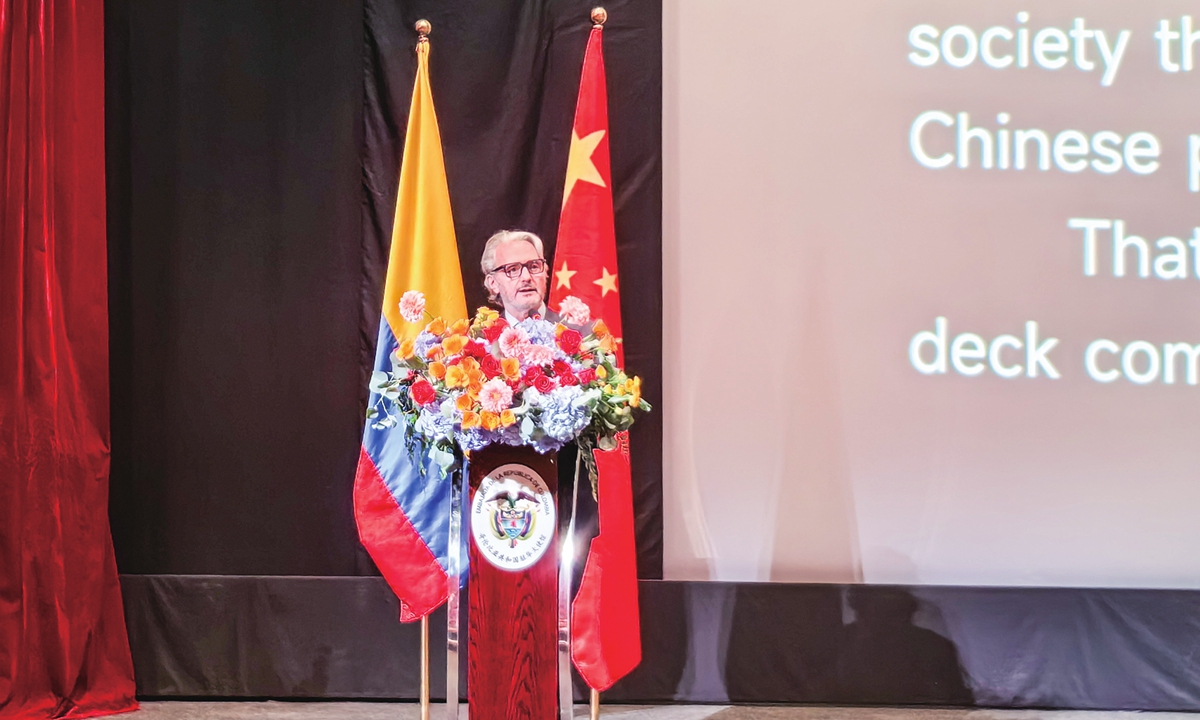
Sergio Fausto Cabrera Cárdenas, ambassador of Colombia to China gives a speech at the inauguration of screening of Chiribiquete: Amazonian Memory at Stake in Beijing, on October 24, 2025. Photo: Dong Feng/GT
The Embassy of the Republic of Colombia in China and Radio Television Nacional de Colombia (RTVC), a public radio and television entity in Colombia, jointly hosted the screening of a documentary titled Chiribiquete: Amazonian Memory at Stake in Beijing on October 24. Ambassador of Colombia to China Sergio Fausto Cabrera Cárdenas told the Global Times that it is very important for people to understand each other as mutual understanding will help enhance the lasting friendship between the two peoples."I think it's very important that the people of our two countries learn about each other. For instance, the Chinese people get to understand Colombia's history and past, and let the Colombian people know more about Chinese culture. This will help enhance the lasting friendship between the two peoples," Ambassador Cabrera said.
In his welcome remarks, Ambassador Cabrera said that "this is a special year for our country's relations with China, [as it marks] 45 years since the establishment of our diplomatic relations. It's a time to remember and reflect on our important, common past, and how we can project this partnership and friendship into the future." Colombia, with 200 years of republican life, has been built under the legitimacy of the laws, constitutional order, democratic values, and the republican body. "Above all, respect and interest toward different cultures can enrich our worldview from all regions and communities to build a prosperous society through the spirit of achievement, solidarity, and improvement that unites the Colombian and Chinese people," said Ambassador Cabrera.
Rock pictographs estimated to date about 17,000 years ago, show us the origins of humanity and their relationship with the environment and nature. It is also the origin of a spirituality that integrates the aesthetic with the sacred, which is why it is for the communities of that region, a sacred space, Ambassador Cabrera introduced.
In relation to the Chinese culture, the ambassador mentioned rock paintings from part of Zuojiang Huashan Rock Art Cultural Landscape, a UNESCO World Heritage site in Ningming county, South China's Guangxi Zhuang Autonomous Region, noting that for the two nations, it is important to listen and learn from our ancestral communities.
María Paula Fonseca Gómez, deputy television manager of RTVC, said in her remarks that they wished to present a documentary that becomes a journey to the heart of our natural wealth, on a trip to culture and all the archaeological knowledge in Colombia. A documentary that opens a new perspective on the origin of humanity and the role of America in our millennial journey as human beings, exploring Chiribiquete through touring the country's beauty, going to the heart of Colombia's power of life and finding new perspectives on human origin.
She said that the documentary aims to open a window to the world so that a heritage declared by UNESCO as a double good of humanity is known so much for its exceptional biodiversity as it is for its universal cultural value.
"Chiribiquete: Amazonian Memory at Stake" tells the story of a journey into the depths of the ancestral mystery of Chiribiquete's rock art, guided by a handful of Colombian scientists who have dedicated their lives to the effort of deciphering it. The film is regarded as an invitation to embrace their indigenous past, as Colombians so often denied.
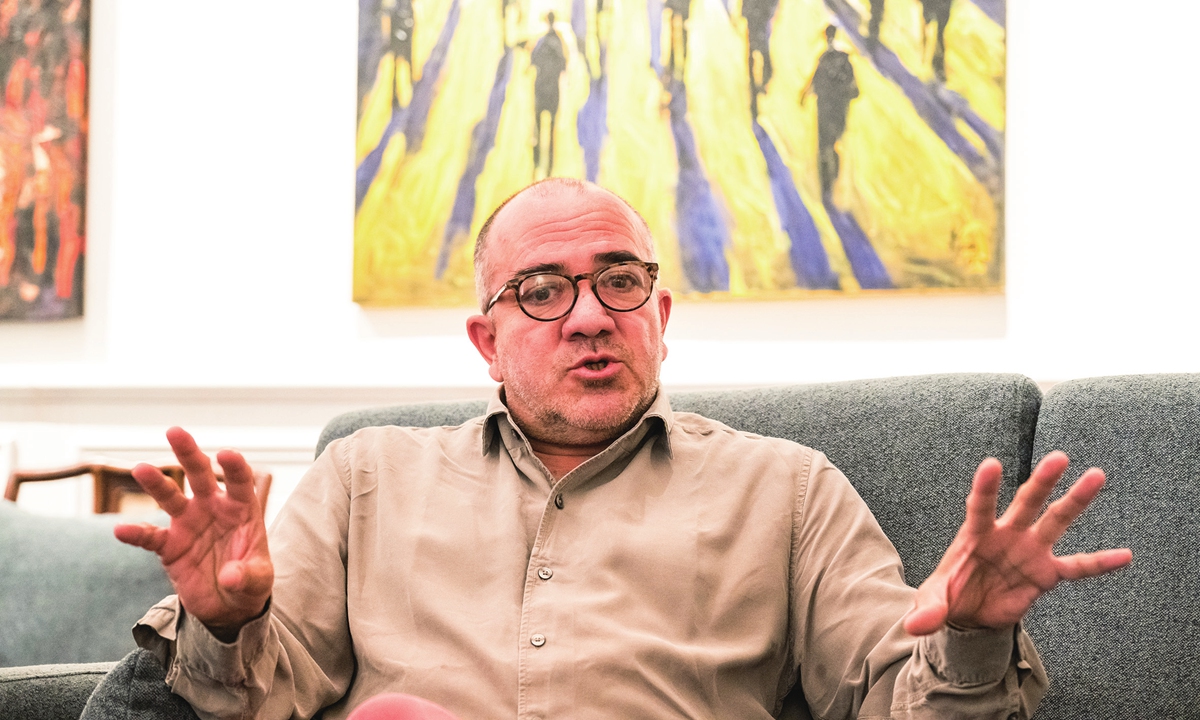
Film Director Juan José Lozano Photo: Chen Tao/GT
In an exclusive interview before the public screening, Colombian filmmaker Juan José Lozano told the Global Times that the main task of this filming is to use the camera to follow the scene, mainly to have a dialogue with scientists in the language of the camera, and try to understand how they explore the vast land in their daily lives, in various aspects such as archaeological excavation and research.Chiribiquete National Natural Park in the Colombian Amazon houses one of the most important rock art treasures in the Americas in its tepuis. Inscribed a UNESCO World Heritage Site in 2018, Chiribiquete Park, with its more than 75,000 pictograms recorded to date, is perhaps the only place in the world where a continuous pictorial tradition can be seen, likely initiated 20,000 years ago and extending to the present day.
Despite the immense potential for scientific research within Chiribiquete Park, only 10 percent of its surface area has been explored.
But only a handful of scientists have conducted archaeological exploration in the Amazon region. They discovered a large number of rock paintings and archaeological heritage, and determined the age of these artifacts through indirect dating techniques.
The scientists conducted an archaeological expedition in a national park in southern Colombia, an area considered sacred to indigenous people who created numerous rock paintings on the cliffs.
Scientists have made some important archaeological discoveries, on which they have had ample time to conduct in-depth research. In addition, they have discovered some ancient rock paintings that depict various animal and human activities.
"The perspective of this film is to accompany these scientists in their field research. It shows natural landscapes such as rainforests and mountains from a macro perspective. At the same time, it also observes rock paintings from a micro perspective. Because these rock paintings are very important, the research of scientists is recorded through the perspectives of these two frameworks," Director Lozano told the Global Times.
Lozano elaborated that for the Colombians, the world of Chiribiquete is a sacred place where culture and nature meet. In other words, this is where the prehistoric civilization, place of human activities started, he said.
While in the Zuojiang Huashan Rock Art Cultural Landscape in Guangxi, 38 sites of rock art illustrate the life and rituals of the Luoyue people dated from around the 5th century BC to the 2nd century on the steep cliffs in the border regions of South China. In the surrounding landscape of karst, rivers and plateaus, they depict ceremonies that have been interpreted as portraying the bronze drum culture once prevalent across southern China. This cultural landscape is the only remains of this culture today.
"It is possible that these prehistoric civilizations have something in common," said Director Lozano.
The film director also shared two stories of the scientists - professor and researcher Fernando Urbina Rangel, who conducts research on the southern border of the park, on the Amazonian banks of the Caquetá River. There, Rangel visits a Murui-Muina (Uitotos) community at a site with a high concentration of petroglyphs (engravings on stone) to explore the myth-rock art relationship with them. With five decades dedicated to the research on the community lives, the 85-year-old is the person who has most studied the petroglyphs of the Caquetá River and one of the most respected voices on Amazonian mythology and cosmogony in the country.
The other scientist the director featured is Clara Peña-Venegas, a microbiologist, specialist in Amazonian soils, and researcher at the Amazonian Institute of Scientific Research. Her research is focused on the cultivated land of prehistoric civilization.
The Amazon's land is not very fertile. The tribe planted the crops and researchers today focus on black soil, associated with terra preta, a type of very fertile soil identified in Brazil about a century ago. Early carbon-14 analyses there have dated the soil to approximately 2,000 to 800 years before the present, underscoring a substantial, ancient human impact on the region's soil biology and carbon dynamics.
That said, Director Lozano tells the stories of the two tribes and their relations to the environment. In Colombia, there is a saying that thousands years ago, people in the region transferred from Asia to Latin America.
"Even though we are far from each other geographically, we might have something deep in connection, especially the rock paintings in Chiribiquete and Huashan. In effect, we are like brothers," the director said.
Talking about the transmission of culture and history, Director Lozano said the two countries see different patterns. For China, the transmission turns out to be a linear trajectory and has never been interrupted. While in Colombia, the cultural and historical transmission is cyclical. By studying the paths of past civilizations, it is expected that the research will shed light on the future," he analyzed.
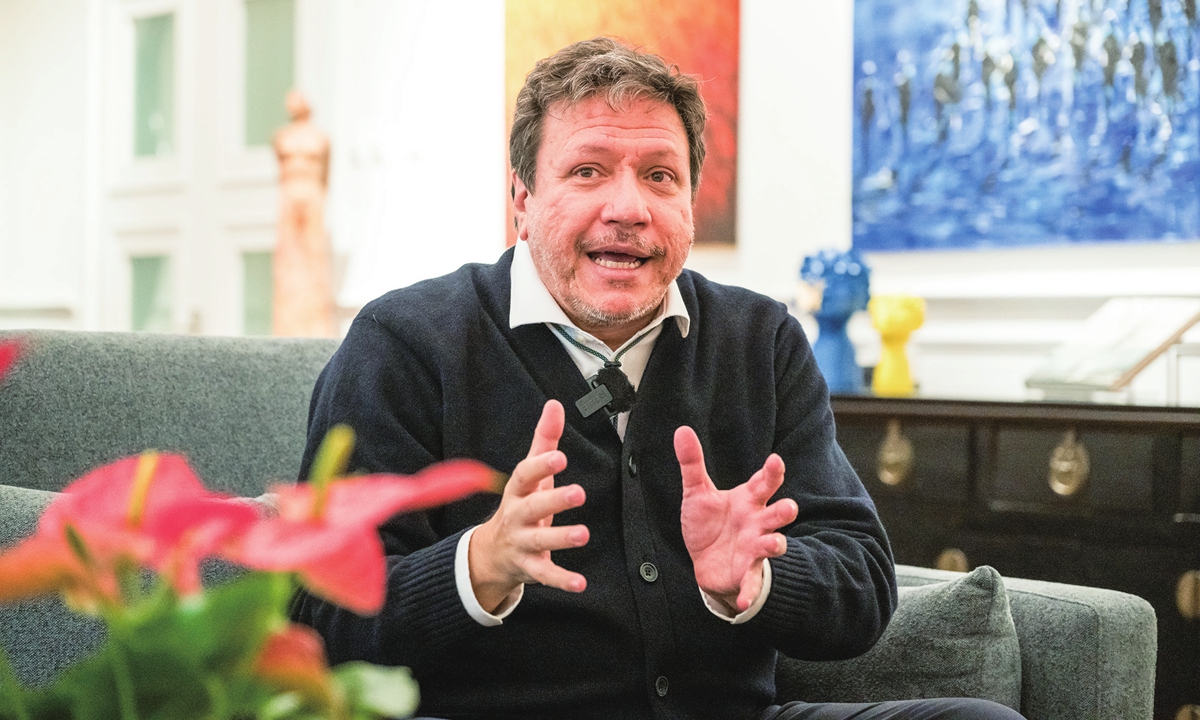
Santiago Gamboa, writer and minister counselor of the Embassy of Colombia in China Photo: Chen Tao/GT
Santiago Gamboa, writer and minister counselor of the Embassy of Colombia in China, told the Global Times that the 45th anniversary of bilateral relations between the two countries provides a great opportunity for cultural exchanges, through which we could share our modern perspectives with each other."Leave alone the nationalities, we share the same human origin. No matter Colombian, Chinese, or European, we might have a common ancestor. Through the rock art in Chiribiquete we can see the ancient people actually draw pictures on the rock walls out of the same interest, whether it was depictions of animals or plants," said Minister Counselor Gamboa.
Through such simple rock stroke to carve the painting, we can see that the ancient people were seeking a kind of divine protection to promote hunting. There are hunting scenes in the rock paintings, seeking to make hunting go more smoothly. From this perspective, regardless of nationalities or races, all human beings are sharing the same inspiration. The spiritual realm is common, after all, we have common ancestors, Minister Counselor Gamboa said.
As cultural institution in the embassy, the minister counselor would like to support the two countries to make more efforts to seek common ground in rock art. Such a documentary helps with further cooperation and understanding.
It is expected that the film could serve as a wake-up call for all the people to realize the Earth is in danger of challenges such as climate change, urging everyone to care more about the shared planet, said Minister Counselor Gamboa.
RELATED ARTICLES