ARTS / CULTURE & LEISURE
All transformations aim to achieve normality
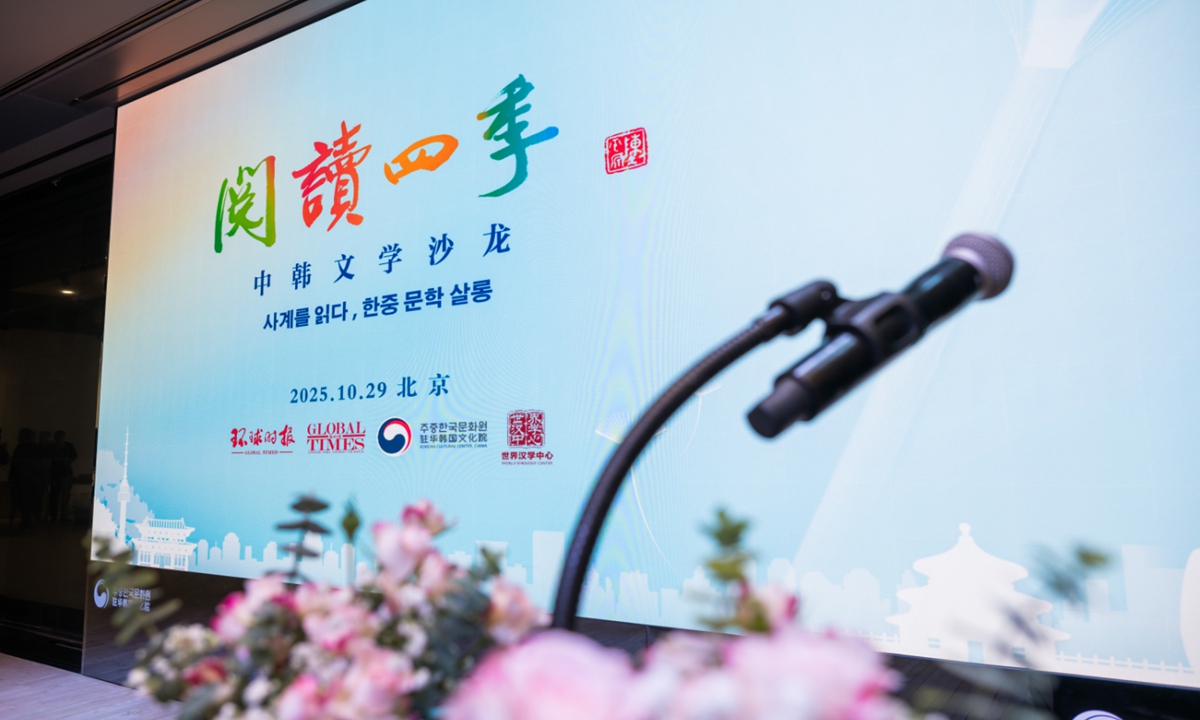
A scene of the Global Times "Reading Through the Seasons" China-South Korea Literature Salon at the Korean Cultural Center, China Photo: Chen Tao/GT
Editor's Note:Aiming to build a new platform for cultural exchange between China and South Korea through literary dialogue, the Global Times "Reading Through the Seasons" China-South Korea Literature Salon was held last week at the Korean Cultural Center, China. During the event, Dong Xi, president of the Guangxi Writers Association and a professor at Guangxi Minzu University, shared his recent reflections on reading South Korean writer Han Kang's work.
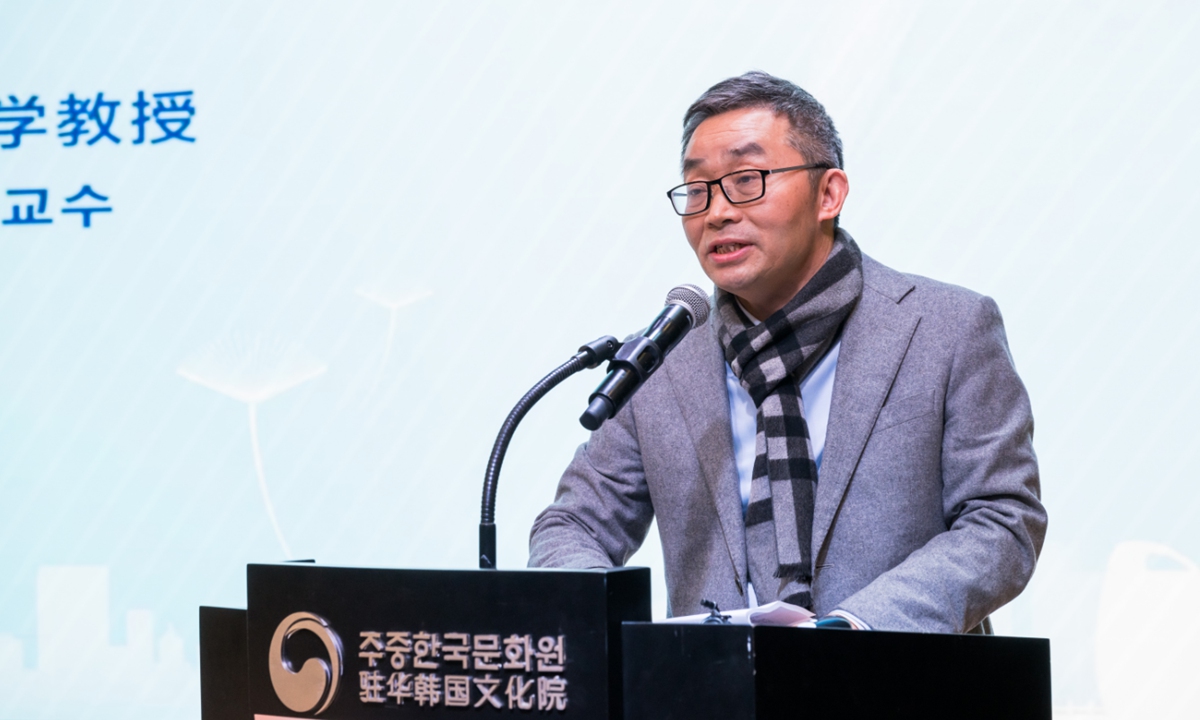
Dong Xi Photo: Chen Tao/GT
Recently, I read the novel The Vegetarian by the South Korean writer Han Kang, who won the 2024 Nobel Prize in Literature. A woman named Kim Yeong-hye, after having a dream in which she saw blood, combined with childhood memories of her father abusing dogs, decides to stop eating meat. She throws out all the meat in her refrigerator. Her husband can't understand her at all, their relationship begins to crack, and they eventually divorce.Kim's brother-in-law is a painter. He becomes obsessed with a birthmark on her buttocks. Kim's sister thinks they have gone mad and sends Kim to a psychiatric hospital.
In the hospital, Kim does handstands every day, imagining her palms as roots digging into the earth and her legs as tree trunks growing upward, covered in branches and leaves. She imagines herself transforming into a tree.
Why did this novel move me so much? Perhaps it was because it portrays a character unlike any other. First, the protagonist is a vegetarian, refusing to eat meat and to kill, anxiously preoccupied with this choice every day. Second, she imagines herself as a tree, longing to become a plant.
This reminds me of the Chinese writer Yang Zhengguang's medium-length novel Lao Dan is a Tree, written in the 1990s. The story is about an old man named Lao Dan, who attributes all his grievances and injuries to a local human trafficker named Zhao Zhen. His hatred reaches its peak. Having an enemy gives him a sense of purpose, and he becomes exhilarated. This emotion is reminiscent of how people today vent online, sometimes feeling an inexplicable thrill toward a fictional adversary.
Although Lao Dan's chain of hatred is loosely connected, it is not particularly solid. Once he chooses his target, he begins to spar with Zhao Zhen. He seeks justice, telling people how Zhao Zhen seduced his daughter-in-law. But his confessions receive little sympathy and instead attract onlookers who treat his story as titillating material.
Eventually, the crowd grows indifferent. Unable to vent his inner grievances, Lao Dan instructs his son to take revenge, telling him to kill Zhao Zhen's dogs. His son, Da Dan, masters the skill of killing dogs, but when he reaches Zhao Zhen's house, he is bitten by the family dog, leaving him crippled. Lao Dan becomes even angrier. Unable to seek justice or exact revenge, he stands atop Zhao Zhen's dung heap, imagining his legs growing roots into the pile, transforming himself into a thriving tree, like a surveillance camera constantly watching his enemy.
This character also reminds me of the French writer Jean-Marie Gustave le Clézio, a Nobel laureate in 2008, who wrote the novel Le Procès-Verbal (The Interrogation). In his novel, a young man named Adam Pollo is dissatisfied with societal realities and feels out of place in the city. He goes to an island, lives in an abandoned house, basks in the sun every day, and empties his mind. He imitates dogs, longs to become a stone, or even the moss growing on a stone. Isn't this a kind of "metamorphosis"? Le Clézio portrays the struggle between the individual and society, showing a desire to return to a more primitive state.
This naturally brings to mind Franz Kafka's The Metamorphosis. Kafka writes about Gregor Samsa, who wakes up one morning to find himself transformed into a giant insect. Anxiety and tension immediately ensue. He lives with his mother, father, and sister, and he is the family's main support. Now transformed, what can he do? He panics and hides under the sofa, ashamed and fearful of frightening his family. At first, his family, especially his mother and sister, show concern. But gradually, he becomes a burden, forgotten, and ultimately dies of starvation in his room.
Why does this image move me? Because the author not only uses sensitive writing to capture subtle human emotions but also transforms the character's physical form. This transformation produces a shocking, striking effect. Human beings are naturally capable of showing kindness and taking responsibility, but imagining an insect with such traits goes beyond our conventional understanding.
Those familiar with ancient Chinese culture will know that during the Warring States Period (475BC-221BC), there was a thinker, philosopher, writer, and Taoist named Zhuangzi. In his work Zhuangzi: On Seeing Things as Equal, he recounts dreaming that he is a butterfly, joyfully fluttering around, forgetting that he is Zhuangzi. Upon waking, he is unable to determine whether he is Zhuangzi, who dreamed of being a butterfly, or a butterfly dreaming of being Zhuangzi. Isn't this perhaps the earliest "metamorphosis" story?
It is truly marvelous! Writers from different times and countries have all used the motif of "transformation" to express their own experiences and themes. My own medium-length novel Life Without Words (already translated and published in South Korean) also falls into this category. In it, a father is blind, a son is deaf, and a daughter-in-law is mute. Together, they form a household which "cannot see, cannot hear, cannot speak," yet they partially communicate by relying on each other's functioning senses. The novel portrays an extremely abnormal family striving to approach a normal state.
So perhaps I can say: All transformations are ultimately aimed at achieving normality.
RELATED ARTICLES