ARTS / CULTURE & LEISURE
New discovery at Liao Dynasty site reveals fusion of nomadic, Central Plains cultures
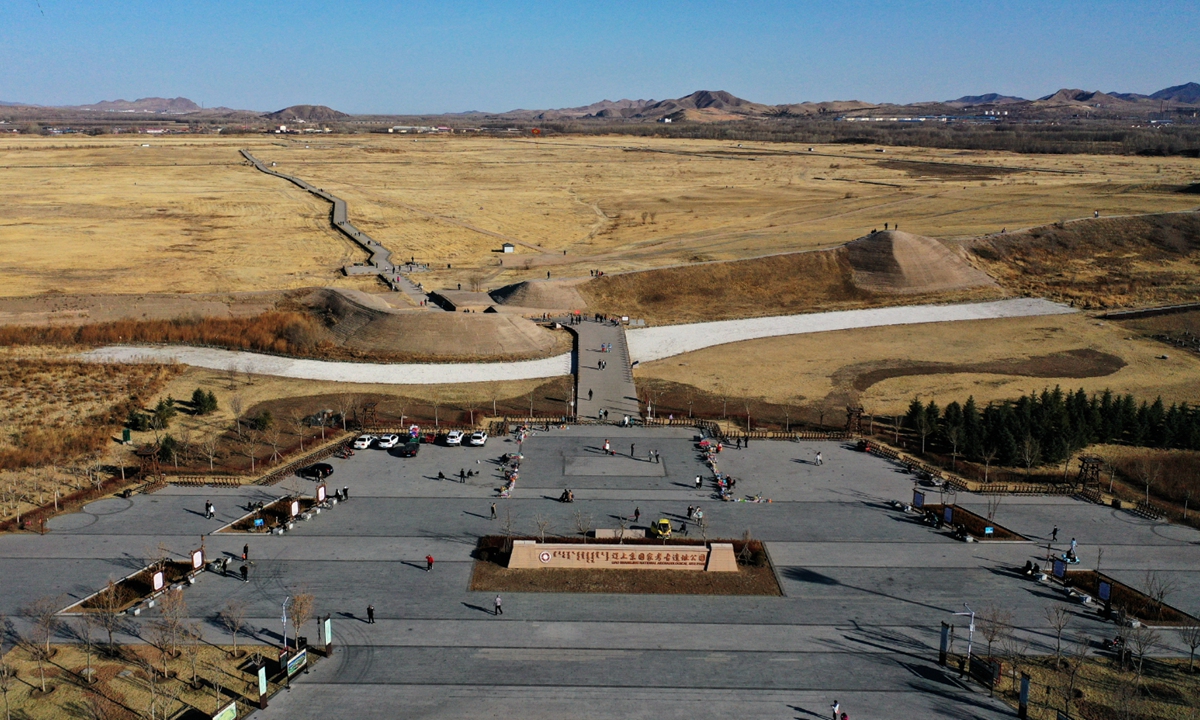
The Liao Dynasty Shangjing site Photo: VCG
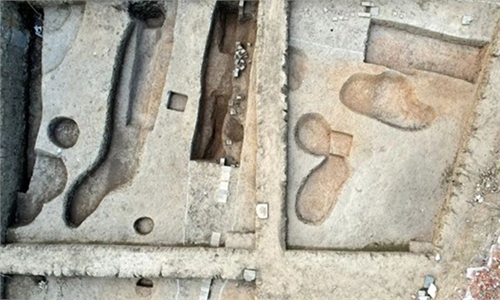
After more than five months of meticulous excavation, Chinese archaeologists have discovered and confirmed four large courtyard complexes in the southwest portion of the imperial city at the Liao Dynasty (916-1125) Shangjing site, offering fresh insights into the historical legacy of this ancient "grassland capital." Experts say the findings provide striking evidence of the formation of the Chinese nation's pluralistic and unified cultural paradigm.Located in Chifeng, North China's Inner Mongolia Autonomous Region, the Shangjing site was founded in 918 by the Khitan people, making it China's first capital city established by a nomadic ethnic group on the northern grasslands.
The newly uncovered courtyards are remarkable in scale, with one complex oriented to the south and the other three facing east.
Wang Ying, an associate researcher at the Institute of Archaeology at the Chinese Academy of Social Sciences (CASS), said that historical records indicate that the southwestern part of the imperial city once housed administrative offices such as those for Linhuang prefecture and Linhuang county, as well as ritual buildings like the Confucian Temple and the Imperial Academy.
The area also contained royal Buddhist and Taoist temples. "These new discoveries provide important clues to understanding the nature and functions of these major Liao Dynasty structures," Wang said.
Wang explained that the diverse orientations of the courtyards reveal the Shangjing site's inclusive approach to urban planning. "The east-facing layout reflects the Khitan people's tradition of revering the east and worshiping the rising sun, while the south-facing courtyards follow the classic Central Plains architectural design associated with ritual propriety. The coexistence of both designs in the same area vividly illustrates the deep integration of nomadic and agrarian cultures," Wang said.
Dong Xinlin, a CASS researcher who also took part in the excavation, told the Global Times that the team has identified the foundations of the palace city in the core area of the imperial city, where no visible surface remains had survived. This finding confirms that the Liao capital followed a "palace city enclosed within the imperial city" layout, an urban design that combined the ceremonial order of the Central Plains with distinct features of the northern grasslands.
"Within the imperial city, we found palace foundations resembling Khitan tents, while the Confucian Temple and Imperial Academy were modeled after Tang-style architecture," Dong said. "The Buddhist temple on the western slope, meanwhile, employed Central Plains timber-frame construction but retained the orientation typical of grassland monasteries, confirming it as the first royal temple established under the Liao Dynasty."
More than 200 clay Buddhist statues unearthed from the base of a large central pagoda show a stylistic blend of Tang Dynasty (618-907) softness and Khitan vigor. "The art embodies a spirit of openness and inclusivity, integrating influences from across regions," Dong added.
The Shangjing site had been designed with a unique north-south dual-city layout symbolizing the blending of cultures. The northern imperial city housed the Khitan emperor and aristocracy, while the southern "ethnic Han city" accommodated merchants and envoys from various states.
"This 'governance by local customs' approach preserved nomadic traditions while incorporating the administrative wisdom of the Central Plains," Wang explained.
Previous archaeological findings had already shown that the palace city's "enclosed square" design mirrored the Central Plains concept of supreme imperial authority, while the city's clear eastward axis reflected its grassland origins. The newly discovered courtyards, experts say, further enrich the physical evidence supporting this hybrid urban model.
Archaeologists also noted overlapping layers of construction from the Liao and Jin (1115-1234) dynasties across the courtyards, suggesting that the sites continued to be used and modified after the fall of the Liao. This continuity, they say, offers valuable insights into cultural transmission and adaptation amid successive regimes in northern China.
"Every new discovery at the Shangjing site deepens our understanding of the pluralistic yet unified character of Chinese civilization," Dong emphasized. "From its dual-city plan to its diverse architectural orientations, this ancient grassland capital stands as an evocative testament to the long history of interaction and integration among China's ethnic groups."
RELATED ARTICLES