ARTS / CULTURE & LEISURE
Brief discussion on poetic quality of Han Kang’s works
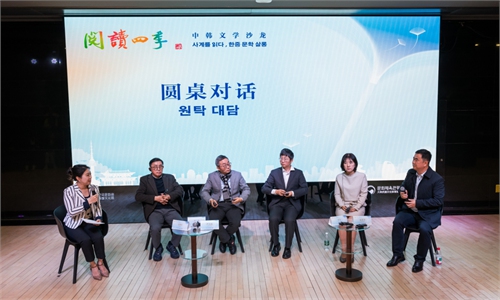
A scene of the Global Times "Reading Through the Seasons" China-South Korea Literature Salon at the Korean Cultural Center, China Photo: Cui Meng/GT
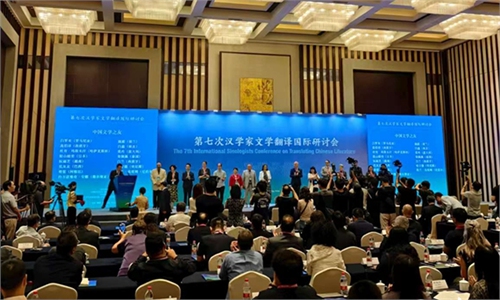
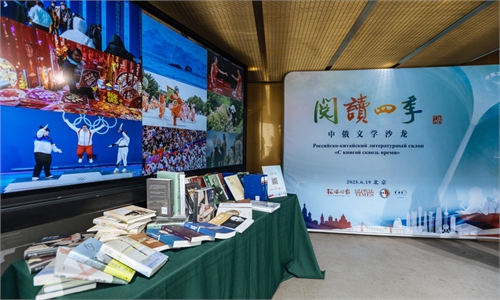
Editor's Note:Aiming to build a new platform for cultural exchange between China and South Korea through literary dialogue, the Global Times "Reading Through the Seasons" China-South Korea Literature Salon was held last week at the Korean Cultural Center, China. During the event, Cui Youxue, an associate professor at School of Chinese Ethnic Minority Languages and Literature, Minzu University of China, shared his reflections on the translation of South Korean writer Han Kang's works.

Cui Youxue Photo: Chen Tao/GT
Han Kang is the first South Korean and first Asian woman to win the Nobel Prize in Literature. She is also an outstanding figure of South Korea's generation of female writers born in the 1970s. In 2024, the Swedish Academy awarded her the prize, stating, "In her oeuvre, she confronts historical traumas and invisible sets of rules, and in each of her works, exposes the fragility of human life. She has a unique awareness of the connections between body and soul, and between the living and the dead; and her poetic and experimental style has become an innovator in contemporary prose." The poetic quality of Han's writing stems from her persistence in writing poetry and her tireless effort to infuse poetic sensibility into novels.
Her literary output spans novels, poetry, essays, children's tales, songs and more. Anders Olsson, chair of the Academy's Nobel Committee for Literature, noted that Han has a rich literary background, and beyond writing she is also active in art and music, which is reflected in her entire body of works.
The poet was born in Jungheung-dong, Gwangju. But the name Yeosu, a city in South Jeolla Province, has multiple meanings for her, as the place name appears in her first short-story collection Love of Yeosu published in 1995. Her second "home" is Seoul (from the age of 10), specifically Suyu-ri in Seoul (today Suyu-dong, the Gangbuk district). She lived about 20 years in Suyu-ri and has often called it "a place I want one day to return to."
In April 1979, during her time in Jungheung-dong when Han was 8 years old, she began writing poems. By her second year in middle school, she was already deeply devoted to writing both poems and diary entries. In one of her childhood poems, she asked, "What is love? Where is love?" and answered herself, "Where is love? It is in my beating chest. What is love? It is the golden thread that connects our hearts."
In her university years, her poem Letter won the Yun Dong-ju Poetry and Literature Award at Yonsei University. She entered the literary world first through poetry before writing novels. One of the poems she wrote was Winter in Seoul. Poems and songs frequently appear in her novels. Her essay collection Quietly Sung Songs in 2007 consists of her reflections on songs and lyrics, and as an appendix it includes a music album composed and sung by Han herself. She published a poetry collection I Put The Evening in the Drawer in 2013.
Inspired by the line "I think only human beings are plants" from Yi Sang's poem Untitled (On Bone Fragment), Han wrote The Plant Wife and The Vegetarian. She publicly stated in 2008 that this line gave her the idea for The Vegetarian. After a long period of exploration and effort, she wrote The Vegetarian.
The interplay of poetry and novel form, along with intertextuality, can also be seen in her 1994 short story Blue Mountain and Yun Dong-ju's poem Self-Portrait. The well in the story corresponds with the well in the poem.
Writing poetic novels has been Han's enduring pursuit. Her 2003 essay collection Love and Things Surrounding Love recalls her time in the Iowa Writers' Workshop in 1998, and in one essay she expresses her excitement at encountering poetic novels. From this we can glimpse Han's strong desire to write novels that are poetic in nature.
From a translator's perspective, engaging with Han's works is not only a linguistic challenge but also an emotional journey. During the process of translation, I have always felt that Han's works are heartbreaking. Perhaps when I first translated her novels more than 10 years ago, I still had a tender and fragile heart. After translating one of her stories, I felt such deep pain as if I couldn't bear the suffering contained in her writing. So I set the work aside to recover a bit before translating another piece. Yet again, I felt the same heartache. Translating her works is truly difficult, especially trying to experience and convey the pain that the author expresses.
Moreover, compared with other writers, Han's works have a distinct quality of their own. I often wonder whether this uniqueness comes from her restrained use of language, or from her intense focus on psychological depictions of pain, or perhaps from something else entirely. Whatever the reason, she has her own unmistakable voice.
To present this distinctive side of Han to Chinese readers, I believe a translator must take on the attitude of being humble, staying as faithful to the original text as possible. Sometimes that means adding footnotes, or reaching out to the author to confirm difficult passages. As translators, we must remain loyal to the original work and to the role of the translator itself. This attitude should never change, especially when AI translation is increasingly watching over our work. It's all the more reason for us to approach translation with sincerity and dedication.
Translation and reading are inseparable; each nourishes the other. It can be said that the history of literature is also a history of translation. From the perspective of translation studies, many literary historians share this view, though over time, the role of translation has faded into the background of history. Now, we should bring translation back into focus and reexamine the extensive translation work of the past. Both translation and reading have made significant contributions to the development of each nation's literature, language and even to the formation and progress of the nations themselves.
In light of Han's emotionally rich and poetic writing, the act of translation itself becomes part of the broader dialogue between literature and humanity. Reading is a form of communication between minds. A good book or a good novel can touch your soul, and if you experience that kind of emotional resonance, your day will feel truly fulfilling. Reading allows every reader to find a sense of fullness each and every day.
RELATED ARTICLES