ARTS / FILM
Chinese documentarian explores rebirth of East Asia’s oldest tribe
A director’s ‘doculife’
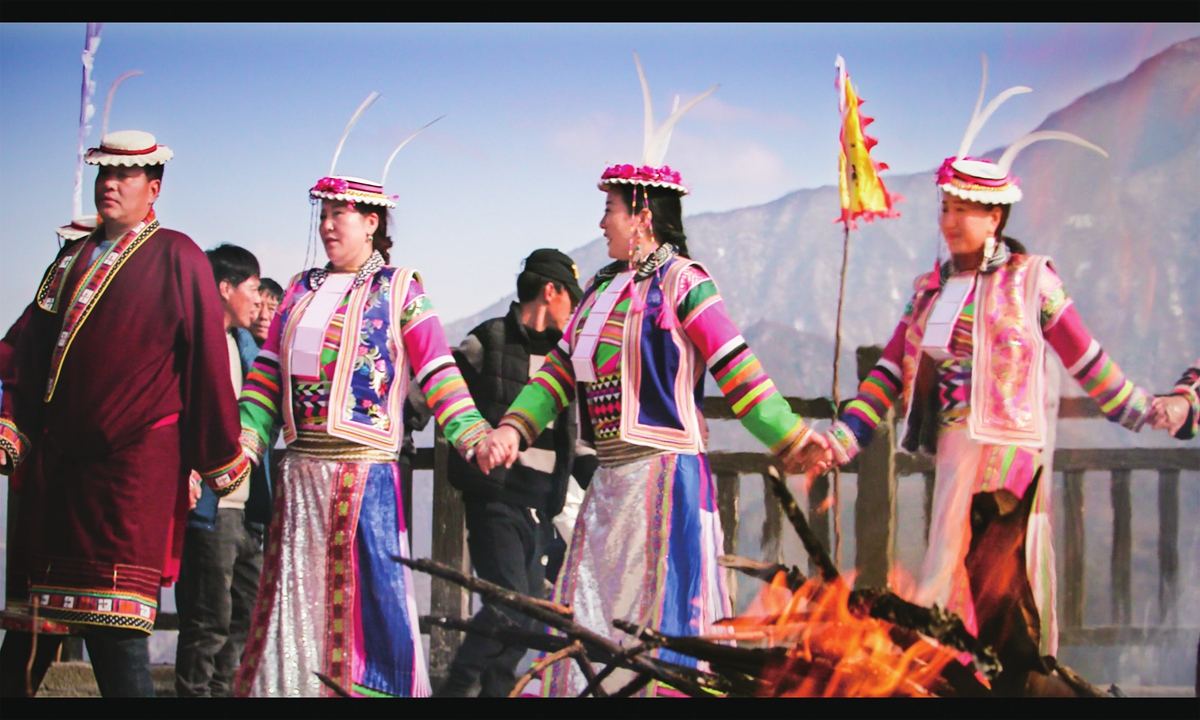
Baima people perform their iconic "yuanyuan wu," known as "circle dance." Photos: Courtesy of Zhang Tongdao
Film director and professor approaching retirement, Zhang Tongdao has devoted his entire career to exploring how to tell human stories through documentaries. His lens has captured renowned writers, ordinary people of the post-00s generation, and more. Professor Zhang told the Global Times that whoever steps into his frame, he always aspires to "naturally fuse into" their unique reality. The passion behind his creative pursuit is nowhere more evident than in his upcoming documentary, The Sisters of Baima Tibetan.The Sisters of Baima Tibetan chronicles the Baima Mountain in Baima village's recovery after a flood in Southwest China's Sichuan Province's Pingwu county, through the story of four sisters and their family. The sisters, versed in mask dance, which they perform wearing white chicken feather hats, are part of the Baima people, a population that does not have a written language, but is believed be one of East Asia's oldest tribes, according to Shanghai Observer on November 2.
From his first encounter with the four sisters in 1999 to his final filming in 2023, Zhang's 24-year journey with the community saw him evolve from a curious outsider to a community member, witnessing how the local people rebuilt their lives through rebuilding their homes.
Rebuilding home, spirit
In 2020, Tian Dongmei, the daughter of one of the four sisters, called Zhang. On the phone, the young woman asked the director for help after losing contact with her mother. At that time, the Baima village had just been hit by a flood. Water burst through doors, submerging people's homes. Houses collapsed, and the villagers were evacuated down the mountain as they watched their homes crumble before their eyes.
A sense of urgency gripped Zhang in distant Beijing. He quickly traveled to the site with his team. He told the Global Times that, uncertain as he was about the situation, he "simply couldn't just walk away from it." That initial instinct transformed into a calling, which would later result into the documentary The Sisters of Baima Tibetan.
Rather than amplifying the misery left by the flood, Zhang turned his camera toward the local people's responses to the natural disaster. His film features scenes such as villagers uniting to lift the entire wooden frame of a house, but also does not shy away from the tension that arose during the rebuilding process.
Even though tears, memories, and rifts marked the rebuilding journey of the Baima people, what the documentary reveals is the resilience and optimism they displayed in the face of hardship. When rebuilding homes, the eldest sisters, who usually managed household duties, stepped outside their traditional roles to carry bricks and tiles. Despite the flood's devastation, the Baima family still held hands during the new year celebration at a karaoke, dancing their iconic "yuanyuan wu," or "circle dance."
It was these scenes that made Zhang realize what was being rebuilt was not just Baima people's homes, but their "spirit and faith." They also prompted the director to say that his previous work on the Baima culture had been an "unfulfilled" one.
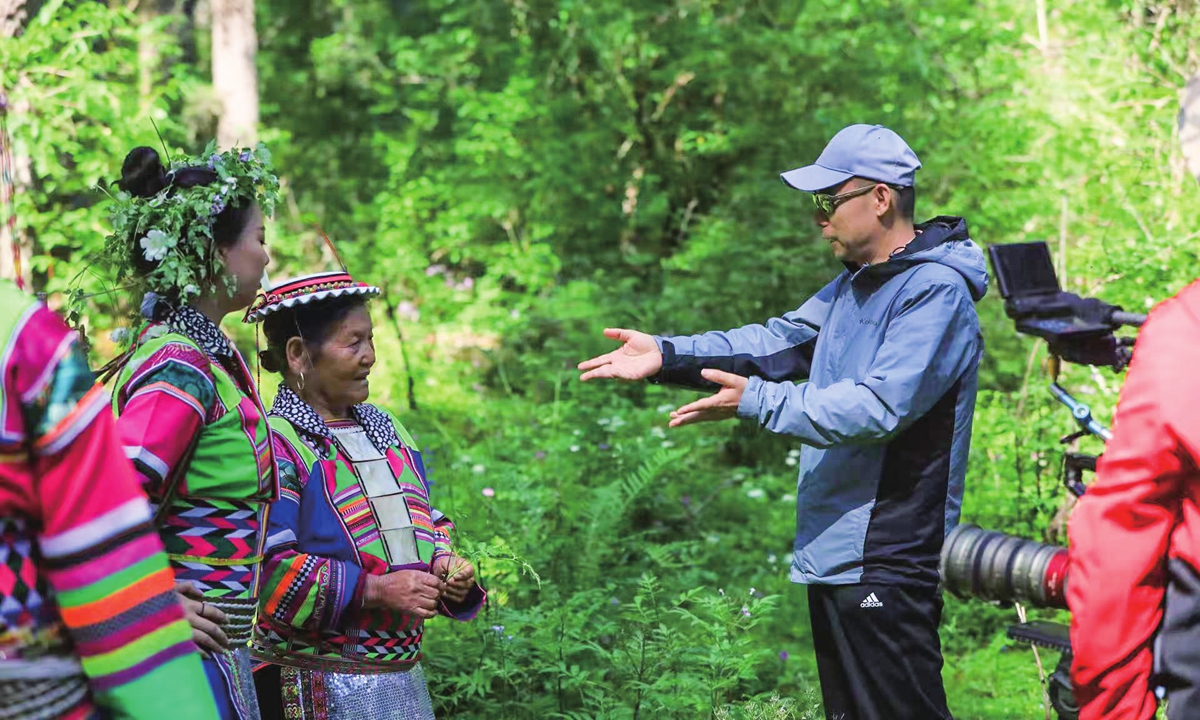
Documentary director Zhang Tongdao talks with Baima people.
Stories become part of lifeZhang completed a documentary called Four Sisters from Baima, which, debuted in 2003, now serves as a prequel to The Sisters of Baima Tibetan documentary. He first met the Baima people in 1999. "I came across the Baima people by coincidence when I went to Sichuan to explore the Sanxingdui culture," Zhang told the Global Times, adding that Tian, the daughter who later called him, was just a little girl back then.
At that time, Zhang documented how the Baima people, once reliant on logging, were transitioning to new livelihoods, like tourism, thanks to national forest conservation policies. "That work focused more on how they were navigating social changes," said Zhang. He said that his limited understanding then led him to showcase the culture's ways, driven by a curiosity for the uncommon, rather than capturing the Baima people's deeper inner pursuits evident in their daily lives.
At the time, he felt his grasp of Baima culture was "not deep enough," yet the local customs portrayed in Four Sisters from Baima spurred both Zhang and the audiences to begin exploring the Baima people's inner beliefs. "Tiaocaogai" (lit: dance with masks) appears frequently in Zhang's documentaries. As a national-level intangible cultural heritage created by the Baima people, this dance is a staple at festive celebrations that the Baima people have been performing since ancient times, to ward off evil spirits and pray for blessings.
Perhaps because they lack a written language, the Baima people have become especially fond of using melodies to channel their life experiences. Almost everything from daily activities to major life events like weddings and funerals has been woven into their songs.
"We are but mere travelers on this earth, what else is there to do if not to sing and dance?" These are lyrics from a Baima melody that Zhang resonated with deeply. The song conveys the local people's wisdom of respecting life itself.
"To sing and to dance is their philosophy of life," the director told the Global Times. He added that this life wisdom of the Baima people might serve as a "form of healing," an antidote for urban dwellers long been bundled by material pursuits and constant pressure. Similar Baima melodies such as the "The Song of the Sun" have also been interwoven by the director into the documentary.
For Zhang, rendering the truth of life with aesthetic sensibility is what makes a good documentary. On the very day of the Beijing premiere for The Sisters of Baima Tibetan, Zhang's other series The Homeland of Literature 2 also debuted on TV. The work accompanies writers like Han Shaogong and Zhai Yongming, on a return to their roots. In the first episode, his camera captures the intimate details of Han's packing before leaving his hometown of Hunan.
From the honey and chair he couldn't bear to leave behind to the quiet blend of acceptance and reluctance after locking his door, these details bring the audience into the writer's inner world. They speak of one's emotional complexity through the mundane.
"A high-quality film doesn't "tell" its ideas; it conveys them through the aesthetic of small, everyday details," Zhang told the Global Times.
"Documentary filmmaking is not just recording," he told the Global Times. "It's living alongside your subjects. Their stories become part of your own life."
The article is contributed by Michael Oduro and Pang Xiang Shan
RELATED ARTICLES