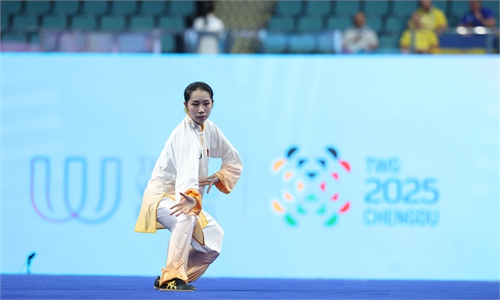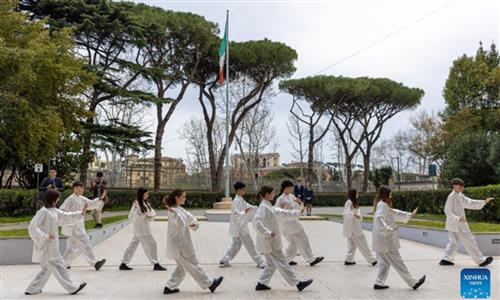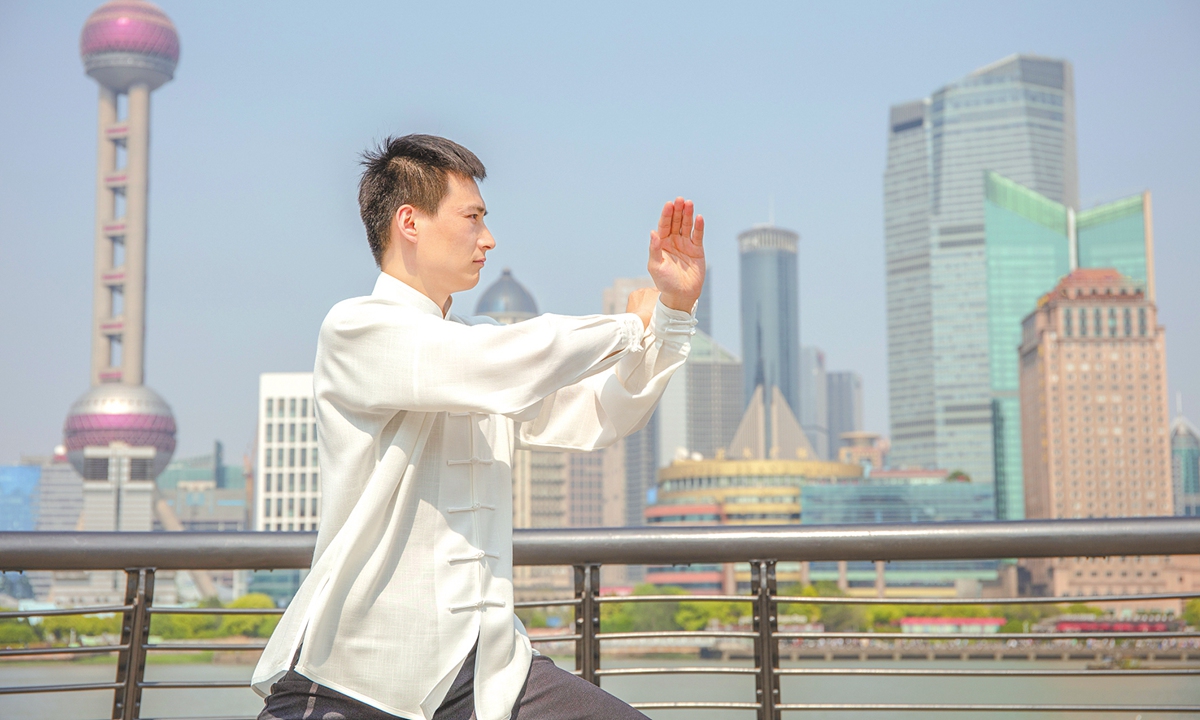
A man practices Taijiquan in Shanghai. Photos: VCG
With a gentle lift of the hands, a slow rise of the body and a steady bend of the knees, Taijiquan has been practiced for centuries by people of all ages and backgrounds. More than an exercise, it's a way of life - one that blends physical health with deep philosophical insight.Recognized by the United Nations Educational, Scientific and Cultural Organization (UNESCO) as an intangible cultural heritage of humanity in 2020, Taijiquan has reached more than 180 countries and regions.
Now, Taijiquan takes another graceful step onto the global stage. With UNESCO's approval of a resolution on November 5 designating March 21 as International , this centuries-old art form has a day of its own to be celebrated around the world.
The decision, made at the 43rd session of the UNESCO General Conference in Samarkand, Uzbekistan, marks the first time an international day has been named after a martial art within the UN system.
The move signifies the widespread global recognition of the important value of Taijiquan, a treasured traditional Chinese sport, and is a vivid example of the Global Civilization Initiative in action, Xinhua reported. Delegates said the establishment of International carries profound significance for improving human health, fostering cross-cultural understanding and promoting peace and sustainable development worldwide.
Jiang Jiding, director of the Taijiquan Special Committee of the China Intangible Cultural Heritage Safeguarding Association, told the Global Times on Thursday that the designation by the UN allows the Eastern philosophy of "overcoming strength with gentleness" and maintaining yin-yang balance to become a shared wisdom for humanity in coping with modern anxiety.
Balanced harmony
Tai Chi, or Taijiquan, is a centuries-old Chinese martial art characterized by slow, graceful movements paired with deep breathing and mindfulness.
Originating in ancient China and with almost 400 years of history, Taijiquan is deeply nourished by traditional Chinese philosophies and health-preservation concepts, such as the cycle of yin and yang, and the harmony between humanity and nature.
Through the coordination of movement, breathing and thought, Taijiquan embodies the interplay of motion and stillness, openness and closure, strength and gentleness, as well as real and feigned force, reflecting an ancient Chinese understanding of the universe and the human body.
Influenced by Taoist and Confucian philosophy and theories of traditional Chinese medicine, it has evolved into several schools over many centuries, including Chen, Yang, Wu and Sun styles, each carrying its own lineage and techniques.
Today, Taijiquan is a familiar sight in parks and public squares around the world and a celebrated part of international sporting events such as the World Games, World University Games, Asian Games and World Wushu Championships.
The choice of date is highly symbolic. March 21 marks around the time of the spring equinox, one of the 24 solar terms in the traditional Chinese calendar, when day and night are of equal length. This balance mirrors the principles of yin-yang balance and harmonious coexistence in Taijiquan.
The spring equinox, known as "Chunfen" in Chinese, marks the moment when the sun is exactly at the celestial equator. From this day on, temperatures are mild, and life gathers new energy, Xiao Fang, head of the Department of Anthropology and Folklore Studies at Beijing Normal University, told the Global Times.
"Choosing the spring equinox as International embodies the practice's core philosophy of balance, unity between humanity and nature, and the pursuit of harmony in body and mind," said Xiao Fang.
According to UNESCO, the new international day is expected to boost the popularization and international exchange of Taijiquan and promote its ideas of "balance between yin and yang," "pursuit of peace," "harmonious coexistence," "mutual respect," and "overcoming strength with gentleness," so as to foster exchanges and mutual learning among different civilizations and contribute to world peace.
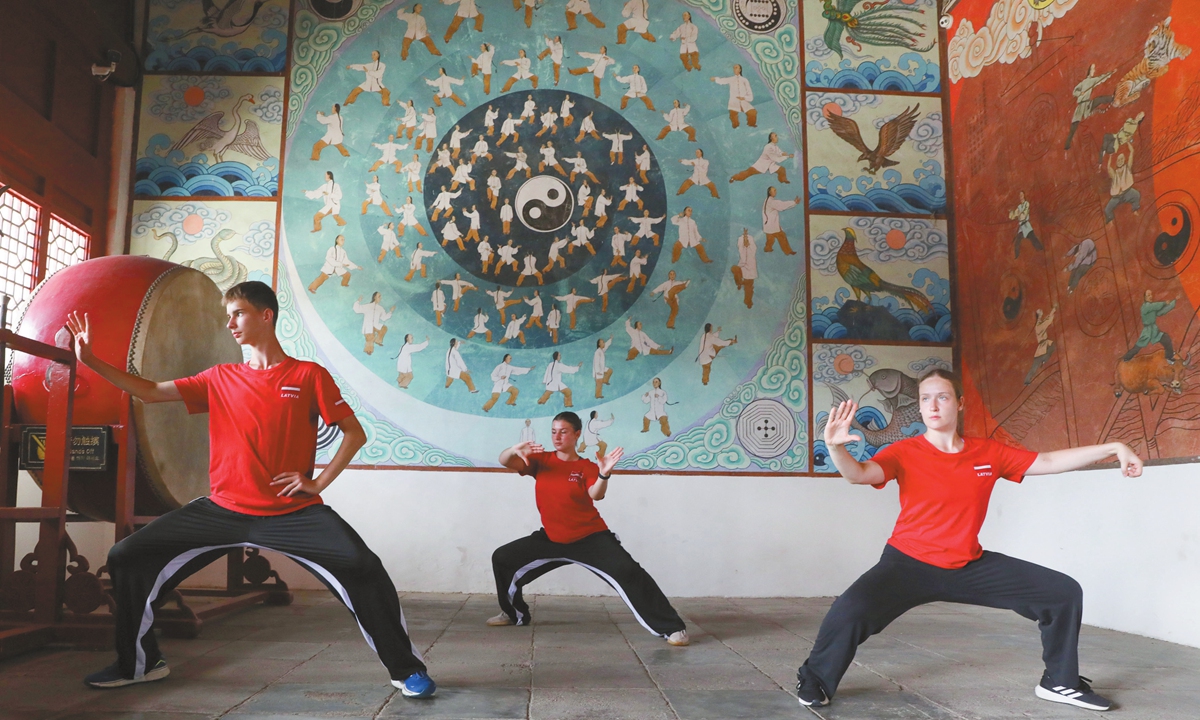
Latvian students practice Taijiquan at an Ancestral Temple for Taijiquan in Wen County, Central China's Henan Province, on August 16, 2025.
Global appealTaijiquan is not only a traditional form of physical exercise, but also an art of cultivating one's character and inner self, Jiang told the Global Times.
The committee has been promoting the "youthful, fashionable, digital, and international" development of Taijiquan, enabling this intangible heritage to transcend time and social boundaries. In doing so, it has evolved from an ancient cultural legacy into a source of spiritual nourishment and a bridge connecting traditional practice with modern life, Jiang said.
"Taking this opportunity, we should further advance the internationalization of Taijiquan, so it can serve as a bridge for dialogue between Chinese and foreign civilizations," Jiang added.
With Taijiquan spreading to millions of practitioners worldwide, the practice has sparked curiosity and dedication across diverse communities.
Li Shuangling, vice president of the Chen Bing Taiji Academy (CBTA), told the Global Times that many foreigners practice Taijiquan to ease physical discomfort or to explore aspects of Chinese culture.
"After sticking with the practice, they discover that it brings significant benefits to both their physical and mental well-being, which in turn inspires more people around them to learn Taijiquan," said Li, adding that the academy currently has over 100 branches across the world.
The establishment of International reflects this growing global enthusiasm, Zhang Shunli, president of the China Taijiquan Association, told the Global Times.
"Taijiquan is not only a physical exercise, but, more importantly, a practice for harmony and peaceful state of mind," noted Zhang.
RELATED ARTICLES