ARTS / CULTURE & LEISURE
Heritage, sea culture draw global visitors to Mazu’s island
Tides of faith
By in Putian Published: Nov 06, 2025 11:26 PM

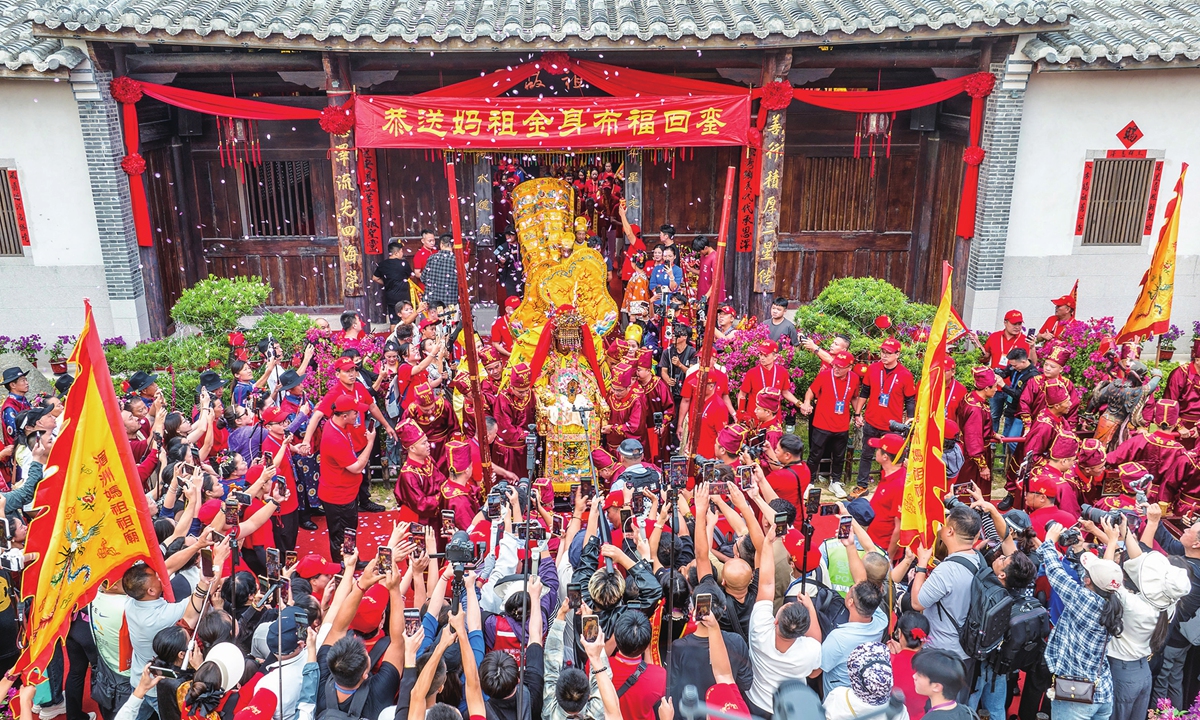
Mazu believers escort a golden statue of Mazu back to the palace for blessings on Meizhou Island, East China's Fujian Province, on October 31, 2025. Photo: VCG
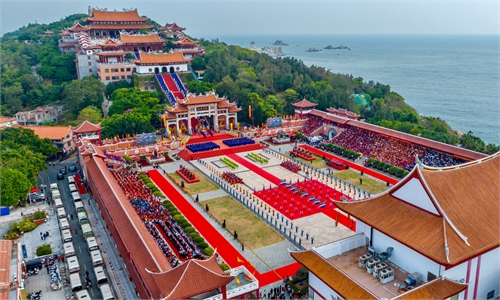
Stepping onto the wharf of Meizhou Island in Putian, East China's Fujian Province, travelers are greeted not only by the briny wind and the rhythmic sound of the tides, but also by the scent of incense wafting on the breeze. Following a steady stream of visitors - some in red vests, others bearing incense sticks and offerings, all speaking in a polyphony of regional accents - there is the island's spiritual heart: the Mazu ancestral temple, home to the revered goddess of the seas. Here, the age-old rituals, burning incense, and grand ceremonies have endowed this small island with a cultural depth that transcends borders.On October 31, the ceremony for the return of the Mazu statue to its ancestral temple was hosted on Meizhou Island, marking the pinnacle of a three-day celebration commemorating the 1,038th anniversary of Mazu's ascension and her ceremonial tour around the island.
In front of the stone stele inscribed with "Mazu Belief" and "World Intangible Cultural Heritage," a vibrant array of intangible heritage performances unfolded - powerful Yingge dances, lion and dragon dances, and a constant burst of fireworks - infusing the island with a festive atmosphere.
Among the crowd were Gitau Recheal Mugure from Kenya and a student from France whose Chinese name is Yuli, and both were there to witness the pageantry for the first time.
"It's astonishing!" Mugure told the Global Times, adding that the stories of Mazu's compassion and aid for those in crisis left a deep impression. To her, the culture of Mazu - though originating from China - crosses boundaries, "weaving people from all nations together."
A living legacy
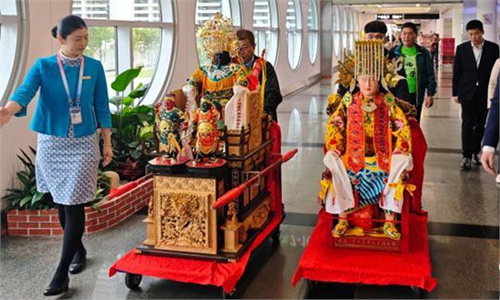
At the vanguard of the Mazu statue's tour, six majestic horses led the way, followed by teams from both sides of the Taiwan Straits. The ceremonial guards and honor escorts marched behind, while local Meizhou women in traditional Mazu attire and Hanfu flanked the golden effigy. The procession, joined by both official escorts and ordinary devotees, stretched for miles in a flowing display of devotion. According to local authorities, this year's tour featured 49 troupes and over 2,700 performers from both sides of the Straits, creating a dazzling spectacle of living folk culture.
As the ceremony unfolded, more locals and visitors joined the ever-growing procession. The performers welcomed their participation with open arms, so the line of celebrants grew ever longer, snaking through the streets of the island.
Han Qi, a tourist from Xi'an, Northwest China's Shaanxi Province, told the Global Times that the inclusiveness of the event and its openness to community participation embodied the true spirit of Mazu: great love, tolerance, and harmony.
According to legend, Mazu was born in the 10th century on Meizhou Island, where she dedicated her life to saving others before ultimately perishing in a shipwreck rescue.
The townspeople built a temple to honor her, and over the centuries, she has been venerated as a goddess whose compassion transcends time and sea.
After the tour, the crowds gathered in the square in front of Tianhou Palace to watch an energetic Yingge dance performance, a vivid traditional art form originating from the Chaoshan region of South China's Guangdong Province. Performers, adorned in striking costumes and vivid face paint, portrayed legendary figures.
Some wore golden flowers in their hair and brandished "green snakes," somersaulting energetically; others twirled staffs in dazzling arcs, their movements echoing with collective chants that reverberated through the audience. Children leapt in excitement, and adults clapped in rhythm, swept up in the power of this national-level intangible heritage.
On Meizhou Island, intangible cultural heritage flourishes everywhere the eye can see. Even outside festivals, the sight of women in distinctive Mazu attire - sailboat-shaped hair buns, sea-blue blouses, and red-black trousers - adds a splash of color to everyday life.
The tradition of making Mazu garments is itself an intangible heritage rooted in faith, encompassing design, fabric selection, cutting, stitching, embroidery, and edging.
Local artisans say that these garments emerge from daily labor and are refined through lived experience, blending harmoniously with the island's natural environment. For the women of Meizhou, Mazu attire is both a reflection and a celebration of life.
Today, visitors can immerse themselves in local culture by donning traditional Mazu costumes thus stepping, however briefly, into the rhythms of island life. At this year's Global Mazu Culture Forum that ended on Sunday, French student Yuli became the center of attention by arriving in full Mazu regalia, a living symbol of cultural fusion.
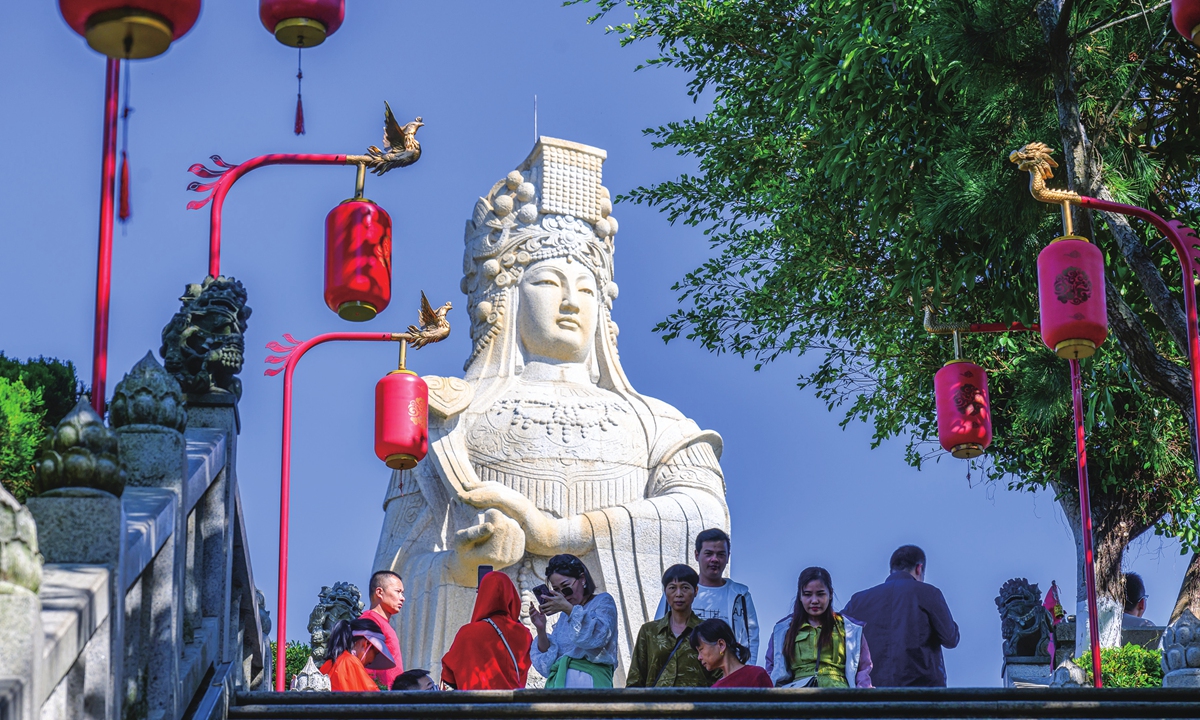
The statue of Mazu on Meizhou Island Photo: Courtesy of the organizing committee of the 10th Global Mazu Culture Forum
Echoes across the seasWithin the ancestral temple stands a stone lion adorned with a red silk flower; its pedestal reveals it was a gift from the island of Taiwan. Along the ascending path, stone tablets record the reverence for Mazu felt by people from both sides of the Taiwan Straits and indeed, from around the world.
Kenyan visitor Mugure told the Global Times that her hometown of Mombasa is also a port city by the sea. Experiencing Meizhou's vibrant maritime culture allowed her to understand more deeply how Mazu culture, rooted in a love of the sea, peace, and inclusiveness, resonates far beyond China. She hopes to bring the spirit of Mazu back to Mombasa, believing its values can blend with local maritime traditions and nourish both cultures.
In recent years, many travelers have come to Meizhou Island drawn by its coastal scenery as much as its spiritual heritage. Renting an electric scooter and heading toward the Goose Tail Marine-abrasion Geological Park, one passes golden beaches where receding tides expose fantastically eroded rocks and locals hunt for clams. At dawn, the soft sand is a stage for the sunrise, where abandoned fishing boats and sprays of wildflowers paint the shore in unexpected colors.
On Meizhou Island, the ancient and the new are forever entwined. Here, faith finds vivid expression in both rituals and in every aspect of daily life, connecting people across continents and generations, an enduring testament to the power of culture, compassion, and the sea.
RELATED ARTICLES