ARTS / CULTURE & LEISURE
Documentary ‘Dear Kuliang’ to debut, highlighting enduring bonds
By Published: Nov 09, 2025 10:55 PM

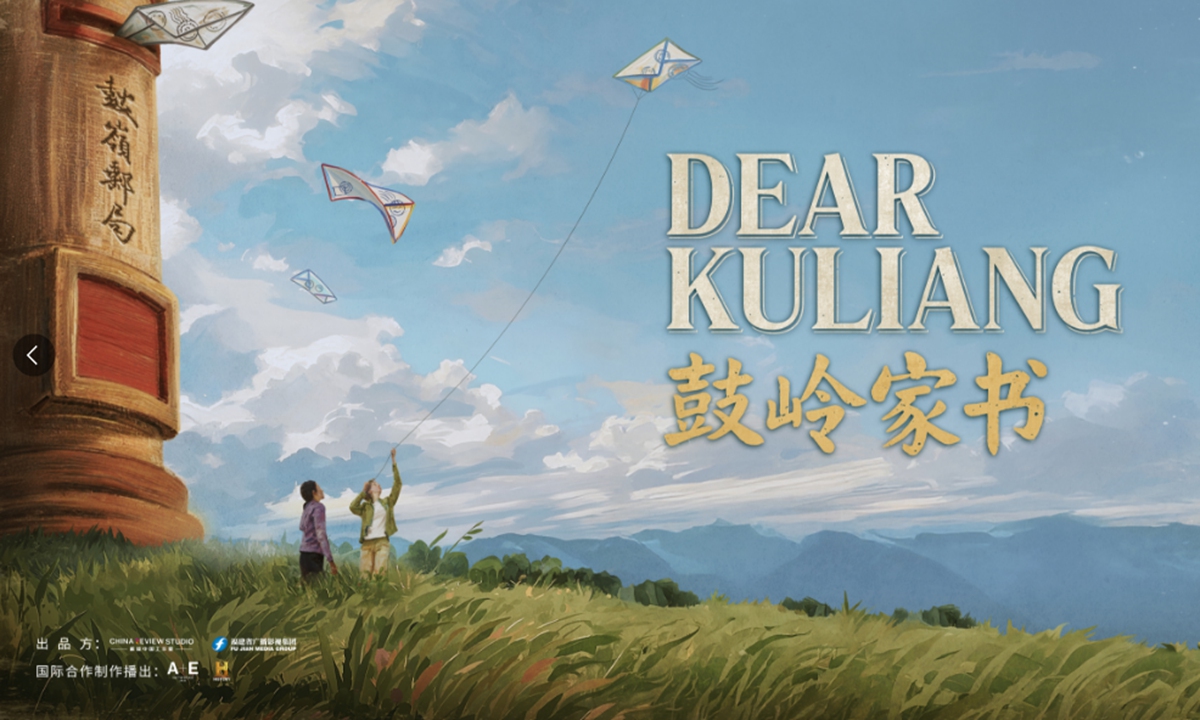
Promotional material for the documentary Dear Kuliang Photo: Courtesy of the producers, China International Communications Group and Fujian Media Group
China-US coproduced documentary Dear Kuliang is set to premiere on Chinese TV channel Southeast Television as well as streaming platforms on Monday, with a global release on major platforms including the History channel Asia, a TV channel in the US, in December.The announcement comes as the film made its premiere at Loyola Marymount University in Los Angeles on Friday, part of the 21st Chinese American Film Festival and the Chinese American Television Festival, which opened on Thursday, according to a press release that the organizer sent to the Global Times on Sunday.
The 50-minute documentary tells the story of Kuliang, a mountain retreat in East China's Fujian Province, from an international perspective. It follows Holly Bradsher, a US high-school student, as she traces the life footsteps of her ancestor, Dr Mary Carleton, and others in Kuliang.
Using a dual narrative structure weaving the past and the present, it portrays a century of people-to-people friendship between the two nations, the press release noted.
Director Liu Siyuan told the Global Times that after nearly two and a half years of preparation and production involving filming in multiple locations across both countries, the project aims to showcase the warmth and strength inherent in US-China civilian exchanges.
Liu explained the film's innovative approach in an interview. "We moved away from the conventional paradigm of elderly figures searching for their roots," Liu said. "Instead, we focused on a dialogue between younger generations and adopted a distinct female perspective."
The narrative spotlights the legacy of Carleton, who served as a medical missionary in Fujian for nearly 40 years, and her adopted daughter, Mary Singgieu Carleton, who became the first Chinese female Master's graduate from Columbia University and later protected students and staff during the War of Resistance against Japanese Aggression (1931-45).
Liu emphasized the deliberate choice of a young protagonist. "Holly represents the future. Her journey itself is an act of inheritance." The director also highlighted the extensive use of period-appropriate props and settings, and the innovative integration of a large-scale holographic projection to visually reconstruct Carleton's long-lost Kuliang home.
After shooting the documentary, Liu said this story demonstrates that the Kuliang spirit is not confined to history or one location, but existed in the past, continues today, and will extend into the future.
"We're now seeing similarly heartwarming stories of China-US civilian exchanges across many parts of China. If this documentary inspires more international friends to visit Kuliang after its release, that alone would be a meaningful achievement," she said.
Chinese youth Zhou Tianyi, who befriended Holly in the documentary, also shared her experience with the Global Times. "When we first met at the airport, we hugged spontaneously as if we had known each other for years," Zhou recalled. They immediately bonded, discussing everything from Netflix shows to mystery novels during the car ride to Kuliang, forming the emotional core of the modern narrative.
"For me, the Kuliang spirit is about understanding and respect as the foundation for friendship, peace, and love," Zhou added, reflecting on visiting the sites where Carleton worked.
At the Los Angeles screening, audience responses were overwhelmingly positive.
Eric Johnston, a US middle-school teacher and researcher on Kuliang culture, praised the film for preserving shared memories. Having led US students on cultural exchanges to Fujian for years, he said the Kuliang story is about sincere human connections beyond borders.
James Su, chairman of EDI Media Inc and organizer of the Chinese American Film Festival and the Chinese American Television Festival, expressed hope that the screening would help more people learn the stories about Kuliang and further enhance mutual understanding and friendship between the peoples of the two countries through increased film industry exchanges.
RELATED ARTICLES