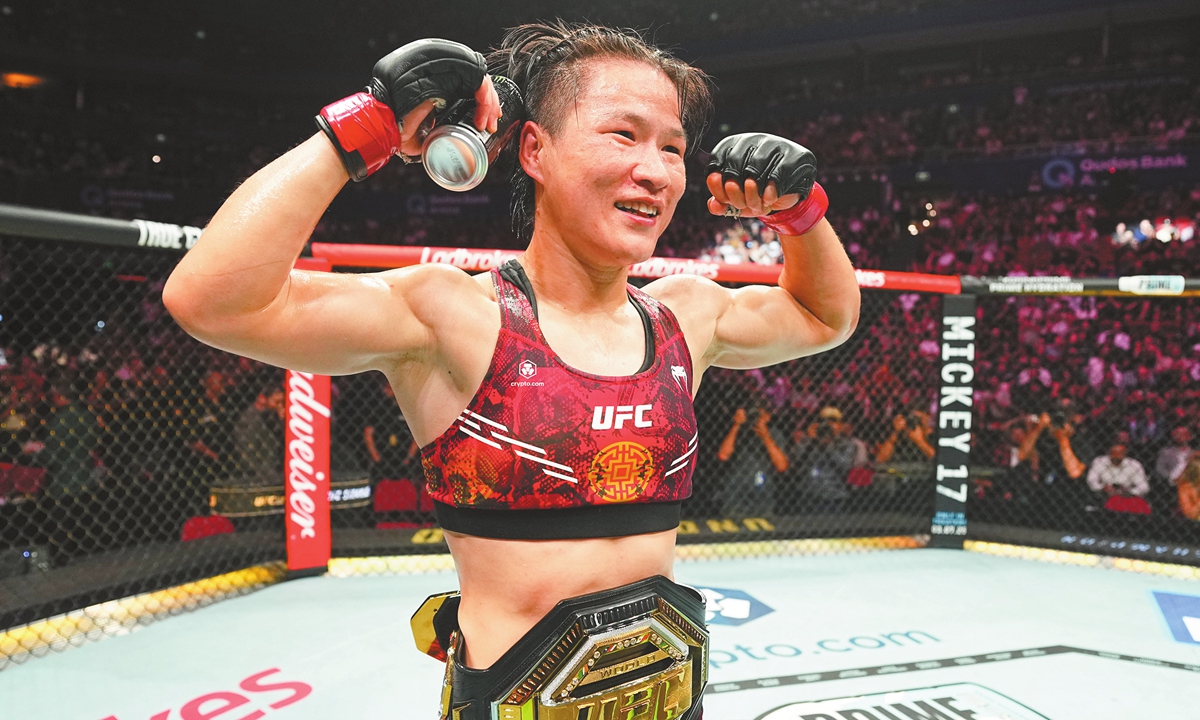
Zhang Weili reacts after a victory against Tatiana Suarez in the UFC strawweight championship fight during the UFC 312 event on February 09, 2025, in Sydney, Australia. Photo: VCG
For China's mixed martial artist Zhang Weili, remaining in her strawweight division in the UFC is far from satisfying, as the 36-year-old fighter has elevated herself to challenge the flyweight world champion.
Zhang faces Kyrgyzstani-born UFC flyweight champion Valentina Shevchenko at an UFC event in New York on Saturday, marking the first time a Chinese fighter has ever competed for titles in two divisions.
Since regaining the strawweight belt in November 2022, Zhang has defended it three times - against Amanda Lemos, Yan Xiaonan, and Tatiana Suarez - cementing her place among the sport's elite. But for Zhang, domination in one division was not enough.
"In this division the opponents are all very strong," Zhang told the Global Times in an exclusive interview.
"No matter if it's strength, speed, tactics, or technique, you have to improve in every aspect. In MMA, you can't have any weaknesses. If you have one, it can be dangerous, so I must upgrade myself completely."
Natural evolution
Zhang's move up to flyweight didn't happen overnight.
She told the Global Times that she has long wanted to challenge herself against bigger, stronger opponents.
"Ever since I became UFC champion in 2019, I wanted to move up a weight class," she said. "I've always aimed to test myself against the best. From my beginning days of fighting to now, my goal has never changed."
Her decision to leave behind the strawweight belt, a title she's guarded with fierce pride, was met with mixed reactions online. Some fans even called her move a gamble, a description Zhang disputes.
"I don't think it's a gamble," she told the Global Times. "This fight happened naturally, step by step. Everything just flowed."
The phrasing is apt. Zhang often describes her fighting philosophy with a quote inspired by Bruce Lee: "Be water."
"During a fight, you can't set everything in advance - how many punches or kicks you'll throw," she explained. "You respond to what your opponent gives you. Now I focus more on letting my skills connect naturally, letting everything flow like water."
Zhang's opponent Shevchenko is widely regarded as one of the greatest female fighters in UFC history.
A former Muay Thai world champion, Shevchenko dominated the flyweight division for years with precise striking, masterful distance control, and a nearly impenetrable defense.
"Valentina is very experienced," Zhang said. "Her sense of distance and rhythm control is exceptional."
Shevchenko's resume includes victories over elite names like Joanna Jędrzejczyk and Jessica Andrade, both of whom Zhang has also faced.
A win in New York would make Zhang the first Asian woman to hold UFC championships in two divisions, a distinction held by only a handful of fighters in history, including legends like Conor McGregor.
The pain of growth
Preparing to move up a division meant more than adding muscle. It required Zhang to retain her body and mind.
"The hardest part of preparation is staying focused all the time," Zhang told the Global Times. "Before, when I worked on conditioning or strength, I'd feel exhausted or in pain. But now I've learned to adjust my mindset. I don't see training as suffering anymore."
For Zhang, this new phase of her career is as much about inner peace as physical power.
"Every day I focus on training, fixing small technical issues, and getting better. I feel happy and really enjoy the process," she told the Global Times.
Zhang's ascent mirrors the steady growth of MMA in China. Her story has inspired countless young athletes, especially women, to take up combat sports once considered too brutal or niche.
"Through our efforts, I hope the world can see the spirit of Chinese athletes," Zhang said. "It's a new beginning, one that can give many athletes and people in the industry more strength and confidence."
Indeed, even if she falls short against Shevchenko, Zhang's legacy in MMA is already assured.
"No matter what happens," she said, "this fight is a wonderful beginning. Everything has meaning if you can learn from it and grow."
Zhang's impact in MMA has transcended the UFC Octagon. She has become far beyond a sports figure in China, but also a symbol of perseverance and female strength.
Zhang says she never fixates on records or labels.
"I don't think too much about being a popular figure," she said. "I just believe people shouldn't limit themselves, whether they're male or female, young or old. "Human potential is limitless. If I had set limits for myself, I wouldn't have won a UFC title, moved up to a new division, or tried acting. If you never try, you'll never know what you can do."
Recently, Zhang made an appearance in a domestic movie called The Next Typhoon. A documentary titled Endless is set to premiere on the same day as her fight in New York.
"Acting in a movie let me experience another kind of life," she said. "It was really interesting. Whether it's fighting, training or acting, you need total focus. That kind of concentration makes me happy."
Her ability crossover between sports and popular culture echoes her broader philosophy that growth comes from embracing new experiences, even the uncomfortable ones.
"No matter whether it's fighting, acting, or everyday life, you have to keep growing," Zhang said. "You must constantly make yourself better and become the person you want to be."
RELATED ARTICLES