ARTS / CULTURE & LEISURE
National Games mascots let people ‘celebrate together,’ says lead designer
Creative journey continuation from Beijing 2022
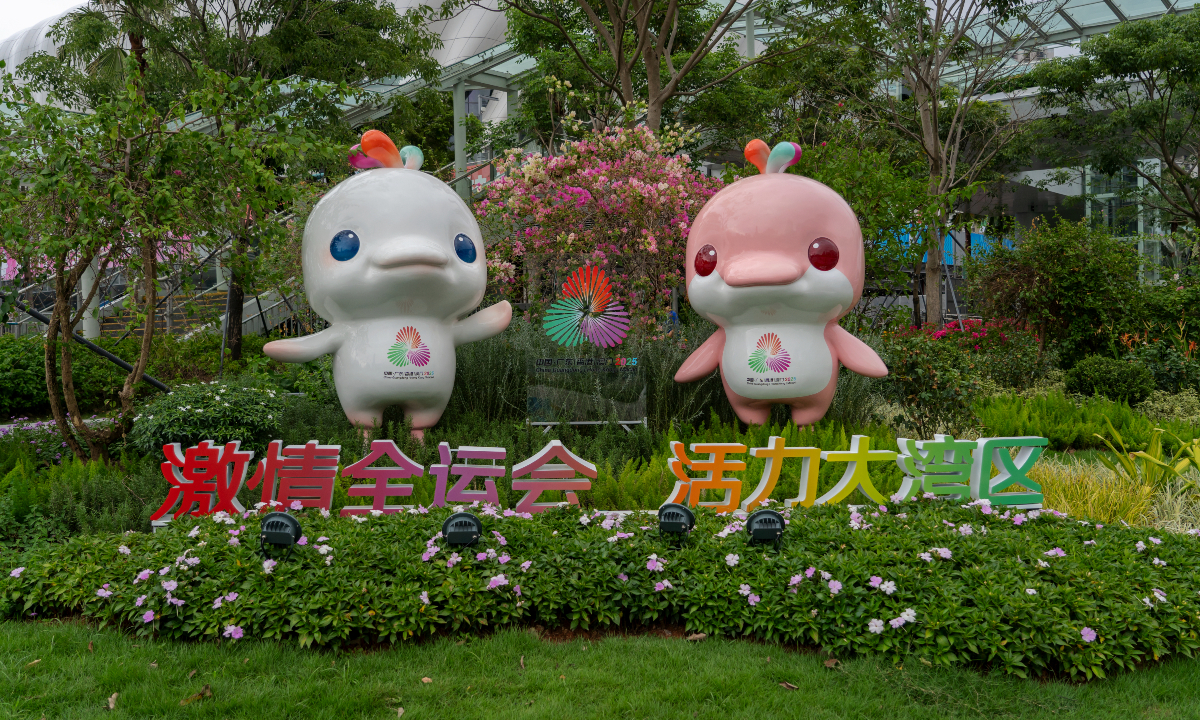
A display featuring mascots of China's 15th National Games debuted in front of the Shenzhen Sports Center in Guangdong Province. Photo: IC
Liu Pingyun, the lead designer who also participated in the design of the Beijing 2022 Winter Olympics mascot "Bing Dwen Dwen," told the Global Times on Wednesday that he welcomed the good-natured jokes and fan-made creations, saying they align with his original design goal: to create mascots that would allow people to "celebrate together."
The two mascots' rounded shapes, bright colors and adorable appearance have also sparked jokes online, with netizens humorously comparing them to some of Guangdong's famous local dishes. On platforms like Xiaohongshu, users are flooding comment sections with memes and emojis.
According to Liu, the design team aimed to make the mascots lovable to attract more people to notice the Games. As their popularity grows, the mascots have drawn even greater attention to the Games and the Great Bay Area (GBA), clearly demonstrating the value they bring.
Behind the playful surface lies thoughtful symbolism. "Xiyangyang" and "Lerongrong" are inspired by the Chinese white dolphin, a nationally protected wildlife species.
"The Chinese white dolphin carries the name 'China,' and it returns to the Pearl River Delta every year to breed," Liu explained. "It represents love for one's homeland and the spirit of belonging."
The dolphin's social and cooperative nature, he said, mirrors the teamwork and resilience of athletes competing at the Games. The choice also reflects the "green" philosophy of the event's organizers, who have emphasized sustainability and environmental protection throughout the planning and operations of the Games.
Liu told the Global Times that in large-scale events, mascots are usually designed without a set personality or gender. This time, "Xiyangyang" and "Lerongrong" come as a pair, one white, one pink, leaving ample room for public imagination.
For example, the pink coloration of "Lerongrong" reflects the natural flushing of the Chinese white dolphin's skin during activity. This detail is reflected in the design of sports assignments, with strength-based events being associated with the pink mascot, while skill-based events are paired with the white one.
He also noted that the playful movements of the performers bring the mascots to life, giving them a sense of personality and amplifying their impact. "They serve as an important bridge and channel," Liu said. "Every link in the chain of exposure enriches the mascots' character, making them more vivid and memorable to the audience."
Some netizens have commented on the mascots' three water spouts, calling them "adorable to the point of sprouting!" The design mimics the playful spray of dolphins leaping from the sea while subtly incorporating the symbolic colors of the three host regions. The color red represents Guangdong, drawing inspiration from the kapok - the official city flower of Guangzhou. Hong Kong is epitomized by purple, connected to the bauhinia, while Macao is symbolized by green, tied to the lotus.
For Liu and his team, the mascot design had to meet three principles: relevance, locality, and modernity. "Relevance means it must reflect the character of the Games themselves," Liu said. "Locality means capturing the spirit of the Greater Bay Area, since the Games are co-hosted by Guangdong, Hong Kong, and Macao. And modernity means that no matter how you look for an element, the key is to make it enjoyable and appealing to the public - that's what truly matters."
The organizing committee reports that over 2,800 officially licensed products have been released, ranging from keychains and zodiac blind boxes to lion dance charms. More than 700 retail stores are selling mascot merchandise, including 600 in Guangdong Province alone.
Online sales have been equally explosive. Many listings on e-commerce platforms show "sold out" signs, and social media posts show some fans queuing at physical stores to grab limited-edition items.
For Liu, the success of "Xiyangyang" and "Lerongrong" feels like a continuation of a creative journey that began with "Bing Dwen Dwen," the panda mascot that became a global phenomenon during the 2022 Winter Olympics. "Bing Dwen Dwen" opened a door. It showed that China can create world-class cultural IPs that resonate both domestically and internationally, said Liu.
Since then, China's cultural and entertainment industries have seen a surge in original characters, from Labubu to Nezha, that combine strong design with emotional storytelling. The 15th National Games mascots, Liu said, are another example of the trend.
"This is a good moment for China's cultural and creative industries," he said. "But with opportunity comes responsibility. We designers have to think carefully about how to sustain this momentum - how to make these characters not just viral, but enduring and more valuable."
RELATED ARTICLES