ARTS / CULTURE & LEISURE
Mobile esports: from trend to mainstream
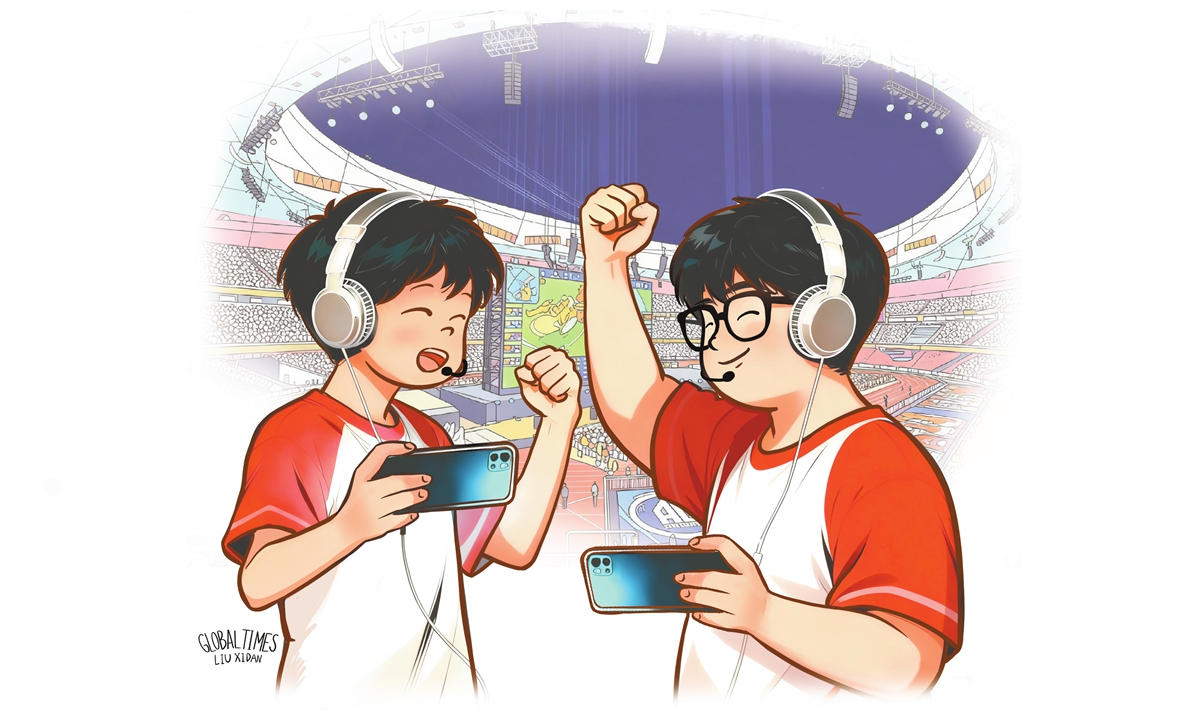
Illustration: Liu Xidan/GT
The mobile game Honor of Kings' King Pro League (KPL) Grand Final - recently held at the National Stadium, also known as the Bird's Nest - turned an early winter night in Beijing into a heated spectacle. As the first mobile esports event ever hosted at the iconic venue, it drew 62,196 spectators, setting a new Guinness World Record for the largest live audience at a single esports event. The tournament quickly topped Chinese social media Sina Weibo's trending searches, and related discussions continued to gain momentum online.Today, mobile esports have evolved beyond a reliance on single-source advertising or traffic-driven models, establishing a richer, multi-layered value system that combines entertainment, social engagement, and commercial potential.
They have reached the pinnacle of traditional sports stages in an unprecedented way, reshaping how the public views this youth-driven digital culture, and highlighting the growing influence of young audiences on today's entertainment landscape.
According to KPL organizers, tickets sold out in two batches, within just 15 and 12 seconds, respectively. "More than 85 percent of ticket holders came from outside Beijing, with some traveling all the way from Malaysia and Australia," said Huang Cheng, chairman of the KPL Alliance.
The mobile esports craze has translated into urban vitality, creating a positive interaction between digital culture and real-world consumption. Beijing's Chaoyang district set up multiple secondary viewing sites in major commercial areas for the KPL grand finale. At Beichenhui Mall alone, foot traffic reached 35,000 on the day of the finals - an increase of nearly 60 percent year-on-year - generating a significant boost in local sales.
The surge of mobile esports is not a phenomenon that has just emerged this year. Data shows that by the end of 2024, China's esports user base had surpassed 490 million, with 68.5 percent under the age of 30. The mobile esports sector alone has reached a market size of approximately 139.9 billion yuan ($19.6 billion). With the further expansion of 5G networks, mobile esports is expected to benefit from improved connectivity and enhanced gaming experiences.
HRH Prince Faisal bin Bandar bin Sultan Al Saud, president of the Saudi Esports Federation (SEF) and the Arab Esports Federation, told the Global Times that more than half of the global esports market now comes from mobile platforms.
"This is not just a trend; it is becoming mainstream," he said. "The widespread availability of mobile phones allows almost anyone to access the world of esports."
"When you see 60,000 people in a single arena watching a mobile esports final, with tickets selling out in just seconds, it shows that mobile esports hasn't merely arrived - it has already become one of the most important components of the esports landscape," he noted.
According to Faisal, China and India are global pioneers in this field. He warned that without a strategic presence in mobile esports, one risks missing a significant portion of the global esports market.
Faisal's observations are closely reflected in the reality of China's esports development. Mobile esports has risen so rapidly not only because of its low barrier to entry and anytime-play convenience, but also because of its strong social attributes, allowing young people to connect virtual competition with real-life interaction.
Whether it is fans at the Bird's Nest chanting "Assemble!" or players creating and sharing event videos on Sina Weibo and Bilibili, they are all finding a sense of group identity through esports. Young people use it to form communities, express their passion, and tightly link their consumption behavior with emotional identification.
"It's more than just a game; it's where we meet friends, share excitement, and feel like we belong to something bigger," a 19-year-old mobile gamer based in Beijing told the Global Times, capturing both the social and emotional dimensions of the phenomenon.
This collective emotional resonance allows young people to experience a sense of "being present" between virtual competition and real-world gatherings.
Of course, behind the craze, concerns about "addiction" and "over-entertainment" have also emerged. Some adolescents, while immersed in virtual competition, may neglect their studies or offline social interactions; the commercial orientation of certain events has also sparked debates over whether the "spirit of sports" is being diluted.
Industry insiders note that helping young people strike a balance between enthusiasm and rationality is a challenge the esports industry must confront on its path to maturity.
From the dazzling lights of the Bird's Nest to the buzz on social media, mobile esports is reshaping how a generation of young people expresses culture. It is both a product of technological advancement and cultural innovation, and an outlet for emotional belonging and social interaction. Faced with this wave sweeping the Generation Z, our task is not to simply praise or caution, but to consider how the energy ignited by passion can truly become a driving force for upgrading the cultural industry and fostering growth among young people.
The author is a reporter with the Global Times. life@globaltimes.com.cn
RELATED ARTICLES