A strategic choice: the Cotarella family in Guangzhou
Wine producer bets on China


Brothers Riccardo (right) and Renzo Cotarella Photos: Courtesy of MF/Milano Finanza
For decades, the Chinese wine scene has been a duopoly: on one side, the established elegance of French Premiers Crus; on the other, the commercial power of the Australians. For quality Italian wine, entry has always been a challenge, having to navigate established consumption habits and the looming shadow of historical competitors.The competitive balance has recently been redefined. Despite market data still showing strong French influence and fierce competition, Italy is consolidating its share, aiming to capture the growing demand for premium wines.
In this evolving scenario, the Cotarella family - boasting a six-decade history that has shaped the terroir between Umbria, Lazio, and Tuscany, and creator of icons like Montiano - has meticulously orchestrated its entry. The company, now led by the third generation (Dominga, Marta, and Enrica), has decided that its status as a top producer must be tested in the world's most complex market, armed with scientific rigor and respect for tradition.
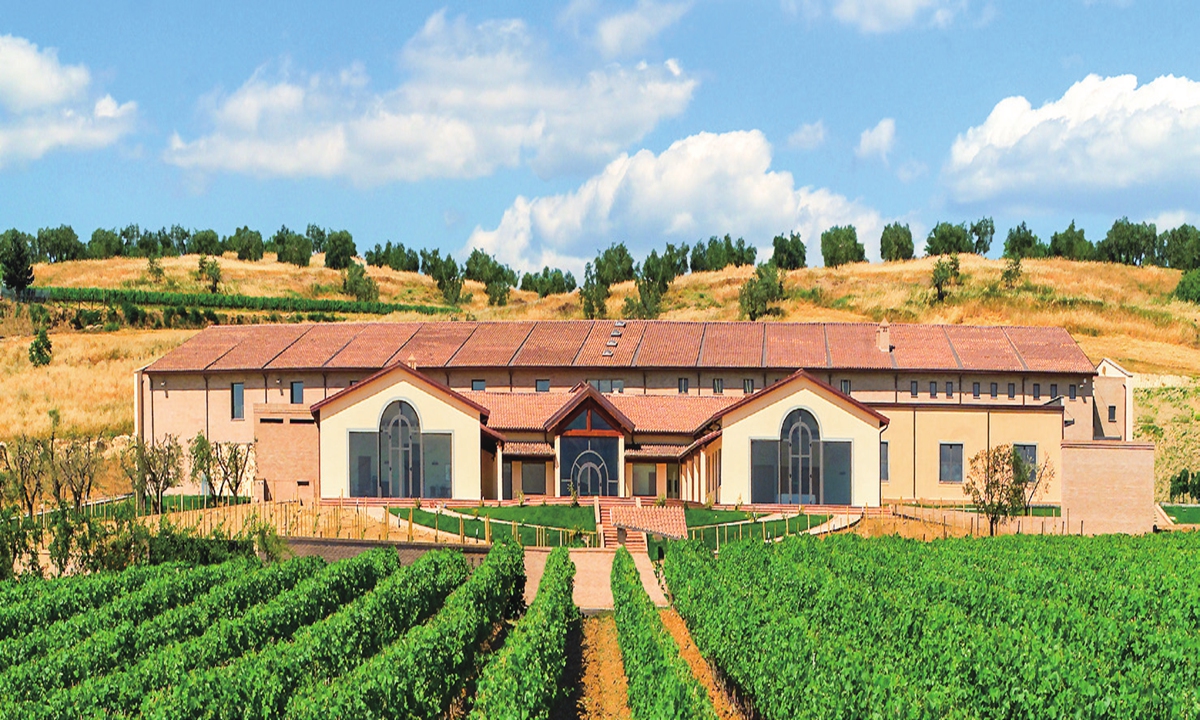
The headquarters of the winery in Montecchio, in the province of Terni (Umbria), in central Italy
Montiano at the heartFor the Cotarella family, Asia is no longer a distant horizon but a strategic priority. "The Cotarella family's experience in China does not reflect the entire market, but it is a specific model that works for us," explains Andrea Leone, head of international sales.
"We have been steadily entering since 2020-2021, and China has quickly become one of our most important foreign markets after America and Japan, especially for our Montiano."
The approach has been facilitated by a key importer, almost a "friend," based in Guangzhou, South China's Guangdong Province, a megacity of eight million inhabitants. This choice is not random: the importer comes from the large Chinese community in Prato, a fundamental cultural and commercial bridge.
This deep understanding of the Chinese commercial fabric reveals a crucial tactical strategy centered on the B2R (Buy-to-Restaurant) model. "The key is to try to develop the restaurant sector," observes Leone. The peculiarity is that "on average, the Chinese do not buy wine at restaurants; they buy it at wine shops and have it delivered." Consequently, restaurants maintain essential wine lists, effectively delegating selection to the customer, who, with their bottle from home or the wine shop, bypasses the traditional channel.
The push of Brunello, the Northern route
With more than a billion people, China is a market that "is of interest simply due to its large numbers," and the investment is tangible. However, in a context of fierce global competition - seeing the rise of excellent producers from South Africa to New Zealand, and even unexpected English sparkling wines - the real battle in China is not fought on volumes but on quality and margin.
The Cotarella family has responded to this challenge with a strategic maneuver: the acquisition of the Siena-based company Le Macioche, with production strictly limited to 20,000 bottles of Brunello di Montalcino. Since Brunello production is constrained and strictly limited, the business strategy can only be vertical. "The only lever for growth, in terms of value, is the progressive increase in price," reveals Leone.
The investment has entirely benefited quality, with a completely renovated winery inaugurated with the 2022 harvest. The goal is crystal clear: to elevate the image of Brunello and confer upon it a status that justifies a premium price internationally, focusing entirely on margin.
In terms of geographical penetration, the company is now looking to the North. Although Chinese logistics are "almost frightening" and comparable to "Amazon Prime" in efficiency, the current importer does not yet consistently cover the North, meaning cities like Beijing.
The immediate future may see the Cotarella family seeking regional partners to develop these areas, demonstrating that, while wine is global, the art of distribution in China remains an extremely local and strategic affair, notwithstanding hyper-efficient technology.
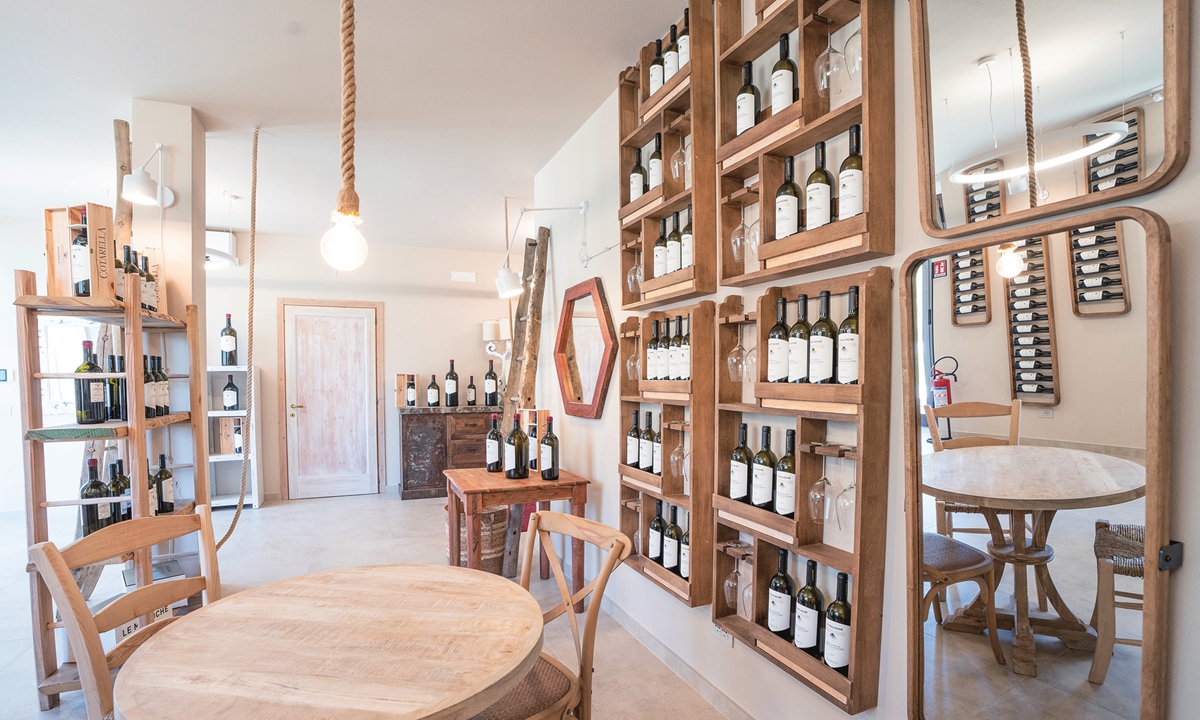
One of the showrooms of the winery in Montecchio
A family signatureCotarella is a young yet historic brand, backed by decades of experience and tradition in the wine industry. A brand that encompasses the best of production and all the skills developed and acquired over the years.
The company was founded in 1979 in Montefiascone by brothers Riccardo and Renzo Cotarella: two winemakers deeply rooted in this land straddling Lazio and Umbria, who over the years have held important positions in the wine sector, receiving significant recognition. Riccardo Cotarella, president and winemaker of Falesco, is currently the president and director of Riccardo Cotarella Winemaking Consultancy, a professor of Viticulture and Oenology at the Viterbo University, a consultant for over 80 wineries in Italy and around the world, president of Assoenologi Italia, Union Internationale des OEnologues, and was the president of the Scientific Committee for the setup of the Wine Pavilion - A Taste of Italy at EXPO Milan 2015.
One of the company's primary objectives has been to recover the ancient grape varieties of the area. Over the centuries, the territory had enjoyed a reputation for producing extraordinary wines, exclusive to papal tables and ancient nobility, but for countless decades, it had been in a concerning state of neglect. Thus began long years of research and selection aimed at isolating ancient clones, now considered extinct, and delicate micro-varieties, of unparalleled aromatic and organoleptic value, which had almost completely disappeared from the specialized vineyards of the 1960s.
RELATED ARTICLES