ARTS / CULTURE & LEISURE
Youthful energy takes center stage at China's premiere film awards
By Published: Nov 16, 2025 09:01 PM
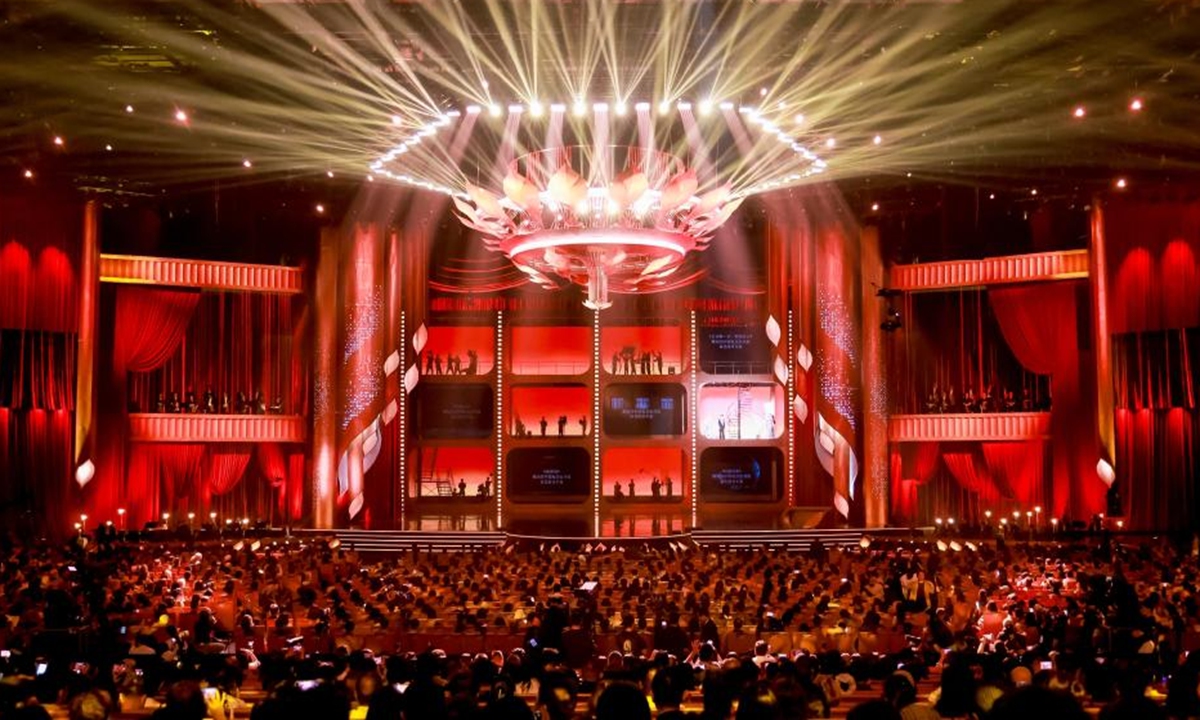
This photo taken on Nov. 15, 2025 shows the awarding ceremony of the 38th Golden Rooster Awards in Xiamen, east China's Fujian Province. Photo: Courtesy of Xinhua News Agency
If the Chinese film industry were a grand stage, then the China Golden Rooster and Hundred Flowers Film Festival would be the spotlight that illuminates its brightest talents. This year, the festival, which concluded on Saturday, shone upon a group of youthful filmmakers and actors.Nowhere was this generational shift more apparent than in the sphere of acting. Twenty-four-year-old Jackson Yee's win as the youngest best actor in history of the Golden Rooster Awards for Big World was a signal event. His portrayal of a young man living with cerebral palsy was not only a technical tour de force, but also a deeply moving, nuanced performance that invited empathy and understanding from audiences and critics alike.
Yet Yee's triumph was not an isolated phenomenon. Other young talents, such as 20-something actor Liu Haoran and actress Duan Aojuan, garnered nominations with their own skillful, layered performances.
Their ability to embody complex roles with subtlety and authenticity reflects a maturing ethos among young Chinese actors - one that values preparation, emotional intelligence, and a willingness to challenge themselves on screen.
Meanwhile, this creative momentum extends well beyond the screen.
This year's festival highlighted a surge of bold, diverse storytelling from young directors determined to expand the narrative possibilities of Chinese cinema.
Gao Peng's narrative film A Long Shot - recipient of the best directorial debut award - demonstrates a clarity of vision and narrative control rarely found in first-time filmmakers. Dargye Tenzin's Dog Tashi, a sensitive exploration of a Tibetan boy's journey to adulthood, was nominated. These directors, along with many of their peers, are not simply following established patterns; they are actively questioning and reinventing them.
Their willingness to embrace more diverse topics, experiment with style, and take creative risks is breathing new life into national cinema and providing audiences with a richer, more varied palette of cinematic experiences.
"Many of the major awards were won by filmmakers born in the 1980s, 1990s, and even 2000s - a key reason why this year's Golden Rooster Awards have been called 'youthful.' The remarkable presence of young talent among winners of these mainstream honors also signals that a generational shift among Chinese filmmakers is accelerating," Shi Wenxue, a veteran film critic based in Beijing, told the Global Times.
Director Gao, whose award-winning film had reaped a major reward at the 36th Tokyo International Film Festival with its visual presentation, told the Global Times that he has noticed the new generation of Chinese film directors are growing more skilled and showing increasingly diverse creative styles.
More talents who can give consideration to both artistic expression and commercial factors have come to the forefront.
They increasingly focused on discovering their unique styles, infusing their work with personal perspectives, even within the established frameworks of various film genres.
Another emerging trend is the cultivation of multi-skilled, cross-disciplinary talent among these younger generations. Today's young filmmakers and actors are no longer content with single-track careers.
It is increasingly common for actors or actresses to double as producers or directors to write their own scripts, or even juggle several roles within a single project.
This "multi-hyphenate" ethos injects dynamism and originality into the creative process.
When a director understands the nuances of acting, or when an actor brings a producer's eye to a project, new perspectives emerge - often resulting in works that are more cohesive and innovative.
The impact of these trends is already visible in the kind of work being produced. Films and performances highlighted at the festival were marked by a palpable sense of urgency and freshness. Young filmmakers are not only telling new stories, but also telling familiar stories in new ways - using their unique perspectives and hybrid skills to challenge conventions and expand the aesthetic vocabulary of Chinese cinema. This dynamism has not only captured the attention of critics and audiences, but is also pushing the industry as a whole to adapt, innovate, and raise standards, according to Shi.
RELATED ARTICLES