ARTS / CULTURE & LEISURE
National Games opens new chapter in cross-boundary cooperation
Without a hitch
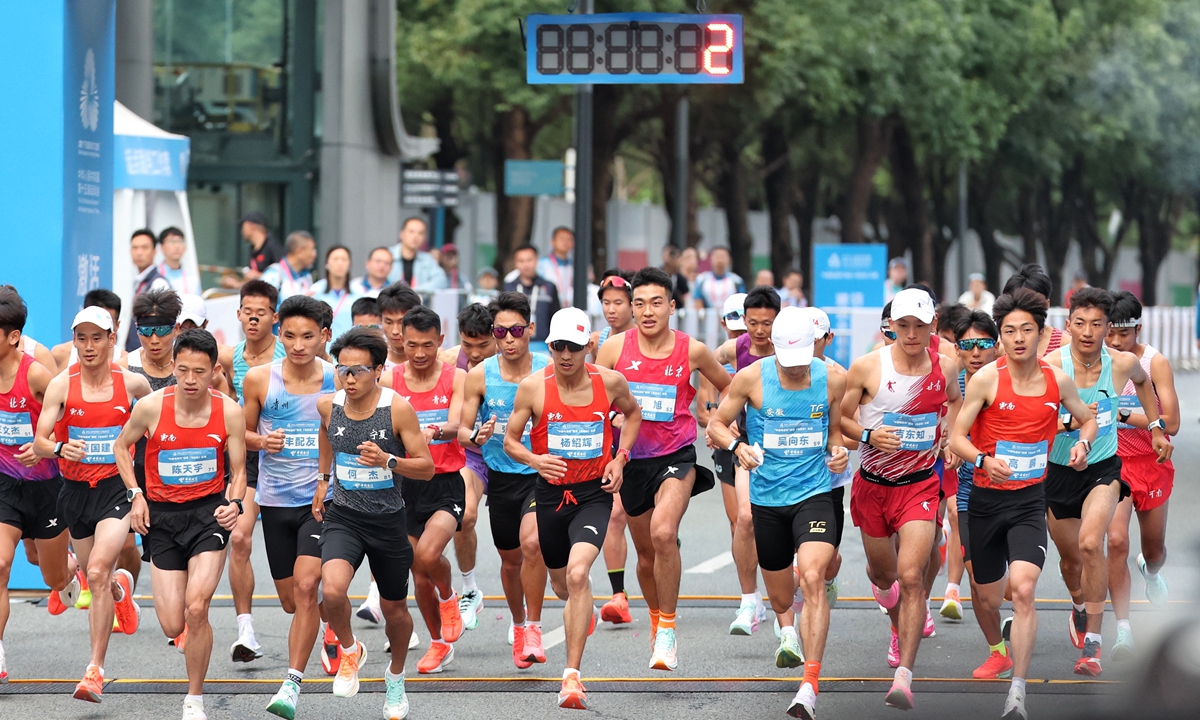
The men's marathon of China's National Games kicks off on November 15, 2025. Photo: VCG
Thanks to technological tools and regional cooperation, the first cross-boundary marathon in the 66-year history of China's National Games concluded without a hitch on Saturday.As one of two cross-boundary events at the ongoing National Games held in South China's Guangdong-Hong Kong-Macao Greater Bay Area, the marathon featured facial recognition technology and smart wrist bands for runners, enabling "zero delay, zero contact, zero waiting" customs clearance for personnel, vehicles, and materials to ensure smooth operations.
The other event that completed in seamless fashion was the men's individual road cycling race, during which 103 athletes raced through border checkpoints in the Guangdong-Hong Kong-Macao Greater Bay Area six times without hitting the brakes.
Yeung Tak-keung, head of the National Games Hong Kong coordination office, told the Global Times that the Games' cross-regional model of cooperation not only ensured that the event was staged smoothly, but also enhanced the region's overall capacity to host major events, laying a solid foundation for future collaboration.
Totaling 231.8 kilometers, the men's individual road cycling race was the first ever cross-boundary competition in the National Games' 66-year history. It was also the first cycling race held on the Hong Kong-Zhuhai-Macao Bridge.
Centering on the iconic bridge, the race route passed a string of distinctive landmarks, including Zhuhai Lovers' Road, the Guangdong-Macao In-Depth Cooperation Zone in Hengqin, Hong Kong Disneyland Resort, and the Macao Bridge. This allowed both riders and spectators to fully experience the diverse charm of the Greater Bay Area.
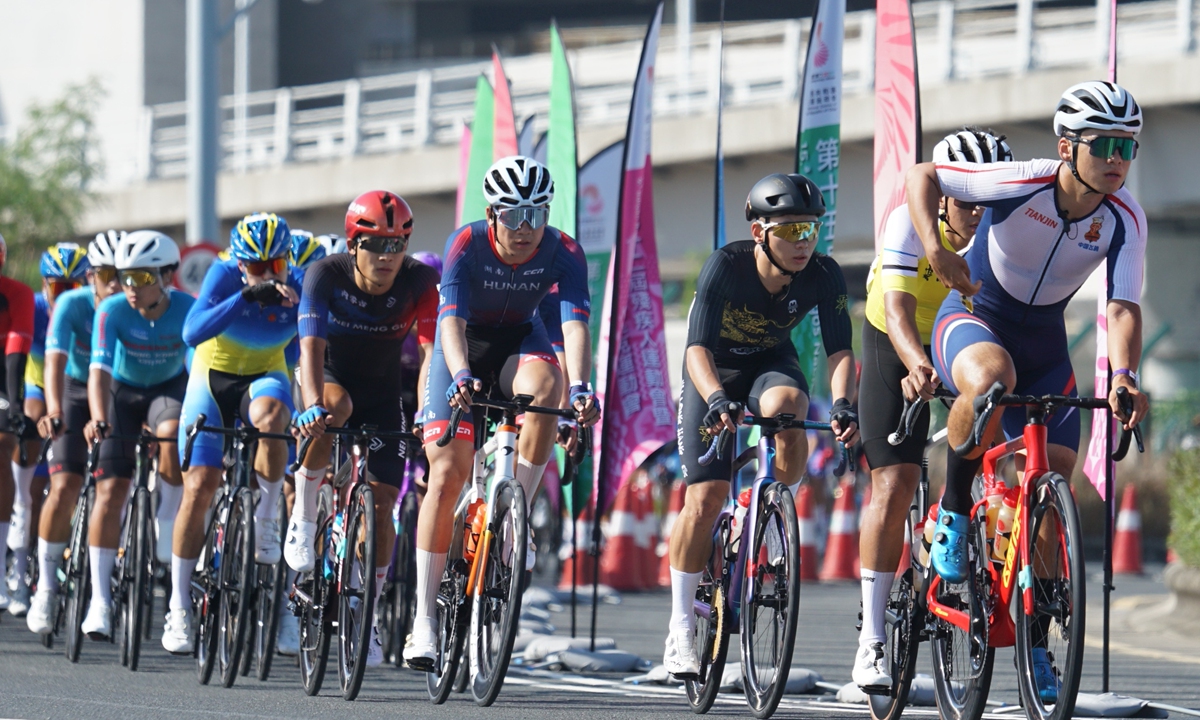
The men's individual road cycling race of the National Games kicks off on November 8, 2025. Photo: VCG
Meticulous coordinationBy hosting this edition of the National Games, the regions in the Greater Bay Area are building closer sports cooperation, breaking through regional boundaries, and carrying out resource sharing and complementing strengths. These efforts are sure to help attract more major sports events to the Greater Bay Area and promote the development of sports in the region, Yeung said.
Min Yuntong, executive deputy director of the National Games Zhuhai Committee, told the Zhujiang Evening News that the cycling race showcased a new model for hosting integrated events across the three regions. It also enabled the smooth flow and seamless alignment of key elements such as mechanisms, technology, materials, and information among the three regions, offering valuable insights for the further development of the Greater Bay Area.
The coordination work for the cycling race route began two years ago, while a test event was held in 2024.
During the race, participants needed to pass through border checkpoints six times. Ensuring the clearance of athletes proceeded smoothly not only relied on technological support but also placed a higher demand on cooperation between the three regions, according to Min.
Organizers adopted a coordination and technology framework that included Radio-Frequency Identification (RFID) systems and China's BeiDou Navigation Satellite System to track rider location and direction in real time.
As the cyclists sped through the checkpoints, technologies such as pre-installed RFID devices at the boundary lines, along with BeiDou satellite positioning, worked together with pre-filed information and real-time sensing data for back-end verification, ensuring fast, smooth, and accurate border clearance.
Because the event involved Guangdong, Hong Kong, and Macao, every detail had to be jointly planned and closely coordinated by the three local governments. Throughout the preparation phase, the three sides maintained constant communication, which included inspecting the cross-border race route, Yeung noted.
On matters such as road closures, temporary control measures at border checkpoints, closed-loop management during the event, escort arrangements along the route, seamless border crossing, and preventing support vehicles or athletes from straying off the course, the governments of the three regions carried out extensive and meticulous coordination, said Yeung.
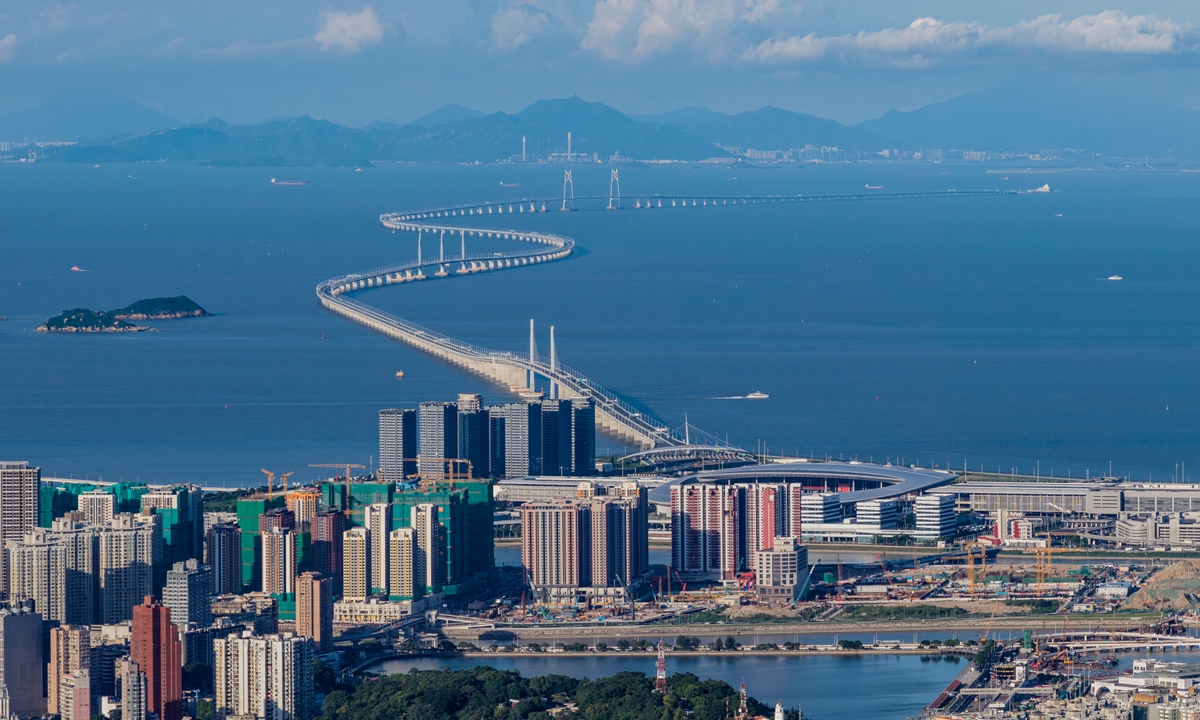
The Hong Kong-Zhuhai-Macao Bridge in Zhuhai, South China's Guangdong Province Photo: VCG
Strong bondsLiu Zhicheng from East China's Shandong Province, who won gold in the race, told reporters that he was excited to be able to ride across the cross-sea bridge, while during border crossings "I could feel the enthusiasm of the people from Macao and Hong Kong."
Silver medalist Xue Chaohua told reporters that this was his first time cycling in Hong Kong and Macao. He noted it was nice to experience the charm of the Greater Bay Area and that he didn't encounter any obstacles or difficulties at all while crossing regional borders.
The marathon event, with the Shenzhen section and Hong Kong section each covering about half of the total distance, also acted like as a strong bond, closely connecting the cities in the Guangdong-Hong Kong-Macao Greater Bay Area.
Huang Zhao, an official with the Shenzhen Bay Inspection Station, Shenzhen General Station of Exit and Entry Frontier Inspection, said that the biometric technologies extensively used in the marathon event are also applied in daily border crossings.
For example, Shenzhen Bay port was the first to implement facial-recognition clearance, which has now been promoted at other ports in Shenzhen. According to Huang, the inspection station will summarize the experience from this event and replicate it in more cross-border sports events to help advance deeper integration of the Greater Bay Area.
A new facial-recognition exit-entry clearance system was launched in November at Hengqin Port in Guangdong, which connects Macao and Guangdong's Zhuhai. The new system allows travelers to clear customs without presenting their physical identification documents. This represents the deep cooperation between the Chinese mainland and Macao under the "one country, two systems" model, according to authorities.
In 2024, the number of Mainland Travel Permits for Hong Kong and Macao Residents and Mainland Travel Permits for Taiwan Residents reached 2.578 million, according to a report by the National Immigration Administration in January.
RELATED ARTICLES