ARTS / CULTURE & LEISURE
National Games swimming competitions end
Teenage sensations win big
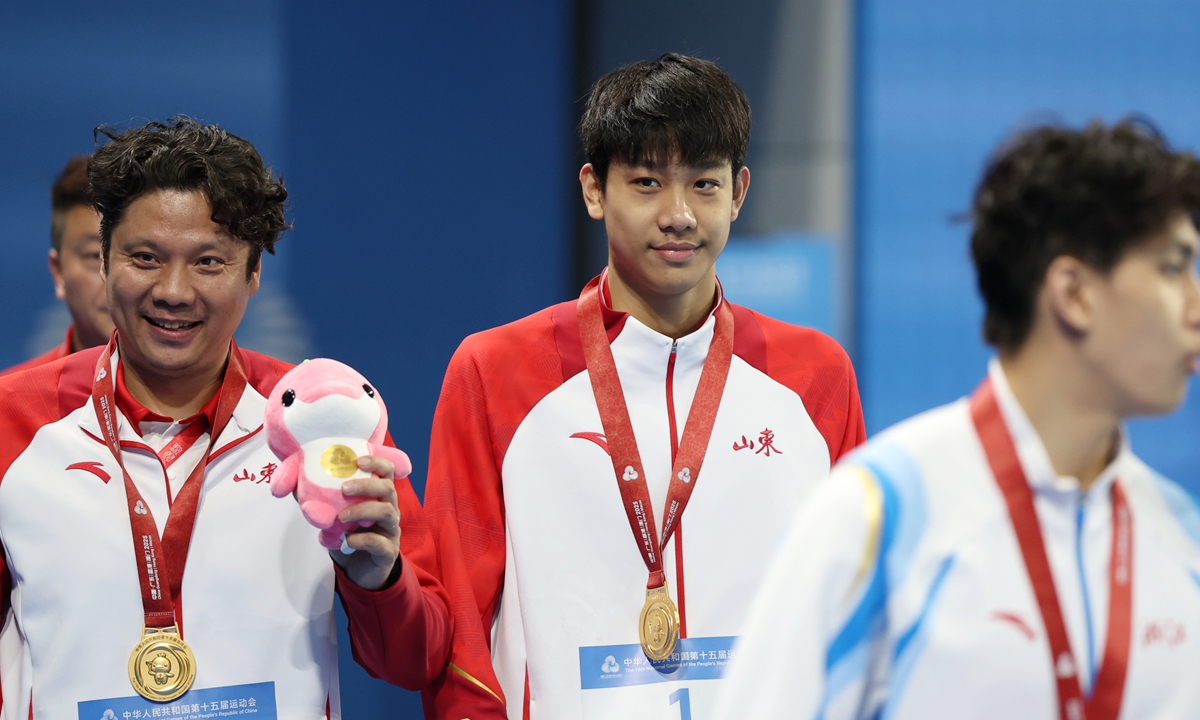
Zhang zhanshuo (center) walks off the podium with his coach (left) after winning the men's 1,500 meters freestyle on November 17, 2025 in Shenzhen, South China's Guangdong Province. Photo: Cui Meng/GT
A wave of teenage talent swept through the National Games on Monday, with young athletes breaking records and toppling established champions as the swimming competition came to a close.In Shenzhen, South China's Guangdong Province, the most prominent emerging names came from teenage sensations Zhang Zhanshuo of the Shandong team and Yu Zidi of team Hebei.
Zhang, 18, asserted dominance in the middle- and long-distance freestyle events. Among his haul of five gold medals, four golds came from individual freestyle races.
What's more surprising is that he won the medals by shattering national junior records in the 200-, 400- and 800m freestyle events.
Much younger than Zhang, female swimmer Yu, now only 13, made her stunning debut at the National Games by competing in 10 events. She defeated defending champion Yu Yiting of the Zhejiang team in the 200m individual medley by setting a new Asian record, and outpaced Olympic gold medalist Zhang Yufei in the 200m butterfly as well as winning a 400m individual medley gold medal on Monday night.
Other young swimmers also stole the spotlight: 15-year-old Lyu Qinyao of the Jiangsu team upset veteran Olympic medalist Tang Qianting in the 200m breaststroke, while 14-year-old Zhang Xinyu contributed to a come-from-behind gold in the women's 4x100m freestyle relay for the Shandong team.
Athletes from Hong Kong and Macao also delivered standout performances at their "home race."
Hong Kong's Ho Yentou claimed the gold in the 50m freestyle, beating Olympic 100m champion Pan Zhanle with 21.71 seconds, becoming the first male swimmer from Hong Kong to win a gold medal at the Games.
Macao's Ng Chi-hin also broke the Macao record twice in the 50m butterfly, marking a historic milestone for Macao swimming.
Hong Kong swimming star Siobhan Haughey, a two-time Olympic silver medalist, bagged two bronze medals on Monday as she competed in the 50m breaststroke and 50m freestyle in less than five minutes.
Reflecting on her first National Games, where she totaled four medals, including two gold medals, she said the atmosphere was great.
"The atmosphere was fantastic and truly memorable," Haughey told reporters in Cantonese on Monday.
The 27-year-old was, however, modest about her medal haul.
"I didn't come thinking about medals; I just wanted to perform my best. Now, having won four medals, I'm very happy," Haughey said.
""This reflects not only my own performance but also the collective effort of the Hong Kong team in recent years," she said.
Zhejiang's veteran and Olympic backstroke medalist Xu Jiayu won the men's 50m backstroke on Monday, while also dominating in the backstroke discipline in the 50-, 100- and 200m events.
Speaking on the challenges of maintaining a high level of performance at both the national and international level, Xu said there's still room for improvement.
"Technically, there are areas that require adjustments, and these changes take time," Xu told reporters. "The current results may not be particularly high in a global context, so we must keep pushing forward."
Beyond the pool, the National Games track events in Guangzhou also witnessed the rise of young sprinters on Monday.
Li Zeyang of the Hubei team outperformed others by winning in 10.11 seconds, followed by Wang Shengjie of team Shandong and Zeng Keli of the Guangxi team.
The current Asian record is 9.83 seconds and was set by veteran sprinter Su Bingtian at the Tokyo Olympics in 2021. Su did not participate in the individual sprint at the Games.
All the men's 100 meters finalists were born after 2000. Veteran Xie Zhenye of the Zhejiang team, a formerly world championship silver relay medalist for China, did not make it into the men's final.
In the women's sprint, 16-year-old Chen Yujie clocked at 11.10 seconds to win the gold medal, setting a new Asian junior record.
The win makes her the youngest women's 100 meters winner in National Games history.
RELATED ARTICLES