‘Winter sweetness’ flies halfway across the Earth
‘Air Silk Road’ boosts transport of high-value, time-sensitive fresh agricultural produce to China

Customers select fresh cherries at a supermarket in Southwest China's Chongqing Municipality on November 8, 2025. Photo: VCG
An aircraft carrying 88.75 tons of Chilean cherries landed at Shanghai Pudong International Airport on Tuesday night after an approximately 24-hour flight. This delivery set a new record for the fastest transportation of Chilean cherries to China.
The all-cargo aircraft CK292 is operated by China Eastern Airlines, and the arrival also marks the launch of its chartered flight delivery service program in the new cherry season.
The air operator told the Global Times on Wednesday that so far, more than 1,100 tons of in-season cherries have been shipped from Chile to a number of Chinese cities including Ezhou, Central China's Hubei Province, Shanghai, Shenzhen, South China's Guangdong Province, as well as Ningbo, East China's Zhejiang Province.
On November 7, the first charter flight carrying 100 tons of Chilean cherries landed at Ezhou Huahu International Airport. The flight, operated by Ethiopian Airlines, departed from Santiago, the capital of Chile, with a stopover in Addis Ababa, Ethiopia. The transportation took nearly 25 hours and covered a distance of 21,000 kilometers, according to a statement the Ethiopian Airlines sent to the Global Times on Wednesday.
After passing customs inspection, the cherries were quickly transported via cold-chain logistics - not only to meet the consumer demand in Hubei, but also to be rapidly distributed to other cities such as Beijing, Shanghai and Guangzhou. The entire process, from touchdown to retail distribution, can take as little as two hours.
The air delivery of Chilean cherries epitomizes how the "Air Silk Road" has been enhancing the transportation of high-value, time-sensitive fresh agricultural produce into the Chinese market, tapping a market home to 400 million middle-income consumers, analysts said.
They also expect the continuous expansion of the airborne network under China-proposed Belt and Road Initiative (BRI) will further shorten the process, supplying more high-quality imports to the Chinese table at lower costs, while bringing substantial benefits to BRI partner countries.
'Winter sweetness'
"Great achievements can be achieved by combining Chile's unique agricultural advantages with China's world-class logistics, innovation and consumer dynamism," Chilean Ambassador to China Pablo Arriarán was quoted as saying in the statement sent by the Ethiopian Airlines. He also expressed his hope to continuously deepen bilateral cooperation so that more Chinese consumers can enjoy healthy, fresh and safe Chilean agricultural products.
"The launch of this dedicated route will surely deepen economic and trade ties between the two countries and inject strong momentum into the China-Chile cooperative plan for jointly building the BRI," Ethiopian Airlines said. It also highlighted the popularity of Chilean cherries in China, saying they "are of superior quality due to the country's unique geography and climate, with plump fruit, vibrant color, and a sweet, refreshing taste that makes them known as the 'diamond among fruits.'"
The strengthened logistic connectivity lays bare the important role of South-South cooperation in promoting the optimal allocation of global resources, the carrier said.
Chile is the first Latin American country to sign a free trade agreement with China, and it also signed the memorandum of understanding on the joint construction of the BRI in 2018, Xinhua News Agency reported. Currently, China is Chile's largest global trading partner, top export destination and primary source of imports, while Chile ranks as China's third-largest trading partner in Latin America and its leading supplier of imported copper, according to media reports.
To strengthen and expand this vibrant cooperation in the economic and trade sector, China Eastern Airlines said it will roll out more diversified logistics solutions such as "sea-air intermodal transport," "whole-aircraft air-to-air transshipment" and transshipment via European hubs. The carrier intends to integrates Southeast Asia and other markets into the global distribution network of Chilean fresh produce, with the goal of turning the "winter sweetness" that travel halfway around the world into a seasonal treat for more families worldwide.
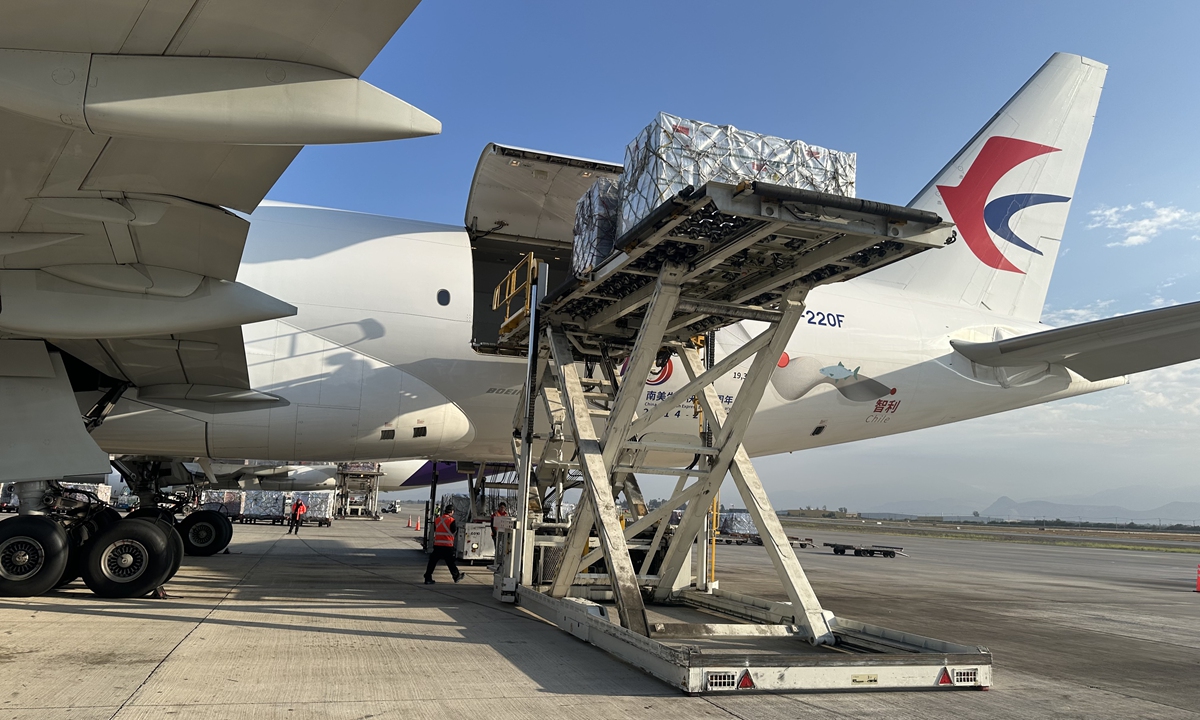
Workers load cherries onto an aircraft operated by Chinese carrier China Eastern Airlines on November 16, 2025. Photo: Courtesy of China Eastern Airlines
Overarching transportation network
With the build-up of an "Air Silk Road" over the past few years, the connectivity and business links among BRI partner countries have been enhanced significantly.
In a latest step to boost aviation cooperation under BRI, the Zhengzhou Xinzheng International Airport and the Kuala Lumpur International Airport signed an agreement to launch "twin hub" initiative in September, Xinhua reported. It is part of a broader effort to strengthen close aviation logistics cooperation between the two airports and remains committed to realizing the common vision of a seamlessly connected "Air Silk Road" between China and ASEAN.
Malaysian Minister of Transport Anthony Loke was quoted as saying in the report that Malaysia is China's second-largest trading partner in ASEAN and its largest source of imports. Through the "twin hub" cooperation model, air cargo transport between the two countries will be further expanded, achieving mutually beneficial and win-win outcomes.
According to the Construction and Development of the "Air Silk Road" report jointly issued by the National Development and Reform Commission, China's top economic planner, as well as the Civil Aviation Administration of China in August, the "Air Silk Road" now connects 100 cities in 65 BRI partner countries. And the construction of four world-class airport clusters and 10 international aviation hubs is also accelerating.
In the first half of the year, China and BRI partner countries operated a total of 168,000 flights, transported 23.044 million passengers and carried 718,000 tons of cargo and mail - representing a growth of 15.3 percent, 9.8 percent and 180.7 percent, respectively, compared with 2019, the report showed.
The aviation authority also vowed that in developing the "Air Silk Road," China will adhere to the principle of coordinated efficiency, actively strengthen multilateral and bilateral cooperation, promote the effective alignment of civil aviation development strategies across countries and regions with the global development agenda, "encourage more countries and enterprises to participate deeply, and enlarge the pie of shared interests."
Observers also pointed out that the build-up of the "Air Silk Road" will not only foster closer economic and trade ties as well as strengthen industrial cooperation, but also strengthen "soft connectivity" such as cultural, and people-to-people exchanges.
RELATED ARTICLES