Poisoning China-Japan relations will only make Japan reap the bitter fruit: People's Daily 'Zhong Sheng' commentary
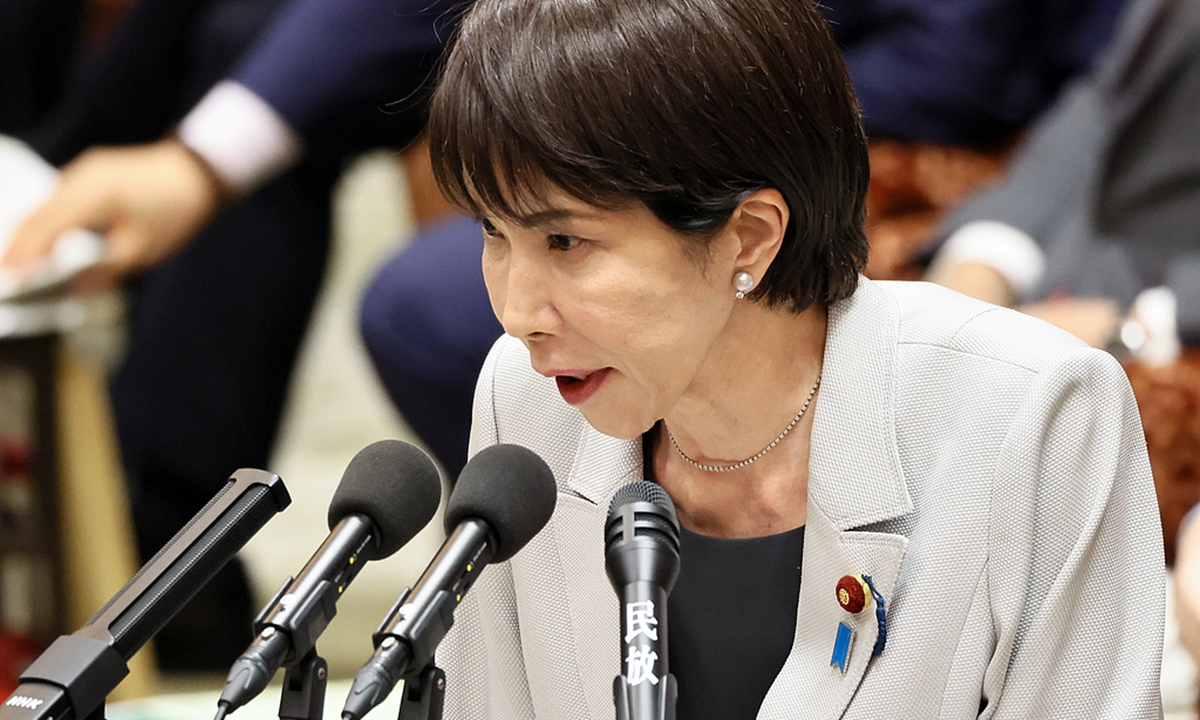
Japanese Prime Minister Sanae Takaichi attends the House of Representatives Budget Committee and responds to questions at the Diet building in Tokyo on November 10, 2025. Photo: VCG
No country would tolerate crude interference by foreign leaders in its internal affairs, nor would any accept threats by foreign leaders to use force against it.Japanese Prime Minister Sanae Takaichi has openly touted the possibility of military intervention in the Taiwan Straits, grossly interfering in China's internal affairs. She has shown no remorse and refused to retract her erroneous remarks. Such actions have seriously violated the one-China principle and the spirit of the four political documents between China and Japan, gravely undermined the political foundation of China-Japan relations and severely hurt the feelings of the Chinese people. Certain Japanese politicians have gone so far to allege that China has "overreacted" to Takaichi's wrong remarks on Taiwan. This is nothing but a distortion and smearing of China's justified and reasonable response.
The Taiwan question bears directly on the very foundation of mutual trust between China and Japan. In the 1972 Sino-Japanese Joint Statement, signed when the two countries normalized diplomatic relations, the Japanese government made it clear that it "fully understands and respects" the stand of the Chinese government that Taiwan is an inalienable part of the territory of the People's Republic of China, and that it will adhere to Article 8 of the Potsdam Proclamation.
In 1978, the two countries concluded the Treaty of Peace and Friendship, which affirmed the principles and contents of the Joint Statement in legal terms.
The third and fourth political documents between China and Japan, issued in 1998 and 2008, both reaffirmed adherence to the position on the Taiwan question set out in the 1972 Joint Statement. On the Taiwan question and other major issues of principle, the four political documents between China and Japan contain clear provisions. They constitute the political and legal foundations of China-Japan relations, and are the fundamental guidelines that must be faithfully followed in handling bilateral ties.
They constitute the solemn commitment made by the Japanese government and have legal effect under international law. There is no room whatsoever for ambiguity or misinterpretation. Whichever political party or person is in power in Japan, they must always abide by the commitment of the Japanese government on the Taiwan question.
Takaichi's erroneous remarks on Taiwan run counter to the spirit of the four political documents and strike at the very foundation of China-Japan relations. As the leader of a country, she should have displayed at least a basic sense of political responsibility and worked with China to promote the sound and steady development of bilateral ties. However, shortly after pledging that on the Taiwan question, Japan will adhere to the position set out in the 1972 Japan-China Joint Statement, she came out with the false argument that a so-called "Taiwan contingency" could constitute a "survival-threatening situation" under which Japan may exercise the right of collective self-defense. This has seriously poisoned China-Japan relations. Such deliberate provocations lay bare dangerous strategic intentions and pose a grave threat to peace in the Taiwan Straits and to regional security and stability.
No country would tolerate crude interference by foreign leaders in its internal affairs, nor would any accept threats by foreign leaders to use force against it. The "poison" that Takaichi has injected into China-Japan relations must be cleared up by herself. The only correct choice for the Japanese side is to stop crossing the line and playing with fire, to retract its wrongful words and deeds, and to truly honor its commitments to China through concrete actions, in a way that is responsible to history and bilateral relations.
The sound and stable development of China-Japan relations serves the interests of the Japanese people, while undermining bilateral ties runs counter to the trend of the times and is unpopular. In recent days, the extremely erroneous and dangerous moves of the Takaichi administration have triggered widespread criticism from people of insight in Japan. Takakage Fujita, Secretary-General of the Association for Inheriting and Propagating the Murayama Statement, pointed out that Takaichi's remarks violate international law and seriously damage relations between Japan and China. An editorial by the Tokyo Shimbun denounced her comments as "careless and reckless," stressing that such remarks "cannot be allowed to speak lightly based on assumptions or impulse" when made by a sitting prime minister. Some Japanese netizens have openly said that Takaichi "lacks basic diplomatic common sense" and called on her to withdraw her erroneous statements; some citizens have even organized rallies to protest her irresponsible provocations. Japanese politicians should listen carefully to these rational voices, rather than continuing down a wrong path.
On major matter of principle, the Chinese people are never ambiguous. The Taiwan question is at the very core of China's core interests. Anyone who dares to touch this red line will face firm opposition from more than 1.4 billion Chinese people and from the entire Chinese nation. This year marks the 80th anniversary of the victory of the Chinese People's War of Resistance Against Japanese Aggression and the World Anti-Fascist War, as well as the 80th anniversary of Taiwan's return to China. As a country that once launched a war of aggression and committed heinous crimes in Taiwan, Japan should draw serious lessons from history and handle Taiwan-related issues with greater prudence. If the Japanese side risks universal condemnation and ties itself to the chariot of forces seeking to split China, it will only end up reaping the bitter fruit of its own making.
RELATED ARTICLES