ARTS / CULTURE & LEISURE
Bridging distances through language of light, shadow with shared passion
Narrating the world in Spanish way
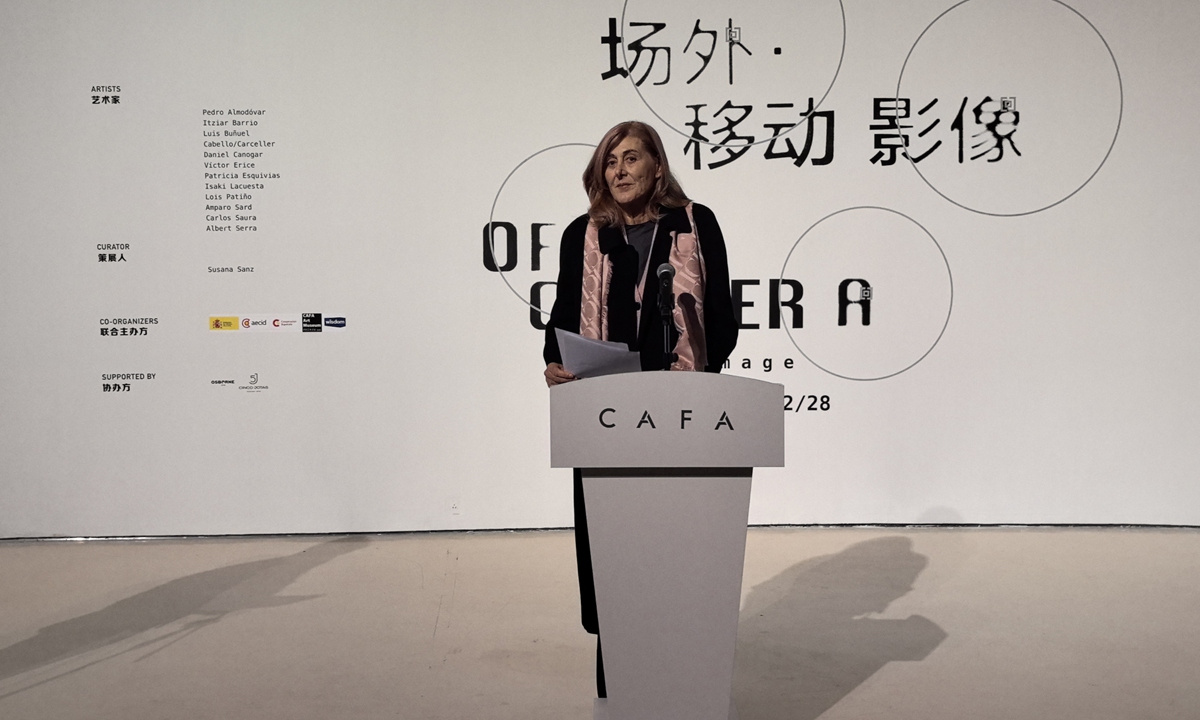
Marta Betanzos, Spanish Ambassador to China gives opening remarks at the exhibition in Beijing on November 14, 2025. Photo: Dong Feng/GT
The Embassy of Spain in China and the Central Academy of Fine Arts (CAFA) Art Museum jointly inaugurated Off-camera: Moving Images in Beijing on November 14. Marta Betanzos, Spanish Ambassador to China, said that the works showcased at the exhibition experiment, question and seek new ways of narrating the world.
Ambassador Betanzos said the featured works are proposals that connect deeply with the concerns of Chinese youth, and with their enormous skills and curiosity in the use of technology and media.
"The dialogue between Spain and China through art enriches us both and strengthens the ties that bind us," noted Ambassador Betanzos in her opening remarks.
She also shared the significance of the exhibition. "At a time when moving images are the universal language of our age, this exhibition reminds us that art is a powerful tool for understanding each other, inspiring each other and building the future together."
For the first time, works by 12 international Spanish artists and filmmakers have been brought together to China, exploring the limits of the image and its technological support, she added, saying the ceremony marked a wrap-up of intensive cultural exchange campaigns as well as King Felipe VI of Spain's state visit to China.
Jin Jun, director of CAFA Art Museum, who chaired the inauguration ceremony, told the Global Times that the exhibition bridges distances through the language of light and shadow. It reflects profound commitment to artistic dissemination and mutual learning among civilizations.
Jin said that it took almost one year to plan the exhibition, which is "an important artistic exchange between the East and the West as the overall spatial design of this exhibition is also very unique, showcasing architectural spaces including industrial-style forms.
Juan Jose Herrera de la Muela, cultural and scientific counselor of the Embassy of Spain in China, told the Global Times that the exhibition is very significant as it is educational and informational.
"What have been chosen to show serves as vehicles to provide narratives, stories and hints," Counselor Juan Jose Herrera de la Muela said.
The image is multifaceted, he elaborated. "We mostly use images only in a strictly narrative way, while here, [at the exhibition] we realize images are composite of many other possibilities. It is enormous, endless. The curator's concept is to show us that images are far more than meaning and narratives, that you can change the meaning, you can moderate it and you can create it again from the very same image," Counselor Juan Jose Herrera de la Muela said.
The visitors to the exhibition will see that all these images come from light and darkness. The works here make people think. "When you put them together, amazing things happen. It is important to understand the mechanism of our visuality, of how we create the meaning, how we use it and how we change and transform it," said the Counselor.
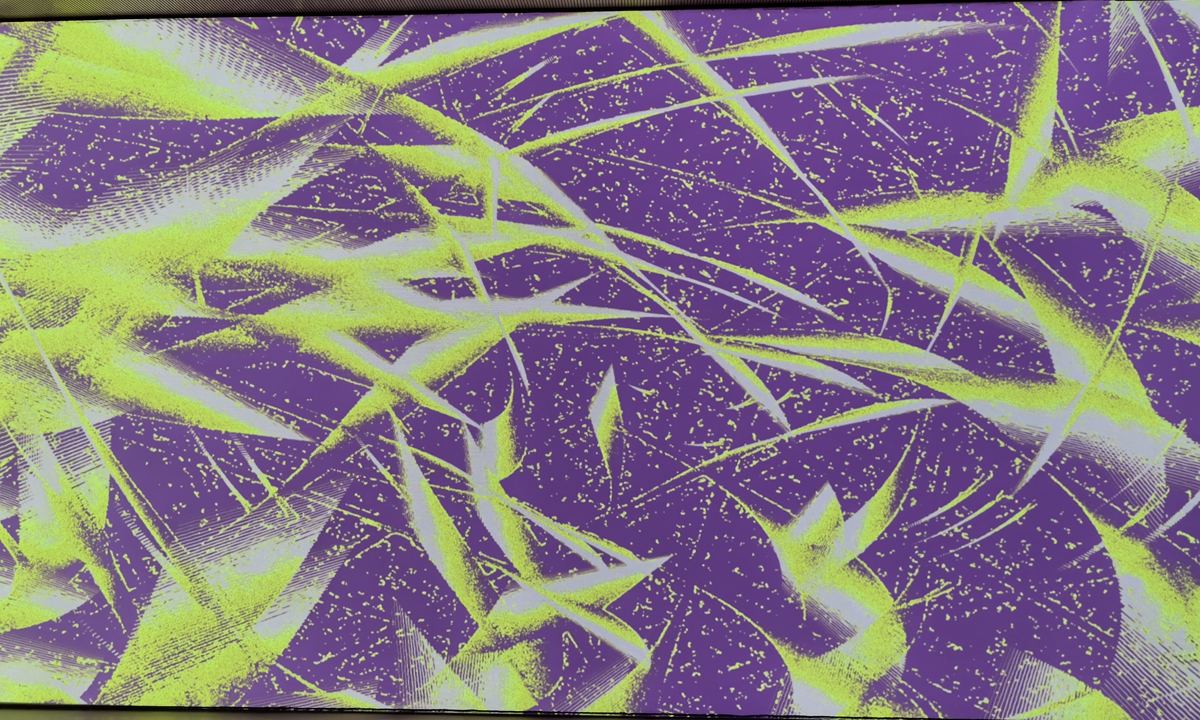
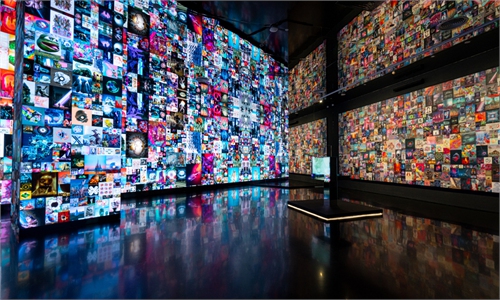
"Orbital, 2025" by Daniel Canogar shown at the exhibition Photo: Dong Feng/GT
Through hosting many cultural activities in China in 2025, Counselor Juan José Herrera de la Muela said that it has been a fruitful year. "We have learned a lot. I think China should be more present in Spain - that is the other part of exchange. The way is paved to show Chinese culture in Spain. Some genres might be more difficult to show, such as Peking Opera, as the traditional art forms need a wider introduction and explanation to the public better. I'm sure people in Spain are eager to get to know Chinese art and culture better. I would encourage Chinese managers and producers to take Chinese artists to Spain. That said, this is just a beginning," he concluded.
The exhibition Off-camera: Moving Images combines artistic approaches to the image with versatility of digital technology. It provides a great opportunity to showcase Spanish contemporary art in Beijing, drawing on the extraordinary creativity of 12 artists from diverse backgrounds who treat the image as an artistic object beyond the realms of photography and cinematography.
In his remarks, Lü Pinjing, deputy director of CAFA, said the exhibition not merely showcases the innovative energy of contemporary Spanish art but also serves as an important bridge for cultural exchange between China and Spain.
"It demonstrates how moving images can transcend geographical and cultural divides, connecting the artistic spirits of our two nations," said Lü, adding that it is expecting the collaboration marks the beginning of deeper engagement between China and Spain, as the exhibition aligns closely with the academy's teaching and research efforts.
In cinema, off-camera is what people do not see, nevertheless it determines what people look at: the suggested, the latent, what escapes the frame to unfold in the viewer's imagination.
Based on this metaphor, the exhibition brings together a selection of Spanish artists and filmmakers whose recent work explores this territory of the invisible, the unfinished, which vibrates beyond the screen.
The exhibition is presented as a monumental and immersive installation experience, in which the moving image abandons its traditional formats to inhabit an expanded space.
By the end of the exhibition, visitors are offered hands-on experience to try a 3D model sculpture with AI tool.
The exhibition lasts till December 28.
RELATED ARTICLES