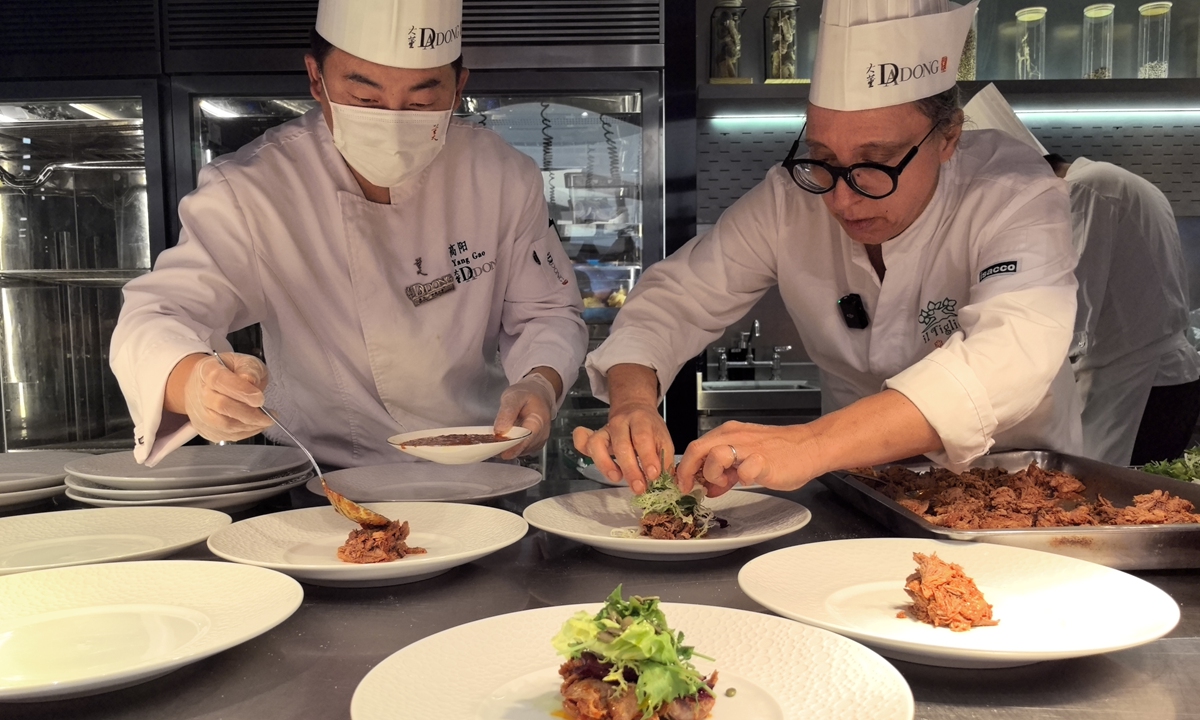
Chef Enrico Mazzaroni (right) prepares a dish during the cooking show. Photo: Dong Feng/GT
On November 19, the Embassy of the Republic of Italy in China hosted "Marche meets China," a cooking show featuring Michelin-starred Chef from Italy Enrico Mazzaroni, as part of its 10th edition of the Week of Italian Cuisine in the World, which took place in Beijing between November 17 to 23. Massimo Ambrosetti, Italian Ambassador to China, told the Global Times that the uniqueness of both Chinese cuisine and Italian cuisine is that they are examples of two great civilizations.
"As it was not only high culture but also daily life. Food and wine are also part of life of sophisticated societies," he said.
Italy is a much smaller country than China, but, in my view, what makes them both absolutely unique is that the Chinese and Italian cuisines are very rich, original and diversified, using many different ingredients. Ingredients are really the driving force of Italian cuisine and Italy shares with China a great tradition for vegetarian food as well.
"China and Italy are two countries in the world with so many diversified excellent original cuisines," Ambassador Ambrosetti continued.
To highlight this year's Week of Italian Cuisine in the World campaign, Ambassador Ambrosetti said that Italian cuisine is very healthy, as it encompasses the so-called Mediterranean diet.
The Ambassador also added that culture is tightly linked to cuisine, being a mixture of traditions, ancient practices, and social interaction. In that sense, Ambassador Ambrosetti said he thinks the cuisine is also the representative of Italian culture, both as a nation and as regional cultures.
"The Week of Italian Cuisine is an interaction between innovation and tradition," the Ambassador said.
"We have a new generation of worldwide renowned chefs, but they base their own cuisine on a very deeply rooted culinary traditions. This is very powerful, because they unite Italian tradition to the benefits of innovation," he elaborated.
Talking about his own experience to explore Chinese cuisine as a diner, Ambassador Ambrosetti told the Global Times that he is very much into the cuisine of North China. "The cuisine of Beijing, as the capital, represents many tastes from all over China. I like Zhajiangmian (a popular Beijing noodle recipe) and Jiaozi (or dumplings) very much, and of course, Peking duck," he smiled.
The Ambassador also tried something different. "I also like spicy food, even though in Italy I'm from the north, where we don't have spicy food, I enjoy Sichuan Province cuisine," said Ambassador Ambrosetti.
Over the past year, Ambassador Ambrosetti has observed growth in bilateral tourism sectors. "There has been a very significant growth of visitors. Another important trend is diversification. Chinese tourists are exploring Italy in many beautiful areas outside the big famous cities, such as Rome, Florence, Venice and Milan," said Ambassador Ambrosetti.
Many Chinese tourists are pursuing in-depth experience. "In addition to famous cities, monuments, locations, many Chinese tourists could like to experience something special," he said.
To Chinese tourists, Ambassador Ambrosetti recommended to prepare their journey into Italian traditions, in order to understand the local main ingredients and products.
"In Italy, it's very hard not to eat well, as there are so many options, similar to China, there are many small restaurants, street food and sea food," he said.
From gastronomical experience to hiking in beautiful natural areas, even to some unique traditions, Chinese tourists are broadening their reach into niche tourist destinations in Italy, also thanks to social media platforms, said Ambassador Ambrosetti.
Chef Mazzaroni showed how Italian courses are prepared in Michelin restaurant in Italy. During his brief trip, he is impressed by the experience of learning from each other while working with Chinese chefs, Chef Mazzaroni told the Global Times.
"Cuisine is an international language. Cuisine is actually a language of the heart. And the heart is where you keep all the people you love, and the cuisine is the expression of this kind of love. In the heart, there is innovation as well," he said.
The Ambassador also shared with the Global Times his outlook for 2026. "On a bilateral basis in Italy and China can be a very good example of very positive and constructive interaction based on mutual benefits and also with the strength of what I call 'cultural friendship.' We interacted since a very distant past in a very peaceful cooperative way," he said.
From Marco Polo to Matteo Ricci, who created the concept of cultural dialogue, his counterpart, Chinese scientist Xu Guangqi, Italian artist Giuseppe Castiglione, "we have a very long and positive story of mutual interaction. I think Italy and China have an incredible cultural cooperation in many sectors. We can rely on this unique background and build up on it an even better, closer and productive positive relations in the future," said Ambassador Ambrosetti.
RELATED ARTICLES