SPORT / MISCELLANY
Legendary sprinter Su Bingtian bids farewell on home turf at National Games
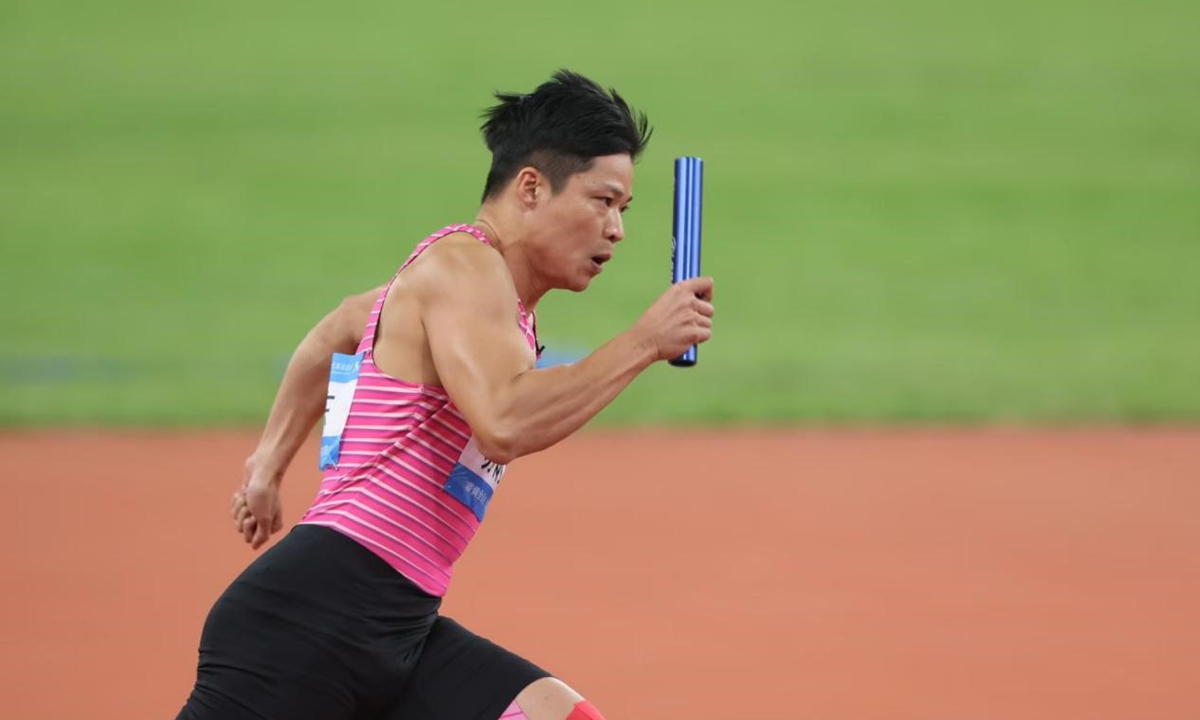
Chinese sprinter Su Bingtian competes in the men’s 4x100 meters relay final at the National Games on November 20, 2025 in Guangzhou, South China’s Guangdong Province. Photo: Cui Meng/GT
Amid the deafening cheers at the near-capacity Guangdong Olympic Center Stadium, China's star sprinter Su Bingtian ran the final race of his career on Thursday.
Representing his home province Guangdong, Su, dubbed the Chinese Flying Man, led Guangdong men's 4x100 meters relay team in the final at the National Games in what has become a deeply emotional and symbolic farewell.
The team finished the race in 38.71 seconds, ranking fourth in the eight-team final in front of 43,924 audience.
His role as the lead-off runner was emblematic. Rather than passing the pressure to younger teammates, Su took on the most technically demanding part, the start.
Speaking after the race, Su admitted that his performance "was just average today," though he had given everything he could.
"To be honest, I didn't perform that well, but I really did my best," he told reporters after the race.
"Our baton exchange today was far from perfect. With my current physical condition and strength, I can't generate my best speed on such a tight curve. That affected our planned baton exchange, which didn't meet the standard we achieved in training."
Su acknowledged that the result left him with regrets, but not disappointment.
"There is no perfect race, and no perfect version of myself," he noted.
"But being able to hold on and finish today already means a lot to me. I'm very grateful to all the spectators who came to support us. No matter what the outcome was, I want to thank them."
Looking ahead to life beyond competitive sprinting, Su said he hopes to continue contributing to the sport.
"I will keep working on promoting athletics and sports in general," he said. "I want to help more young people who love track and field to chase and fulfill their dreams. That's what I hope to devote myself to in the future."
At 36 years old, Su has marked this National Games as the endpoint of his sprinting journey. He previously announced his retirement plans, saying he wanted to conclude his career in his home province at the 15th National Games.
Over the years, Su has rewritten the history of Chinese and Asian sprinting.
He famously broke the 10-second barrier, becoming the first Asian runner to do so in the 100 meters, and set the Asian record of 9.83 seconds in the semifinal of the Tokyo Olympics in 2021.
At the Tokyo Olympics, he also helped China secure a bronze medal in the 4x100 meters relay.
But time catches up with all legends. Earlier this year, at the national athletics Grand Prix in Zhaoqing, Su ran a 10.49 in the 100m heats and then quietly withdrew from the semis, admitting that he "really can't run anymore."
He reflected that to compete at the entry requirement of 10.11 seconds for the National Games' 100 meters was "no longer a realistic goal."
Choosing to end his career not on the individual track, but by anchoring Guangdong's relay effort, Su played his part one last time for the team that shaped him.
In earlier relay events this year, he ran the first leg for Guangdong, leading a team of younger athletes (all born after 2000) and breaking the provincial 4x100 meters record with a time of 38.60 seconds.
Beyond the race itself, his retirement holds deeper meaning: Passing the baton not just physically, but symbolically, to the next generation.
