ARTS / THEATER
China’s innovative path to safeguarding rare Sanjiao Opera
Race to save tradition
By Published: Nov 20, 2025 10:52 PM
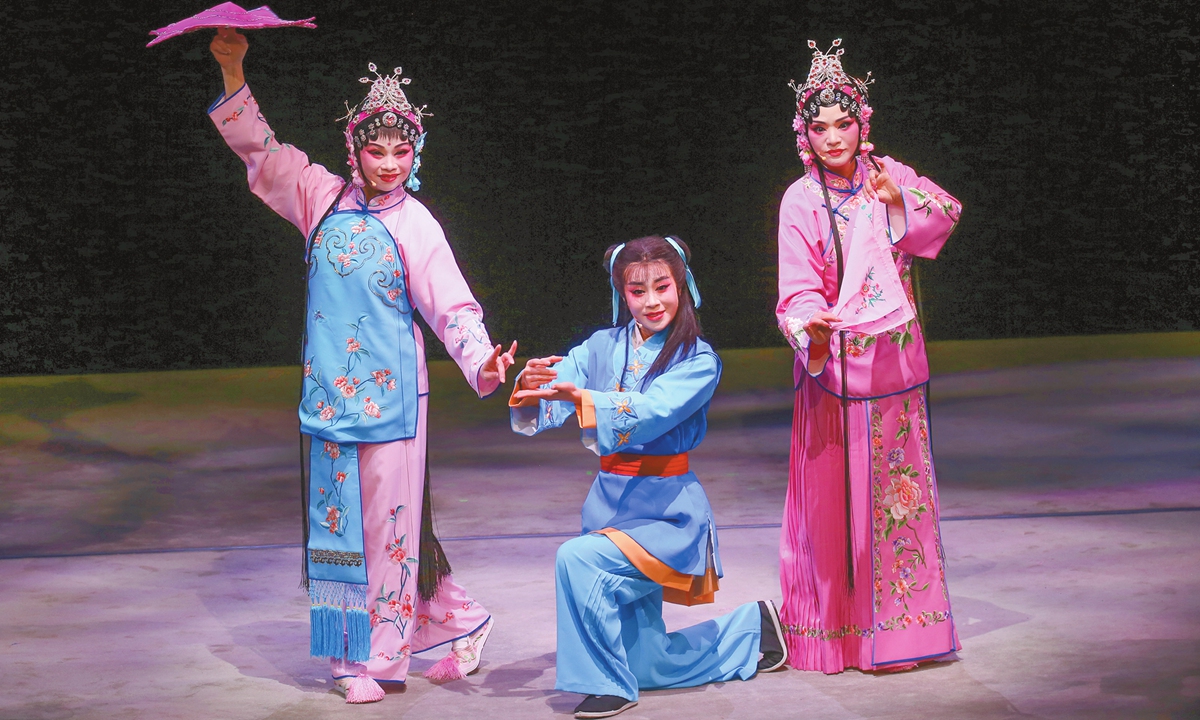
Sanjiao Opera actors perform at the National Centre for the Performing Arts in Beijing in early November 2025. Photos: Courtesy of the China Theatre Association
With a bundle slung over her shoulder and twirling an umbrella, the performer moves with light, effortless steps, embodying a readiness to depart at a moment's notice. This sequence of fluid movements represents conventions deeply ingrained in the artistry of 79-year-old Sanjiao Opera veteran He Yufeng.On stage, a subtle tap of her umbrella tip seamlessly integrates her gaze, gestures, posture, singing, recitation and expression.
Nestled amidst the green hills and clear waters of the northern part of East China's Fujian Province, this folk art known as Sanjiao Opera, or "Triangular Opera," has been performed for more than 400 years. It derives its name from its primary role types - the young male lead, young female lead and the clown - and the triangular patterns often formed by performers' movements.
Lyrics, passed down through generations, carry the local customs, practices and family values of northern Fujian.
Often called a "family drama," Sanjiao Opera's more than 140 surviving plays, such as Cutting Wheat Grass, Pounding Rice, Grinding Tofu, and Selling Thread, are brimming with rustic charm, truthfully reflecting the daily lives of mountain-dwelling common folk.
Focusing on mundane farming household matters, it uses stories of ordinary people such as husbands and wives, siblings and vendors to convey traditional values like diligence, frugality and kindness.
"Sanjiao Opera is the cultural root of folk culture in areas like Shaowu and Guangze," said Yu Shouying, secretary-general of the Fujian Provincial Theatre Association, in an interview with the Global Times on Wednesday. "Its content still offers insights for handling modern neighborhood and family relationships."
However, amid changing times, the emergence of new entertainment forms, evolving cultural landscapes, and shifting social aesthetics, this local art form has gradually drifted from contemporary life, making its path of transmission now fraught with challenges.
China's cultural genes
China's vast territory and diverse local conditions have nurtured a rich variety of operas. Rare opera schools are deeply embedded in regional culture, representing unique expressions of local emotion and life wisdom. According to a national survey, among the 241 opera schools represented by state-owned troupes, 121 of them have only one representative troupe remaining, classifying them as rare schools. Shaowu's Sanjiao Opera is one of them.
As the only state-owned troupe for this school, the Shaowu Sanjiao Opera (Nuo Dance) Folk Culture Research Center bears the heavy responsibility of preservation. Huang Wenjuan, director of the center, acknowledges that after the 1950s and 1960s, no systematic training program for Sanjiao Opera actors was established locally.
By 2002, the troupe had not produced a new Sanjiao Opera work for nearly two decades. Currently, only two folk troupes struggle to survive in northern Fujian. Bai Feng'ai, an actress with the Huayi Sanjiao Opera Troupe, has witnessed a palpable decline in audience numbers over the past decade.
A turning point appeared in 2024 when the China Theatre Association launched a project for protecting and transmitting rare opera schools, with Shaowu Sanjiao Opera becoming one of the first to receive support.
From April to June 2025, a project team comprising members from the Fujian Provincial Theatre Association, Fujian Provincial Art Research Institute and other units conducted fieldwork in Shaowu and Guangze. Through performance recordings, in-depth interviews and seminars, they systematically excavated the cultural connotations of Sanjiao Opera.
"The deeper we understand it, the stronger our sense of anxiety and urgency becomes," noted Bai Yonghua, president of the Fujian Provincial Art Research Institute. "As Wang Kui, director of the Opera Research Institute of the Chinese National Academy of Arts, said, protecting an opera school is tantamount to guarding our cultural territory."
This protection work is often a race against time. In late 2024, veteran troupe leader and drummer Yu Shaolin, relying solely on memory, drafted specifications for the school's unique percussion instrument frame - a case-like drum stand, lost for decades. After a two-month search, a craftsman successfully restored it. Tragically, just two days after its completion, Yu Shaolin passed away suddenly, taking with him his vast knowledge of percussion scores - an irreparable loss for the school's musical rescue.
"The drum stand was meticulously restored, but finding elderly artists who can skillfully use it is now difficult," lamented Yu Shouying, who is Yu Shaolin's daughter.
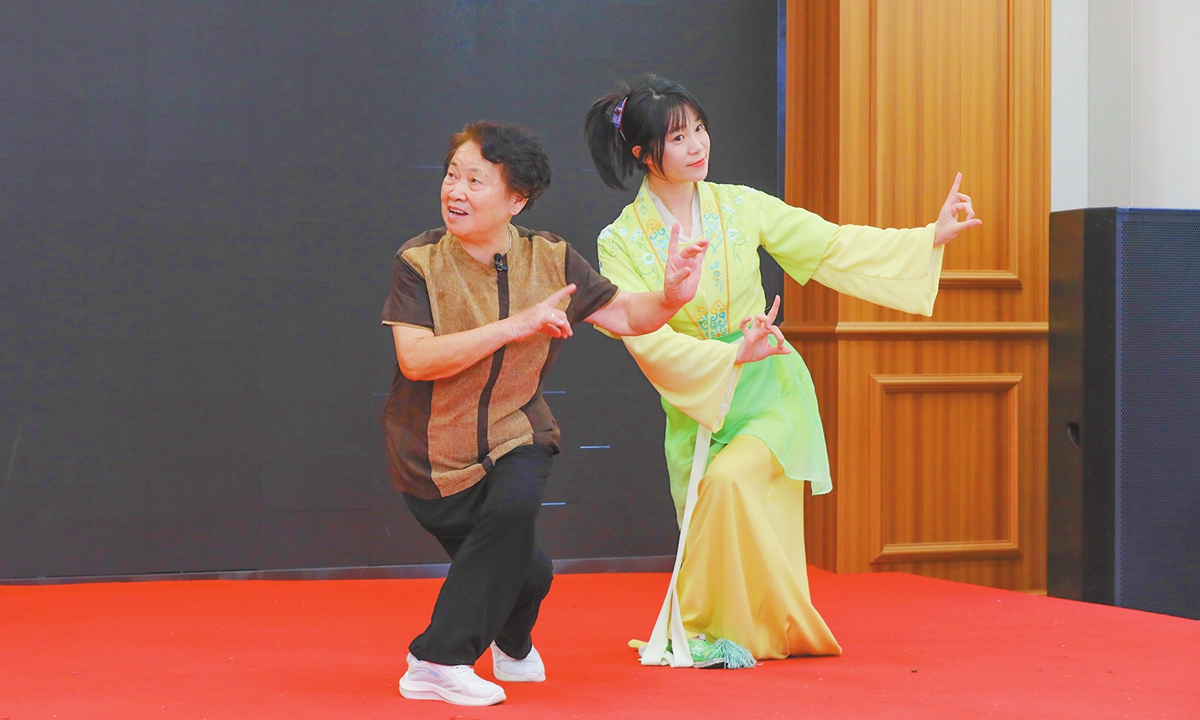
Xu Xichun (left) teaches a young actress.
Running out of timeFacing the crisis of interrupted transmission, systematic protection has become even more urgent. Yu Shouying emphasized that effective efforts must adhere to the principle of "rescue first, then transmission and development," focusing on a dual-track approach: authentic preservation on one hand, and enhancing contemporary vitality on the other.
"The foundation lies in restoring and preserving the traditional form of Sanjiao Opera as authentically as possible," Yu Shouying explained. The project focuses on three aspects: restoring performance styles, protecting the original state of the music, and having professional directors re-stage classic works.
A significant challenge is language. "The dialogue uses a unique local dialect, but over 90 percent of the current actors in the state-owned troupe only have dance backgrounds or come from other operas like Yue Opera. They neither speak the dialect nor have learned Sanjiao Opera performance before," Yu noted.
Therefore, inviting veterans to "pass on the plays" was crucial. The team urgently sought over a dozen elderly artists in their 80s and 90s, but ultimately only four, including Xu Xichun, Li Linde and He Yufeng, could still teach young actors.
Moreover, the music is the soul of the opera. The project team invited 90-year-old veteran composer Mu Zhenyang to conduct rescue work on the musical tunes and singing styles. Simultaneously, Lin Ying, from the Fuzhou Min Opera Theatre, was invited as the re-staging director.
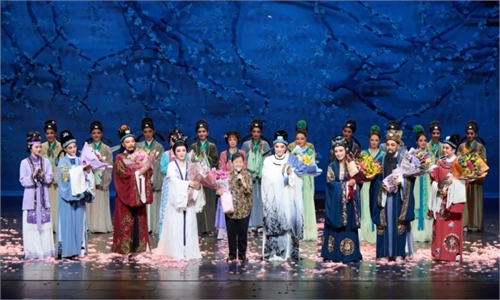
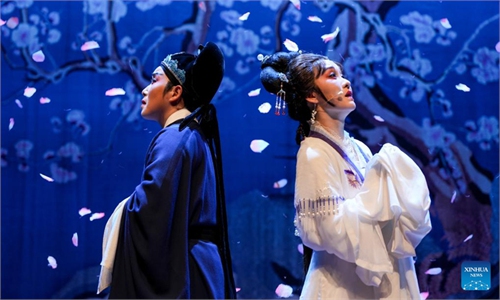
After meticulous re-staging, the traditional play Sisters-in-law Viewing the Lanterns debuted at the National Centre for the Performing Arts in Beijing in early November. Set during the Lantern Festival, it vividly depicts the amusing antics of a sister-in-law, her younger brother and his sister, winning warm applause with its humor and moving melodies.
Chen Yongquan, an executive vice chairman of the China Theatre Association, stated that rare opera schools must return to their native soil and to the common people. Only by re-rooting themselves in the land that nurtured them can they regain vitality.
"The folk sphere is the best soil for the survival of rare opera schools. The affection of the common people is the inexhaustible source of their vitality," Chen said.
RELATED ARTICLES