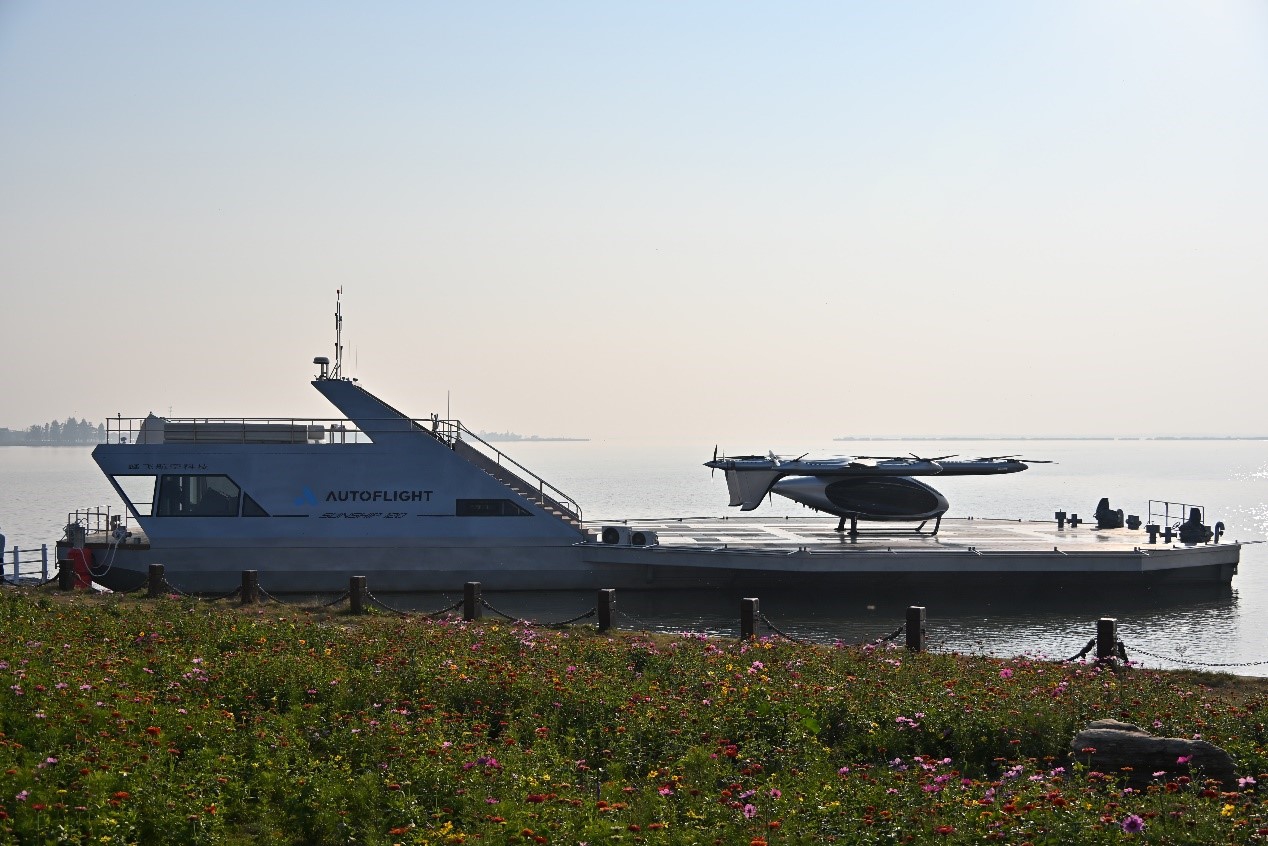
AutoFlight’s sea-air mobility solution Photo: Tao Mingyang/GT
Chinese electric vertical take-off and landing (eVTOL) maker AutoFlight on Saturday unveiled its self-developed mobile water vertiport that enables eVTOL aircraft take off and land on water, which can significantly shorten traditional land-based infrastructure timelines and is expected to become a new driver of China's fast-growing low-altitude economy.
On Saturday afternoon, the company's "CarryAll" eVTOL aircraft took off from the vertiport on Dianshan Lake in Kunshan, East China's Jiangsu Province, within seconds, rising steadily into the air.
Moments later, a trio of eVTOLs swept out over the lake in formation, performing a synchronized aerial display. The demo then shifted to emergency response, as two rescue-configured eVTOLs executed low-altitude drops of emergency supplies. The entire showcase lasted around 20 minutes.
The sea-air mobility solution consists of eVTOLs and the mobile water-based vertiport, supplemented by photovoltaic power and energy-storage units to ensure low-carbon operation. The system can be rapidly deployed dozens or even hundreds of kilometers offshore, including in near-sea oilfields, distant wind farms, and inland waterways, Xie Jia, senior vice-president of AutoFlight, told the Global Times on Saturday.
The platform can support 2-ton-class cargo and passenger eVTOL models, as well as industrial-grade eVTOL aircraft with a range of 500 kilometers for offshore energy operations and maritime rescue. The first batch of systems has already been delivered to "early clients," said Xie.
Tests show that the low-altitude solution enables eVTOLs aircraft to reach offshore platforms up to 150 kilometers away in less than an hour — more than 10 times faster than conventional transport — and, when combined with drones for initial searches, can cut maritime rescue response time by more than 50 percent. In coastal bays and island regions, a 50-kilometer cross-sea trip can be completed in about 20 minutes, with future fares expected to be around 300 yuan ($42), boosting commuter efficiency and enabling new low-altitude tourism.
Xie said the sea-air integrated solution is expected to enter a rapid expansion phase within three to five years. "By 2030, we project that the solution will cover China's major offshore wind farms, more than 50 percent of key ports, and numerous coastal and riverside city clusters."
China's low-altitude economy is poised for rapid expansion. According to the Civil Aviation Administration of China, the market is expected to reach 1.5 trillion yuan ($210 billion) by 2025 and exceed 3.5 trillion yuan by 2035, Xinhua News Agency reported.
The sector has been listed as a strategic emerging industry in the Government Work Report for two consecutive years in 2024 and 2025. Recommendations of the Central Committee of the Communist Party of China for Formulating the 15th Five-Year Plan for National Economic and Social Development call for accelerating the development of industrial clusters in strategic emerging fields such as new energy, new materials, aviation and aerospace, and the low-altitude economy.
Cities across China are rolling out plans to accelerate low-altitude infrastructure construction. On October 17, Yuzhong district in Southwest China's Chongqing Municipality released a three-year action plan from 2025 to 2027 aimed at building safe, efficient and interconnected low-altitude network by 2027, with the local industry projected to exceed 1 billion yuan.
Shenzhen's plan, released in November 2024, aims to build more than 1,200 takeoff-and-landing points by 2026, covering passenger flights, cargo logistics, community deliveries and urban governance services. Industry financing has also continued to rise.
In the first half of 2025, China recorded nearly 100 investment events in the low-altitude economy, with total funding exceeding 7.5 billion yuan, the Securities Times reported, reflecting the rapid and steady development of companies in the sector.
Chinese low-altitude aircraft maker XPENG Aridge began trial production at its Huangpu plant in Shanghai on November 3, with its first "Land Aircraft Carrier" rolling off the line — marking the world's first mass-production facility for flying cars using an automotive-style assembly system, the company told the Global Times.
In overseas markets, Guangzhou-based EHang announced on November 18 that its flagship EH216-S completed a manned demo flight in Doha, Qatar, cutting a 30-minute car journey to an eight-minute zero-emission flight and further advancing cooperation in next-generation air mobility between the company and the city's traffic authority.
