ARTS / CULTURE & LEISURE
Nationwide cultural operation to create archives for China’s old city relics
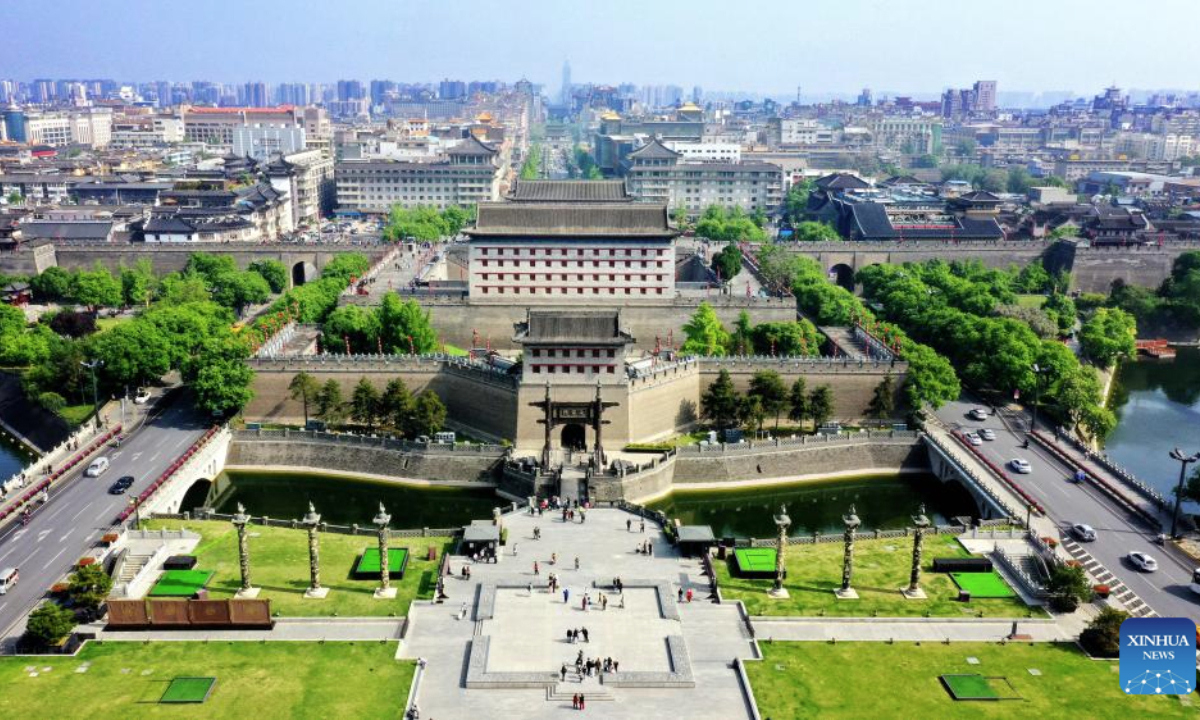
This photo shows the Yongning Gate in Xi'an, northwest China's Shaanxi Province, April 25, 2023. As the provincial capital of northwest China's Shaanxi Province, Xi'an, with a history of over 3,100 years, has served as the capital city for 13 dynasties of China. (Xinhua/Liu Xiao)
Focusing on exploring elements such as old walls, gates, moats, and traditional residences in China's old cities, a special operation has recently been deployed nationwide with the aim of creating archives for the cultural heritage in China's old cities.
The operation was deployed by the leading group office of the fourth national survey of cultural heritage. It is an important part of the ongoing fourth national survey, which is running from 2023 to 2026.
The newly launched campaign designates key survey areas, including historic city cores enclosed by ancient city walls and moats, as well as extended settlement zones outside city gates. Such historic cities, spread across the country, are major ones that used to be national capitals or regional administrative centers, such as prefectural seats, provincial capitals, or county seats. Investigative areas covered in the operation include traditional alleys, public buildings, bridges and waterways across different cities. Additionally, the operation will incorporate ancient above-ground and underground remains such as ancient military sites, temple ruins, and handicraft workshop relics into the census.
Ancient structures in various forms and styles, which bore witness to the history of an old city, are also key subjects of the operation. These historic architectural relics include temples, ancestral halls, academies, schools, dams, canals, ponds, and wells. In addition to ancient heritage sites, important modern and contemporary historical landmarks such as former residences of notable figures, religious buildings, and financial and commercial structures will also be surveyed.
The operation's detailed and extensive scope is likely due to the fact that many historical resources in cities have been "either frozen or overlooked during fast-paced urban development" or "have had their heritage value ignored after being repurposed," Li Bo, an urban historian and planner with Chongqing University, told the Global Times.
The operation will be conducted in an integrated way. Professional provincial-level teams will carry out systematic, wall-to-wall surveys of cultural heritage in old cities in cooperation with local cultural heritage and ancient architecture institutions.
During the process, all provincial cultural relics organs must adhere to the criteria for designating immovable cultural relics by adding newly discovered sites to a provisional list. They will also conduct more detailed reviews of various archaeological investigations and surveys conducted within urban areas. Cultural facilities like memorial halls, concert halls, and exhibition centers built between 1949 and 1978, as well as older commercial districts developed since 1978, reflect the cultural and social evolution that has progressed alongside urban development.
Investigation of similar timelines is also being carried out in Beijing. Moving beyond a mere inventory of physical remains, the city will also collect and record intangible cultural heritage, historical events, anecdotes of notable figures and oral histories related to its old city areas and historic neighborhoods. The city's residents can also participate in the operation by going digital.
Li noted that archives for the old city's legacies are important for three reasons. First, these archives can serve as the "legal, historical and technical basis" for protecting an old city's heritage. Besides, archives record intangible heritage such as historical events and architectural traditions, and such intangible information can ensure that the city's memory can be passed on for generations.
"And most importantly, historical archives of a city can help the planners of today to balance conservation with modernization, fostering new urban alterations to urban planning and sustainable urban growth that respects historical layers," Li remarked.
RELATED ARTICLES