ARTS / CULTURE & LEISURE
China tops UNESCO list as ICH thrives

Illustration: Liu Xiangya/GT
China's intangible cultural heritage (ICH) is undergoing a transformation. Instead of being simply preserved in glass cases or staged demonstrations, it is becoming increasingly woven into youth culture and everyday consumption.
A new report released on Sunday by China's Ministry of Culture and Tourism shows that during the 14th Five-Year Plan period, China's ICH preservation efforts delivered impressive results. With 44 items now on UNESCO's Intangible Cultural Heritage list, China ranks first in the world. Policy support, digital platforms and a surging domestic market have opened the door for traditional crafts to enter contemporary life, becoming a new engine for cultural and industrial integration.
According to the report, China added 325 new items to its fifth batch of national-level heritage projects and recognized 942 new inheritors. A nationwide network of 276 cultural ecology reserves has taken shape, provincial heritage museums have opened at speed, and 2,290 national-level inheritors have completed systematic archival documentation.
But the momentum owes just as much to digital storytelling and the rise of "heritage experiences," which are reshaping how younger generations encounter tradition. These new pathways have allowed the country's most ancient skills to slip into modern lifestyles through immersion.
A recent example comes from the influencer Nanxiang, known for his documentation of Chinese intangible heritage. The creator's first-person footage of the traditional sport known as single-bamboo drifting, a gravity-defying act often compared to "water-walking," went viral. That emotional arc proved magnetic: views soared, helping the heritage site quickly become a must-visit attraction for domestic travelers.
Nanxiang has been candid about the dilemma facing many traditional artisans: "Heritage inheritors understand heritage, but not necessarily how to work the internet."
The solution he and his team pursued was to place the human experience at the center, meeting the internet on its own terms while giving heritage room to breathe.
This trend has been years in the making. For example, the viral "heritage flowery headwear" trend saw young people lining up to try ancient adornment styles after videos went viral online. Even established names like Li Ziqi, whose online videos popularize traditional craftsmanship, have helped push heritage content toward the mainstream. Together, they demonstrate how digital media plus heritage has moved traditional crafts beyond display cabinets and into social feeds.
The scale of the shift is striking. In 2024 alone, China's video platform Douyin hosted an average of 65,000 ICH livestreams every day; that's 45 every minute.
Yang Hong, director of the Intangible Cultural Heritage Communication Research Center at the Communication University of China, told the Global Times that this surge is no accident. "Creators use visual intensity, narrative storytelling and immersive experiences to draw users in through people first, and the craft second. Livestream training programs and platform-level traffic support have opened new channels for visibility."
Workshops, educational programs and immersive cultural spaces have given heritage a tangible place in urban and rural economies alike. In Southwest China's Yunnan Province, tie-dye studios have become staples of the city's tourism circuit, and in East China's Nanjing, online DIY kits for the traditional velvet-flower craft have formed their own consumer ecosystem.
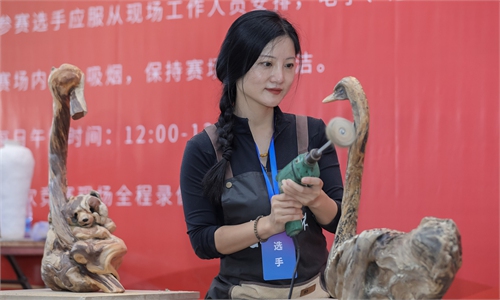
Heritage-themed guesthouses clearly illustrate this synergy. A heritage guesthouse is not just an accommodation, but a cultural vessel where you see people, objects and ways of life. One such inn on the shores of Dali's Erhai Lake welcomes guests with the traditional ethnic Bai tea ceremony, while offering hands-on sessions in tie-dye and woodcarving, traditions embedded directly into the hospitality experience.
On social platforms, business models continue to evolve. Huang Jiayu, a post-1990 promoter of crochet-lace heritage from Fujian, has built her own handmade brand featuring bright, cartoon-inspired designs loved by domestic and overseas audiences. Huang told the Global Times that the brand's growth enabled her to open a crochet factory, host an exhibition in her hometown and attract tourists, while helping traditional artisans secure stable employment.
Across the country, the network of 12,900 workshops created during the 14th Five-Year Plan has provided not only spaces for teaching and practice but also new economic engines for local development.
Even art schools are pushing into new territory. At the end of 2024, Tianjin saw China's first School of Artificial Intelligence Art, focusing on how AI can support heritage innovation. "We're developing an AI model for Yangliuqing woodblock prints," Qiu Zhijie, the academy president, told the Global Times.
Such "small-scale, high-participation" formats, Qiu argues, are proving to be effective carriers for integrating heritage into contemporary life.
ICH is generating an increasing number of jobs and has become an important pathway for young people to find employment and start businesses. Through online showcases and on-site engagement, it can also increasingly take on more social functions in contemporary society.
The author is a reporter with the Global Times. life@globaltimes.com.cn
RELATED ARTICLES