US, Ukraine reportedly narrow 28-point peace plan to 19 points yet most sensitive elements left for leaders to discuss
By Published: Nov 25, 2025 01:22 PM

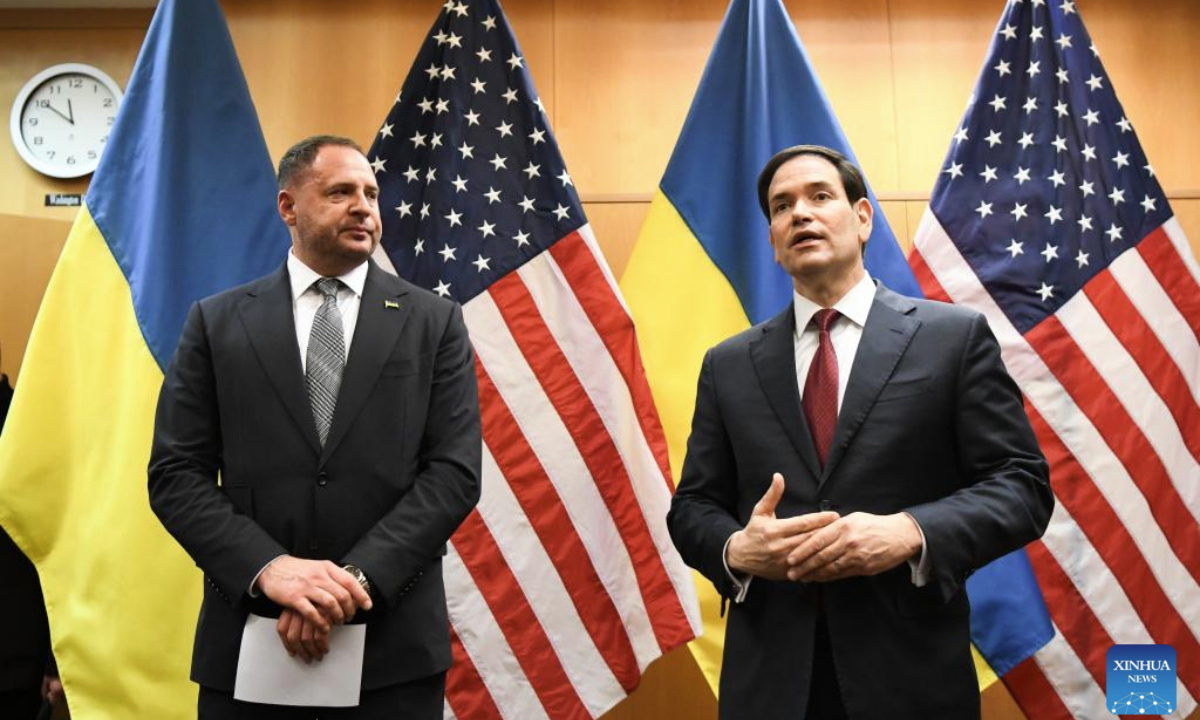
US Secretary of state Marco Rubio (2-L) and Head of the Office of the President of Ukraine Andriy Yermak (2-R), at the beginning of their talks at the US Mission in Geneva, Switzerland, 23 November 2025. Photo: VCG
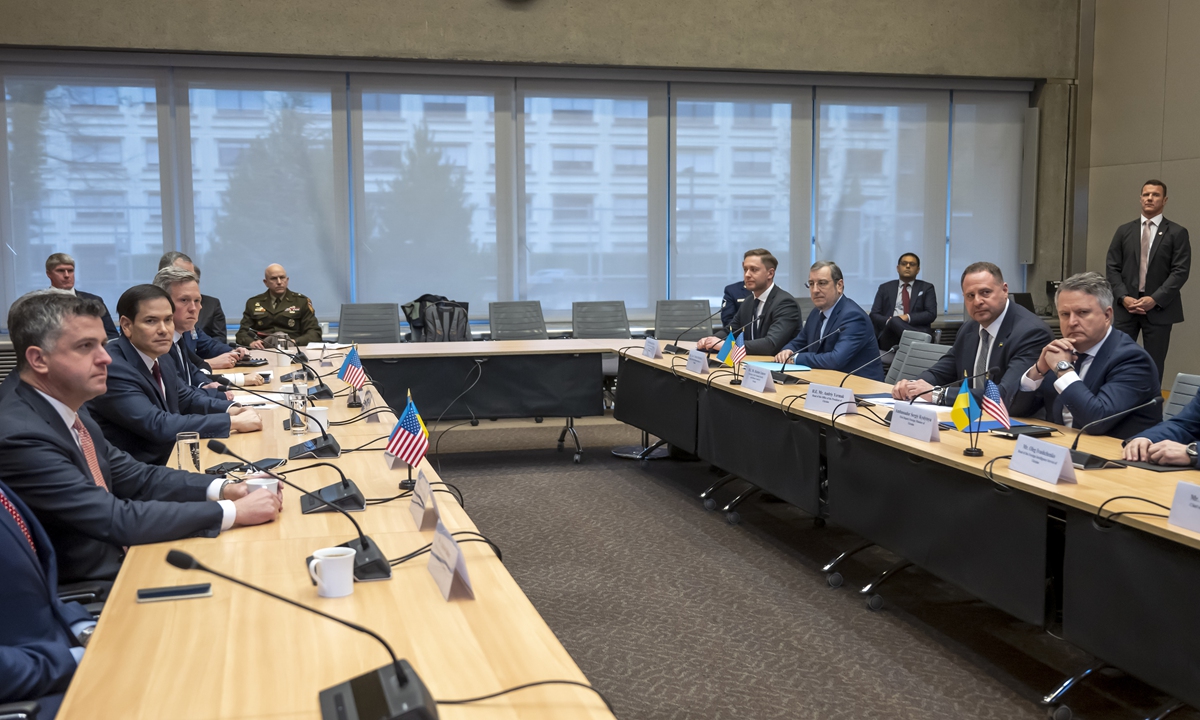
The US-proposed 28-point peace plan aimed at ending the Ukraine crisis has been trimmed to a 19-point framework drafted by the US and Ukraine over the weekend in Geneva. However the most politically sensitive elements remain for the two presidents to negotiate, multiple media outlets reported Monday.
The reported 19-point peace plan echoes the "updated and refined peace framework" mentioned in the joint US-Ukraine statement released by the White House on Sunday local time, which said that the discussions showed "meaningful progress toward aligning positions and identifying clear next steps."
Before the Geneva meeting on Sunday, the US administration had drafted a 28-point plan, which includes ceding territory, reducing the size of Ukraine's army, relinquishing NATO accession, and giving Washington a 50 percent share of reconstruction, triggering alarm in Kiev and across Europe.
"Many of the controversial provisions were either softened or at least reshaped" to get closer to a Ukrainian position or reduce demands on Ukraine, Oleksandr Bevz, a Ukrainian official who participated in the Geneva talks, was quoted by The Washington Post as saying.
He added that the Thursday deadline set by US President Donald Trump for agreeing on the 28-point plan, now appears more flexible than it did before.
Ukrainian First Deputy Foreign Minister Sergiy Kyslytsya told the Financial Times that the new draft bore little resemblance to the leaked 28-point document. "Very few things are left from the original version," he said, without specifying which items were removed.
Kyslytsya said each side will take the latest working drafts back to Washington and Kyiv to brief their presidents. The Trump administration was then expected to approach Moscow to try to advance the talks, he said, according to the Financial Times.
The BBC reported that the new 19-point document likely incorporates at least some of the amendments proposed by European governments and published by Reuters that point to something far more acceptable for Kiev. In that version, an automatic veto on future Ukrainian NATO membership is gone - as well as a cap on troop numbers for the country's armed forces. The text also states that Ukraine commits not to retake its occupied sovereign territory through military means.
The new draft leaves the most contentious issues for Trump and Ukrainian President Volodymyr Zelensky to resolve, according to multiple media reports.
President Zelensky said in an X post on Monday that he and President Trump will discuss "sensitive issues" related to the US peace proposal. He also confirmed that there are "fewer points" than 28 and that "many of the right elements have been taken into account in this framework."
Cui Heng, a scholar from the Shanghai-based China National Institute for SCO International Exchange and Judicial Cooperation, told the Global Times on Tuesday that the number of clauses is not the key; what truly matters is that no consensus has been reached between the US and Ukraine on the most sensitive issues, including territory, security guarantees, and the scale of Ukraine's military forces.
The negotiations have reached core contradictions that cannot be resolved at the technical level. By leaving the most sensitive issues to the presidents of the US and Ukraine, it means that the meeting between Trump and Zelensky will be decisive.
"A deal is possible, but a complete collapse is also equally likely. At this stage, it is still far too early to say that a final peace agreement is anywhere close to being finalized," Cui said.
White House press secretary Karoline Leavitt said Monday local time that President Trump "remains hopeful and optimistic that a deal can be struck" to end the Ukraine crisis following negotiations in Geneva, according to CNN.
Regarding the Geneva version of the US-Ukraine peace plan, Russian Presidential Spokesman Dmitry Peskov said on Monday that "we have read the statements issued following the discussions held in Geneva" but "we haven't officially received anything yet," according to Tass.
Russian Presidential Aide Yury Ushakov supposes that the US will contact Russia soon to personally discuss the details of the peace plan for Ukraine, although there are no specific agreements yet. He said the Kremlin is aware of the EU's peace plan, but its provisions are not constructive and do not suit Russia, Tass reported in a separate report on Monday.
German chancellor, Friedrich Merz, said the talks would be a "long-lasting process." and the next step must be for: "Russia tocome to the table," while Europeans must be able to give their consent to "issues that affect European interests and sovereignty," the Guardian reported.
According to Cui, the US and Russia are the parties with greater willingness to push for peace talks, aiming to end the conflict and secure more favorable terms. For Ukraine, even if it is deeply reluctant, an early peace negotiation would help Kive limit its losses. As for Europe, despite having poured massive resources into supporting Ukraine, it now faces the reality of being sidelined in peace talks and emerges as the clear net loser.
RELATED ARTICLES