ARTS / CULTURE & LEISURE
Mascot for 2026 ‘Happy Chinese New Year’ celebration unveiled
Connecting overseas audiences to zodiac tradition
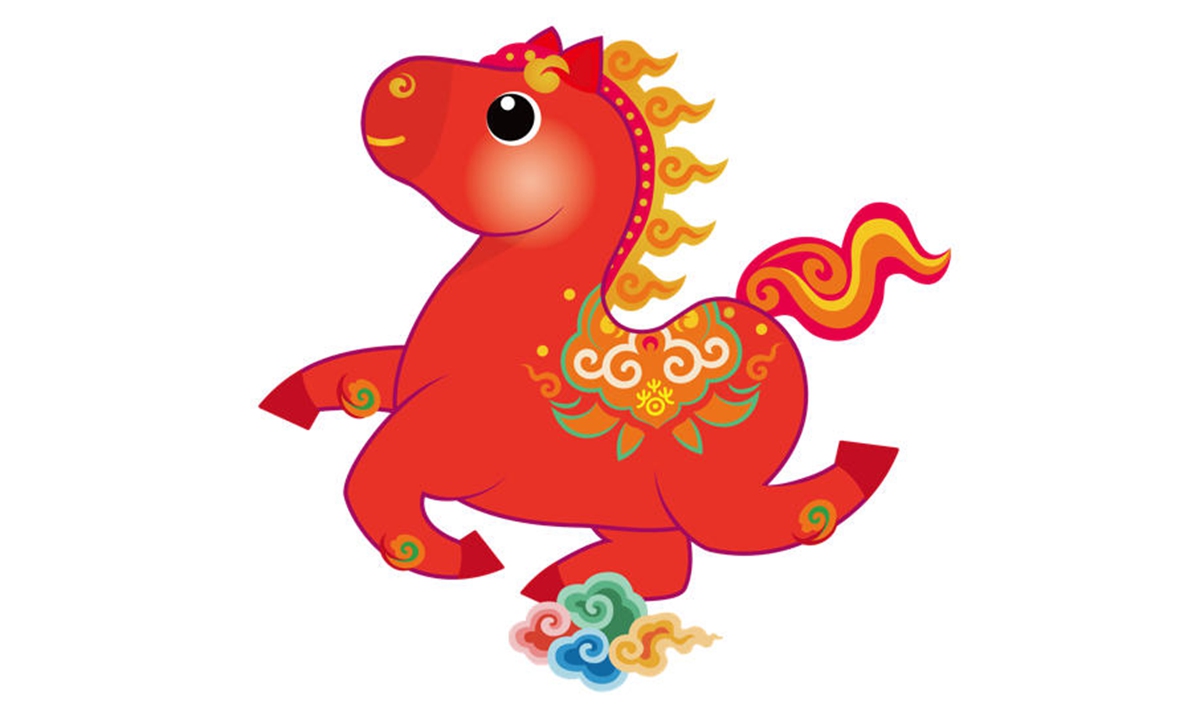
The mascot for 2026 'Happy Chinese New Year' celebration Photo: Courtesy of the Central Academy of Fine Arts
On Tuesday, China's Ministry of Culture and Tourism unveiled the mascot for the 2026 "Happy Chinese New Year" global celebration - the auspicious horse. The mascot and its related cultural and creative products will be widely used throughout the 2026 festivities, bringing new highlights to Spring Festival celebrations around the world."The auspicious horse figure is beloved across cultures worldwide. We hope that through this mascot, overseas audiences can gain a more intuitive and emotional connection to the Chinese New Year, Chinese culture, and especially the zodiac tradition," Lin Cunzhen, head of the design team at the Central Academy of Fine Arts, told the Global Times on Tuesday.
Drawing inspiration from the Bronze Galloping Horse Treading on a Flying Swallow in the Eastern Han Dynasty (25-220), which was unearthed in 1960s Wuwei, Northwest China's Gansu Province, the auspicious horse incorporates mane decorations referencing the Tang-era (618-907) wuhua (literally translated as five colors) horse style. Its primary color is Chinese red, complemented by classic motifs such as auspicious clouds and ruyi patterns (a symbol of good luck), embodying the warmth and festive spirit of the Chinese New Year.
"The auspicious horse's mane is styled in five tufts. In traditional culture, wuhua ma [five-color horse] does not refer to color but to a decorative form in which the mane is arranged into five braided groups," Lin explained.
"By adopting this classic motif, we aimed to give the horse a more dynamic, flowing look, while grounding the design firmly in cultural heritage," she added.
During research, and following the advice of paleontologists, the design team selected the Zhada three-toed horse, an ancient equid that lived on the Qinghai-Xizang Plateau around 4.6 million years ago and the highest-altitude ancient horse species known to science - as the biological prototype for the mascot, according to Lin.
"The core function of the Happy Chinese New Year mascot is to serve as a cultural vehicle that helps bring Chinese culture to the world," Lin noted. "In the past, these mascots were used mainly overseas, but now they are increasingly appearing in China as well, including in commercial products and onsite events."
According to Lin, the mascots have been featured on city buses and large-scale public installations in places such as Rome, Italy and Bangkok, Thailand, and have also been presented as diplomatic gifts to local leaders and officials. They also offer overseas Chinese communities the chance to receive zodiac-themed gifts from their homeland during Spring Festival, strengthening cultural affinity and a sense of connection.
The Spring Festival is the most important traditional festival of the Chinese nation and a vital carrier of Chinese culture.
As more countries recognize the Spring Festival as part of their own celebrations, an increasing number of international friends are turning to the festival as a way to learn about Chinese culture and understand Chinese society. The widespread overseas celebrations of the Happy Chinese New Year program have created a major platform for Chinese culture to go global and offer the world a meaningful window into China.
The Happy Chinese New Year program has been held for 25 consecutive years since 2001. It promotes the values of "joy," "harmony," "sharing," and "blessing," and highlights the theme of "Happy Chinese New Year, Harmonious World," according to the Ministry of Culture and Tourism.
The mascot design team at the Central Academy of Fine Arts has long upheld the philosophy of "drawing wisdom from tradition and interpreting classics through innovation." Their previous creations, including the "auspicious rabbit," "auspicious dragon," and "auspicious snake," have all received wide acclaim both in China and abroad, according to Lin.
"Previous zodiac mascots were showcased in more than 300 Happy Chinese New Year events across some 170-180 countries and regions," Lin told the Global Times.
Wang Deyan, director of the Chinese Language Department at the School of Liberal Arts and Law of North China University of Technology, told the Global Times on Tuesday that from the perspective of cultural scholars, these traditional yet endearingly modern mascot designs embody an unbroken cultural lineage that extends from history into the present.
"They also reflect a recognition of today's spirit of progress, an era striving forward, overcoming obstacles, and rising with renewed vitality," said Wang.
According to Wang, the greatest value of the program over the past 25 years lies not in its scale, but in its steady role as a window through which the world can observe the everyday life and cultural details of China.
"Today, through food, handicrafts, music and other tangible forms, foreign participants are able to see the real face of contemporary Chinese society. This kind of sustained cultural exchange builds understanding and trust," he added.
RELATED ARTICLES