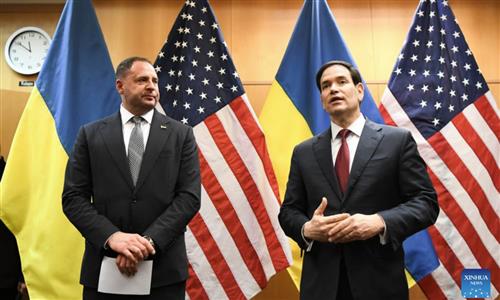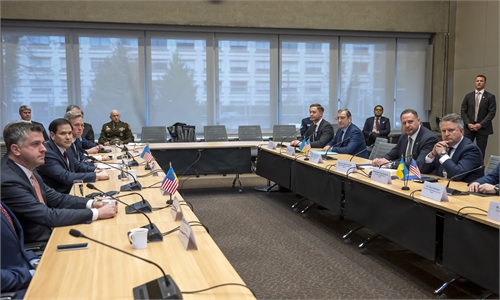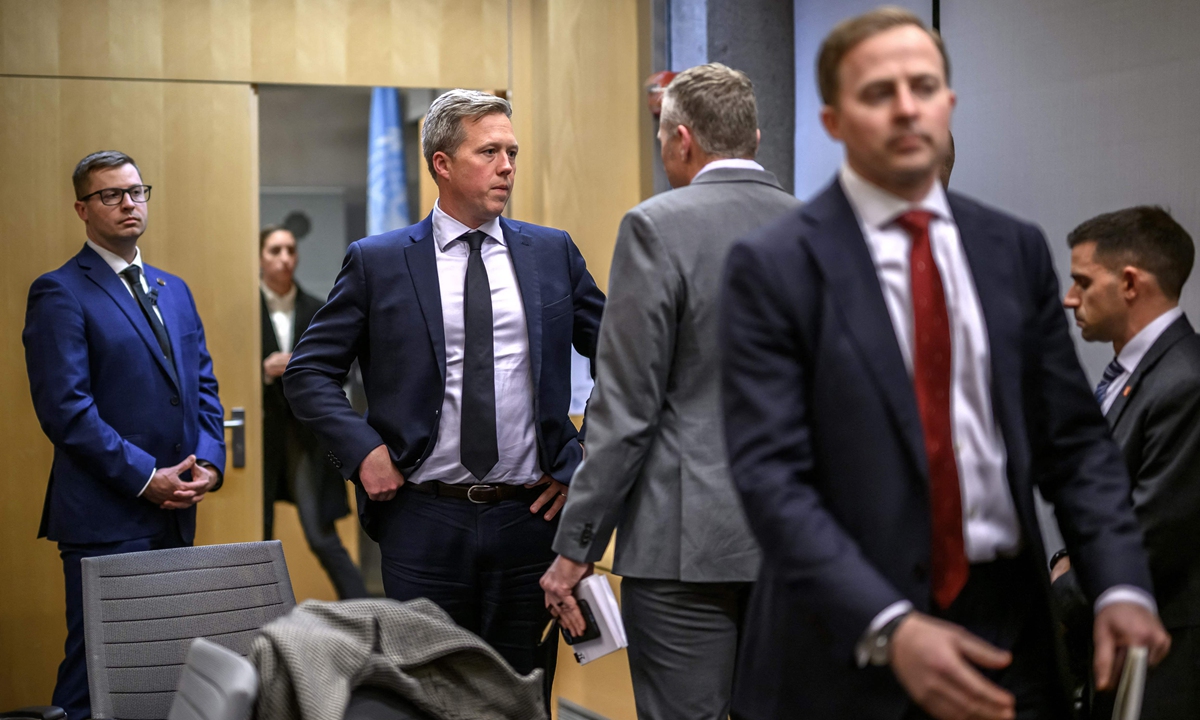
US Secretary of the Army Dan Driscoll (C) speaks with US staff after a closed-door talks with the Ukrainian delegation on a US plan to end the war in Ukraine at the US Mission in Geneva, on November 23, 2025. Photo: VCG
Ukraine has agreed to a peace deal with only "minor details" yet to resolved, CNN reported on Tuesday, citing a US official.
"The Ukrainians have agreed to the peace deal. There are some minor details to be sorted out, but they have agreed to a peace deal," said the US official, CNN cited.
According to CNN, the remarks were made as the US army secretary was in Abu Dhabi holding meetings with Russian officials about the Trump administration's proposal. Ukrainian delegation also presented in the city and stayed in contact with the US Army Secretary Dan Driscoll.
A US military official in Abu Dhabi said Driscoll spent hours negotiating Tuesday with Russian representatives, going in and out of meetings all day. "We remain very optimistic," the official said, CBS News cited. "Secretary Driscoll is optimistic. Hopefully, we'll get feedback from the Russians soon. This is moving quick."
In a post on X, Ukraine's national security secretary, Rustem Umerov, wrote that "our delegations reached a common understanding on the core terms of the agreement discussed in Geneva." He added that Kiev "now count[s] on the support of our European partners in our further steps" and is arranging a visit by President Volodymyr Zelensky to the US "to complete final steps and make a deal with President Trump."
In an earlier post on X, Zelensky wrote that "following the meetings in Geneva, we see many prospects that can make the path to peace real. There are solid results, and much work still lies ahead."
According to Sky News, there has been no reaction from the Kremlin so far on Ukraine's reported agreement to the US peace proposal.
As of press time, there was still no official confirmation as to what specific peace plan the US and Ukraine may have agreed on. The US originally drafted a 28-point peace plan aimed at ending the Ukraine crisis, but it has since been narrowed to a 19-point framework developed jointly by US and Ukrainian officials over the weekend in Geneva.
The earlier 28-point version would have required Ukraine to cede territory in eastern Ukraine, reduce its military and forswear NATO membership. The plan thus crossed several long-standing Ukrainian red lines, drawing criticism from Ukraine and across Europe.
The 19-point outline aligns with the "updated and refined peace framework" referenced in the joint US-Ukraine statement released by the White House on Sunday, which said the talks demonstrated "meaningful progress toward aligning positions and identifying clear next steps."
The meetings were "tense and tough" but productive, said Oleksandr Bevz, an adviser to Yermak who participated in the Geneva talks. He said the Thursday deadline now appears more flexible than it had before. "It's not a code red. It's more important to finalize the text," Washington Post reported.
"Many of the controversial provisions were either softened or at least reshaped" to get closer to a Ukrainian position or reduce demands on Ukraine, he said. By Monday, while not all the language in the draft was considered entirely "acceptable" to Kiev, Bevz said, the text was revised to a point that it could at least "be considered, whereas before, it was an ultimatum," according to Washington Post.
Zhang Hong, a research fellow at the Institute of Russian, Eastern European and Central Asian Studies under the Chinese Academy of Social Sciences, told the Global Times that the latest round of US-Ukraine negotiations is rooted in new battlefield dynamics, Ukraine's domestic political challenges, and the current state of US-Russia relations.
Some Chinese analysts believe that Ukraine, mired in battlefield setbacks, US pressure, and domestic corruption, will eventually have no choice but to accept a humiliating peace.
Chen Yu, Deputy Director and Associate Research Professor of Institute of Eurasian Studies at the China Institutes of Contemporary International Relations, wrote in an article for thepaper.com, arguing that the current round of wrangling over the "peace plan" may once again devolve into a game of political buck-passing.