ARTS / CULTURE & LEISURE
Earliest bronze wares found in Yangtze River Basin with new record
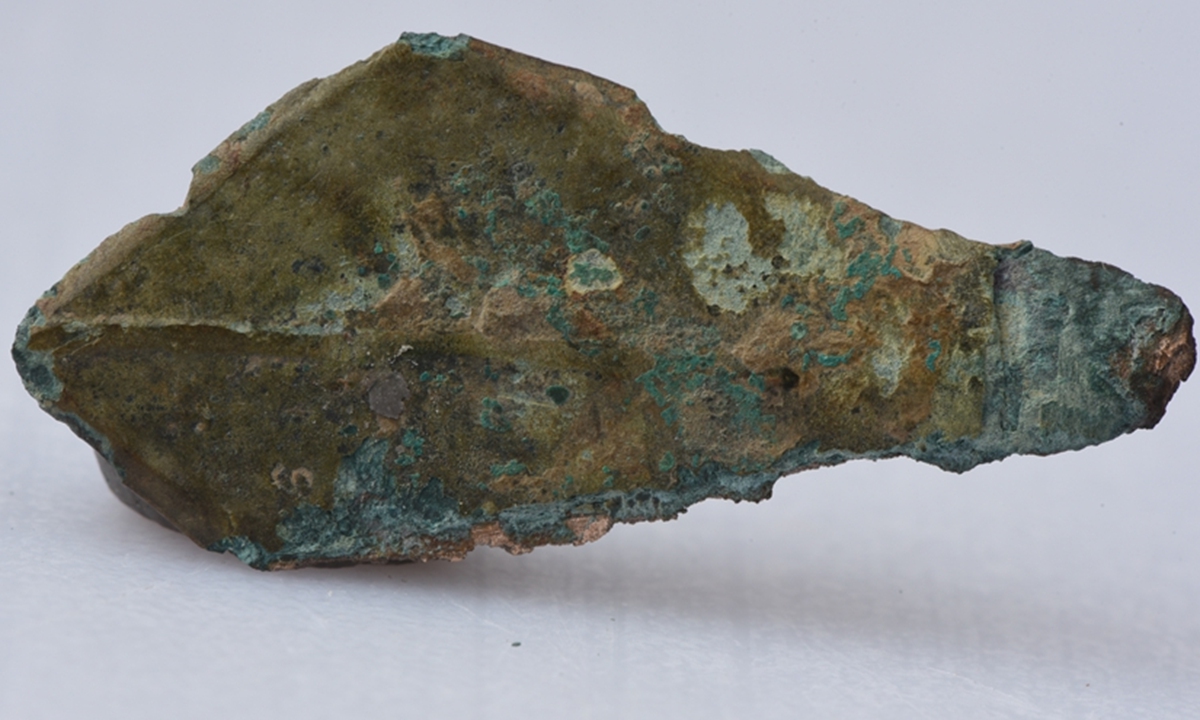
Two newly discovered bronze artifacts unearthed from the Gouwan site in Xichuan county, Central China's Henan Province. Photo: People's Daily Online
Two newly discovered bronze artifacts unearthed from the Gouwan site in Xichuan county, Central China's Henan Province, have been scientifically dated to around 4,500 years ago, making them the earliest-known bronze finds in the Yangtze River Basin.The discovery pushes back the timeline of early metallurgical techniques in the region to the late Qujialing Culture and offers crucial evidence for reconstructing the multi-origin development of early Chinese metallurgy, the Global Times confirmed with the School of Archaeology and Cultural Heritage at Zhengzhou University on Wednesday.
The related research has been published online in the international academic journal Archaeological Research in Asia. Peer reviewers noted that the study, which integrates scientific analyses with field archaeology, provides a fresh perspective for examining the origins and diffusion of early metallurgical traditions in China and holds significant academic value.
Both bronze artifacts were recovered from the layers of late Qujialing culture. One is an arrowhead-shaped bronze piece whose form closely resembles stone arrowheads of the same period. Measuring 3.66 centimeters in length, it features a flat cross-section, and still bears visible casting marks. The second item is a rod-shaped bronze fragment measuring 6.45 centimeters long with a sub-cylindrical profile and clear casting pores along its body. Distinct mold seams are visible on the surfaces of both objects.
Through metallographic examination and elemental analysis, the research team confirmed that both objects were cast using a ternary alloy of copper, tin, and lead. The abundance of impurities suggest the use of polymetallic co-occurrence ore as raw material, indicating a technologically primitive stage of early metallurgy.
"These two bronze artifacts represent an early chapter in China's brilliant bronze civilization and provide new materials for studying the origins, transmission, and evolution of metallurgical technology," Zhang Jian, lead researcher and associate professor at Zhengzhou University's School of Archaeology and Cultural Heritage, told the Global Times on Wednesday.
Zhang noted that most previously known early bronze artifacts in China were discovered in the northwestern and northern regions, and it has long been assumed that bronze techniques in the Yangtze River Basin appeared later than Yellow River region.
Between 2007 and 2009, Zhengzhou University conducted archaeological excavations at the site as part of the Danjiangkou Reservoir construction project under the Middle Route of the South-to-North Water Diversion Project. The excavation revealed the first known prehistoric settlement with defensive ditches in the middle reaches of the Han River.
The new findings suggest instead that metallurgical experimentation in the middle Yangtze River and northern regions may have developed in parallel, challenging the long-standing narrative that bronze culture in the Yangtze River area emerged primarily under northern influence.
According to local media reports, an official from the Henan Provincial Administration of Cultural Heritage said the discovery not only fills an archaeological gap in the early metallurgical record of the middle Yangtze River but also provides tangible evidence supporting the "unity in diversity" model of Chinese civilization.
Zhang added that for the next step, the team plans to conduct further metallurgical experiments and mineral source-tracing studies to clarify the origins, technical pathways, and developmental sequence of early metallurgy in the region.
Between 2007 and 2009, Zhengzhou University conducted archaeological excavations at the site as part of the Danjiangkou Reservoir construction project under the Middle Route of the South-to-North Water Diversion Project. The excavation revealed the first known prehistoric settlement with defensive ditches in the middle reaches of the Han River.
This interweaving pattern highlights a dynamic north-south cultural interaction and provides important data for understanding the formation of a complex and integrated early civilization in China.
"This new archaeological progress not only pushes back the origin of bronze culture in the Yangtze River Basin, but also through the combined force of scientific testing and archaeological evidence reveals a broader historical picture of early Chinese metallurgy, one characterized by parallel developments across regions and a mosaic of mutually influencing traditions," Zhang said.
RELATED ARTICLES