Chinese localities to sharpen focus on high-tech over next 5 years
Policies to maintain nation’s competitive edge: analyst

Beijing CBD Photo: VCG
Chinese localities have strengthened their focus on cultivating strategic emerging industries in their recommendations for the 15th Five-Year Plan (2026-30) period, which analysts said will inject fresh vitality into nurturing new quality productive forces and help the country better navigate external uncertainties while maintaining its edge amid global competition.
According to the recommendations of the Beijing Municipal Committee of the Communist Party of China (CPC) for Formulating the 15th Five-Year Plan for Beijing Economic and Social Development, the capital city will step up efforts to upgrade traditional industries while cultivating and expanding emerging and future industries so as to strengthen the foundation of the real economy, according to a document posted on the local government website on Wednesday.
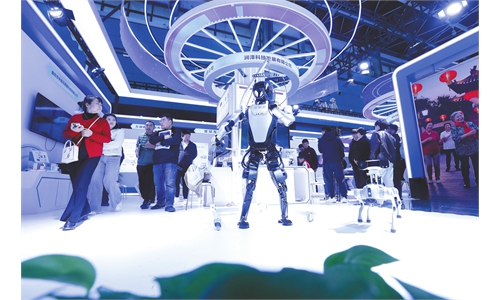
It noted that efforts will be made to promote large-scale application of new technologies, products, and scenarios, and accelerate the development of strategic emerging industries such as integrated circuits, robotics and smart manufacturing, intelligent connected vehicles, and aerospace technology. Efforts will also be made to nurture new growth drivers like 6G, quantum technology, biomanufacturing, and brain-computer interfaces.
In addition, North China's Inner Mongolia Autonomous Region has stressed the development of industries including the low-altitude economy, commercial aerospace, biomanufacturing, generative artificial intelligence (AI), and robotics according to local conditions, according to the Inner Mongolia Party committee's recommendations on Formulating the 15th Five-Year Plan for Inner Mongolia Economic and Social Development published on the local government website.
The autonomous region said that it aimed to encourage various types of business entities and social capital to invest in future industries.
Multiple other regions including North China's Hebei Province, Northeast China's Heilongjiang Province and Central China's Hubei Province have announced similar goals for the next five years, according to documents and press conferences of these local governments.
The plans of Chinese provinces and municipalities to develop and expand emerging and future industries are in line with the recommendations of the CPC Central Committee for formulating the 15th Five-Year Plan (2026-30) for Economic and Social Development, Wan Zhe, an economist and professor at the Belt and Road School of Beijing Normal University, told the Global Times on Wednesday.
The primary task of sci-tech innovation is to lead the development of new quality productive forces. Through innovation in frontier fields such as AI, quantum computing, nuclear energy, and biomanufacturing, China strives to achieve "keeping pace" and "taking the lead" in future industries, thereby comprehensively enhancing total factor productivity - the core in driving the quality of economic growth, Wan said.
Dong Shaopeng, a senior research fellow at the Chongyang Institute for Financial Studies at Renmin University of China, told the Global Times on Wednesday that the accelerated development of new quality productive forces will also help the country better deal with growing uncertainties in the external environment while maintaining an edge amid global competition.
The 15th Five-Year Plan has given top priority to building a modernized industrial system and reinforcing the foundations of the real economy, Zheng Shanjie, head of the National Development and Reform Commission, said at a press conference on October 24 on the guiding principles from the fourth plenary session of the 20th CPC Central Committee.
To achieve the target, efforts will be made to upgrade traditional industries, cultivate and expand emerging and future industries, promote the high-quality development of the services sector, and build a modernized infrastructure system, Zheng said.
From domestically developed large aircraft and the expansion of China's large vessel fleet to breakthroughs made by firms like DeepSeek and Unitree Robotics capturing global attention, China's innovation achievements have been making headlines in 2025. Recently, the World Intellectual Property Organization released the Global Innovation Index 2025, showing that China had risen to the 10th position for the first time.
"China's technological breakthroughs are fueling high-quality productive forces and creating a vibrant ecosystem for foreign firms. This momentum - driven by scale, speed, and integrated supply chains - offers multinationals access to top research and development (R&D) talent, co-innovation partnerships, and a vast tech-savvy market," Nathaniel Madarang, Asia-Pacific president of Goodyear, a US tire producer, told the Global Times in a recent interview.
With 2026 marking the start of the 15th Five-Year Plan period, China's economic structure is expected to further improve, Wan said, expressing expectations for innovation-driven development. "Both high-tech industrial investment and R&D investment will further accelerate," she said.
Dong said that China could also expand tech cooperation with Global South countries to better strengthen industrial and supply chain cooperation.
RELATED ARTICLES