ARTS / CULTURE & LEISURE
The artisan restoring China’s cultural memory
‘Doctor’ of ancient books
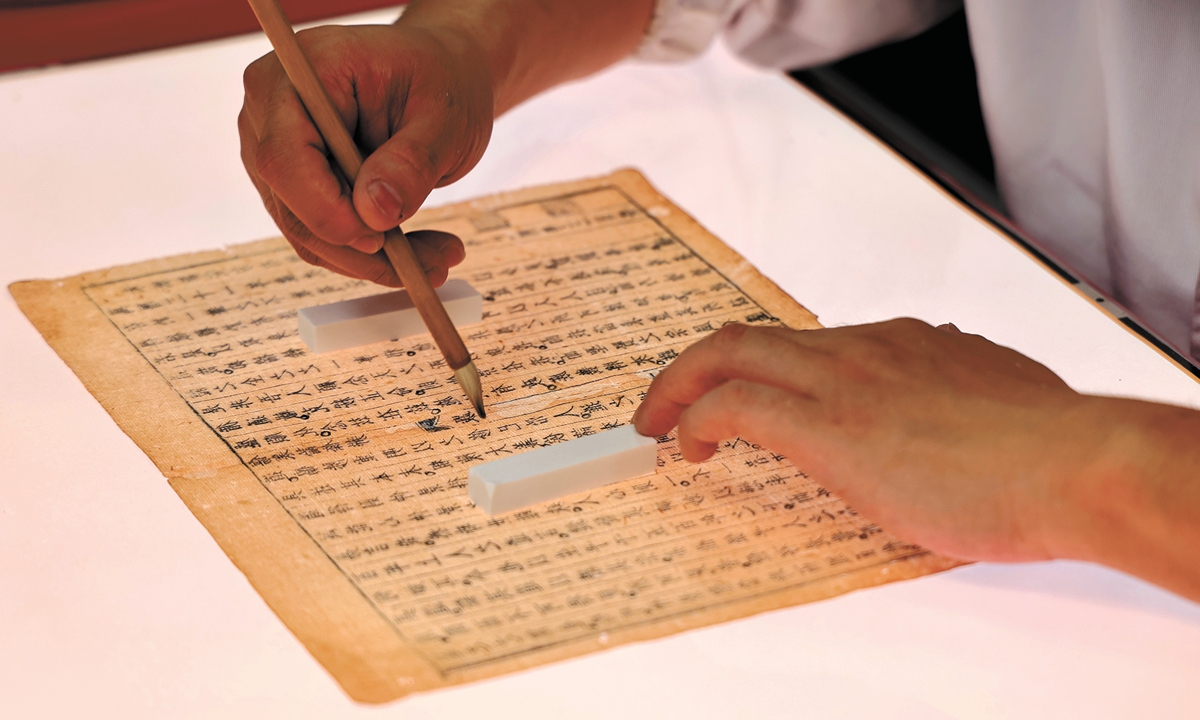
An ancient book restorer repairs damaged pages of traditional Chinese medicine (TCM) manuscripts in Anhui Province in September, 2025. Photo: VCG
As long as the procedures are standardized and the materials suitable, a single restoration of an ancient book can preserve it securely for as long as 200 years said an inheritor of the national intangible cultural heritage of ancient book restoration.Ancient book restoration is not just a technical skill, but more importantly a continuation of culture. A restorer's task is not to make an old book look new, but to preserve its life while restoring it as closely as possible to its original appearance.
Wang Lan, who worked as an ancient book restorer for 17 years at the Capital Library of China in Beijing, told the Global Times that her mission is to breathe new life into old books that have suffered damage from insects, water, or fire. She noted that she feels like a "doctor," treating and healing these "injured" ancient texts.
It is like performing "micro-surgery" on an ancient book. Every step is crucial, and behind every sheet of paper and every drop of paste lies centuries of cultural memory, said Wang.
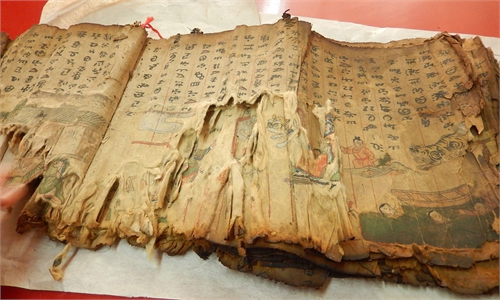
It is estimated that China currently has 50 million surviving ancient books, of which 15 million are in urgent need of restoration. Moreover, some ancient books have suffered further damage due to improper restoration methods used in earlier years, according to a report by Fudan University in November.
Among all cultural relics, paper-based artifacts are the most difficult to preserve because they are the most vulnerable to deterioration. Ancient books, in particular, are treasures of ancient thought and the crystallization of the wisdom of those who went before. They are also the collective memory of the nation and an important vessel of civilization.
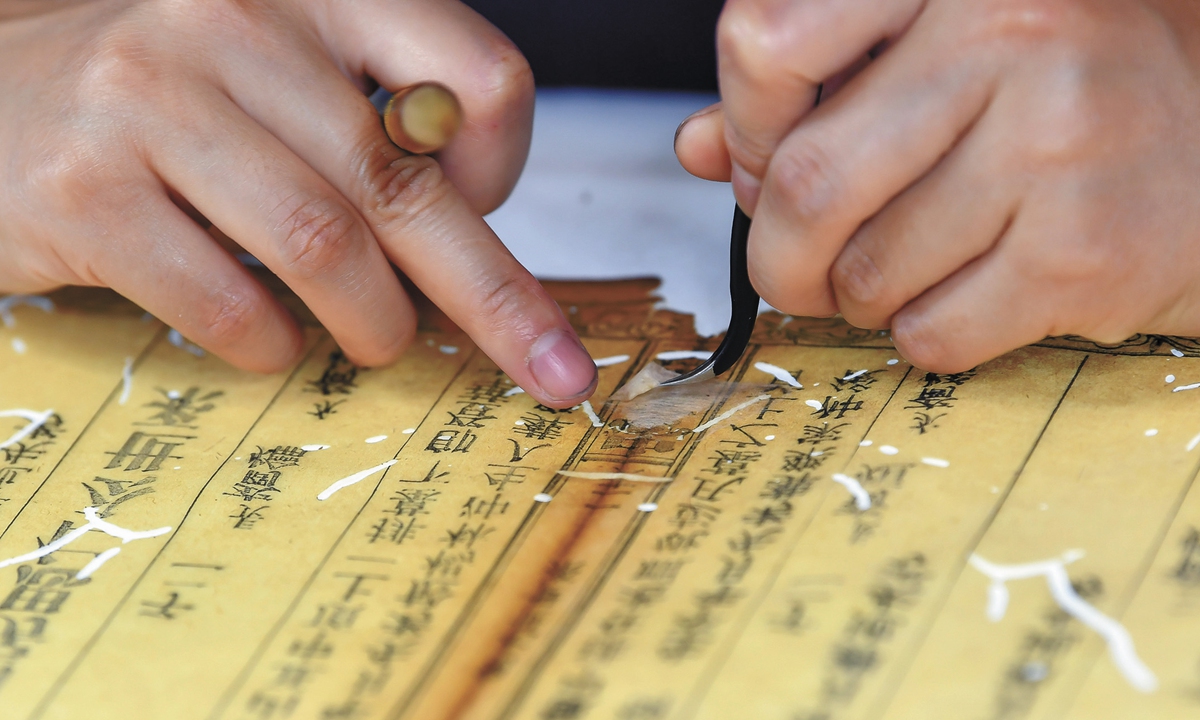
An ancient book restorer inspects the repaired pages of a manuscript. Photo: VCG
Least possible intervention
Since the degree of damage varies from book to book, the restoration process involves more than 20 different procedures.
In general, the main steps include photographing the book before restoration, separating and numbering the pages, washing the pages, repairing the pages, repairing the cover or title label, misting and flattening the pages and cover, and rebinding. After restoration, the ancient book must be bound strictly according to its original format, and its original appearance should not be altered at will during the process, according to Wang.
The earliest record of ancient book restoration in Chinese records appears in Qimin Yaoshu, a monograph of agriculture-related topics written by Northern Wei Dynasty (386-534) agriculturalist Jia Sixie.
The book accurately describes the way repair paper is bonded to and slightly overlapped with the original page; the techniques are meticulous and detailed, with repair traces scarcely detectable. This approach is also consistent with contemporary conservation principles - restoring the old while preserving it with the least possible intervention.
From her perspective, Wang thought that the two major challenges in restoration work are selecting the right repair paper and maintaining long-term dedication.
Paper varies by region and raw materials, and the materials and textures of ancient book paper differ widely. The same is true of today's handmade paper - whether it be white, dark, or aged in color, each batch differs in brightness and thickness.
"Therefore, when choosing paper for repairs, we must compare repeatedly, ideally examining the color in natural light and observing the effect of a single sheet versus a stack of several sheets. Only by identifying the paper that best matches the book can the restoration begin. Sometimes it takes several days - or even more than a month - to select the appropriate repair paper," Wang noted.
The second difficulty is not about technique, but about perseverance. It is not easy to commit to this work over the long term; it requires persistence and a deep sense of responsibility toward the books, she said.
Platform for exchanges
As of June, the number of ancient book restoration specialists has increased from fewer than 100 in 2007 to over 1,000. There are 33 national ancient book restoration centers and 51 national ancient book restoration training institutes, according to information released at a national ancient book restoration conference held in Nanjing, East China's Jiangsu Province in June.
At the recent unveiling ceremony of the National Ancient Book Restoration Center at Fudan University in Shanghai in November, Huang Zhengyi, a senior restorer at the University, said that they will continue to train restoration talent for the country, provide ancient book restoration services for society.
Meanwhile, the Palace Museum in Beijing established a technological laboratory for ancient book preservation in November, joining hands with enterprises to explore new paths for the cataloging, preservation, research, and revitalized use of ancient books.
As handcrafting is a defining feature of ancient book restoration, Wang said that the restorer's personal experience remains the key to successfully restoring a set of books. At present, neither machines nor AI can replace this work. It takes at least 10 years to train a qualified restorer. The cultivation of restoration talent, like the restoration of books themselves, is a slow and patient process.
At present, the master-apprentice model remains the primary method for training in ancient book restoration. Establishing platforms in China for communication and resource sharing among restoration professionals can help promote technical exchange and support career development, Wang added.
Du Weisheng, an ancient book restoration expert at the National Library of China, once said something that left the deepest impression on Wang: "Each time you restore a book, you must approach it as if it were your very first. That's how a book gets truly restored."
RELATED ARTICLES