ARTS / CULTURE & LEISURE
Milano Cortina Games highlight sustainability following Beijing's hydrogen-fueled torch
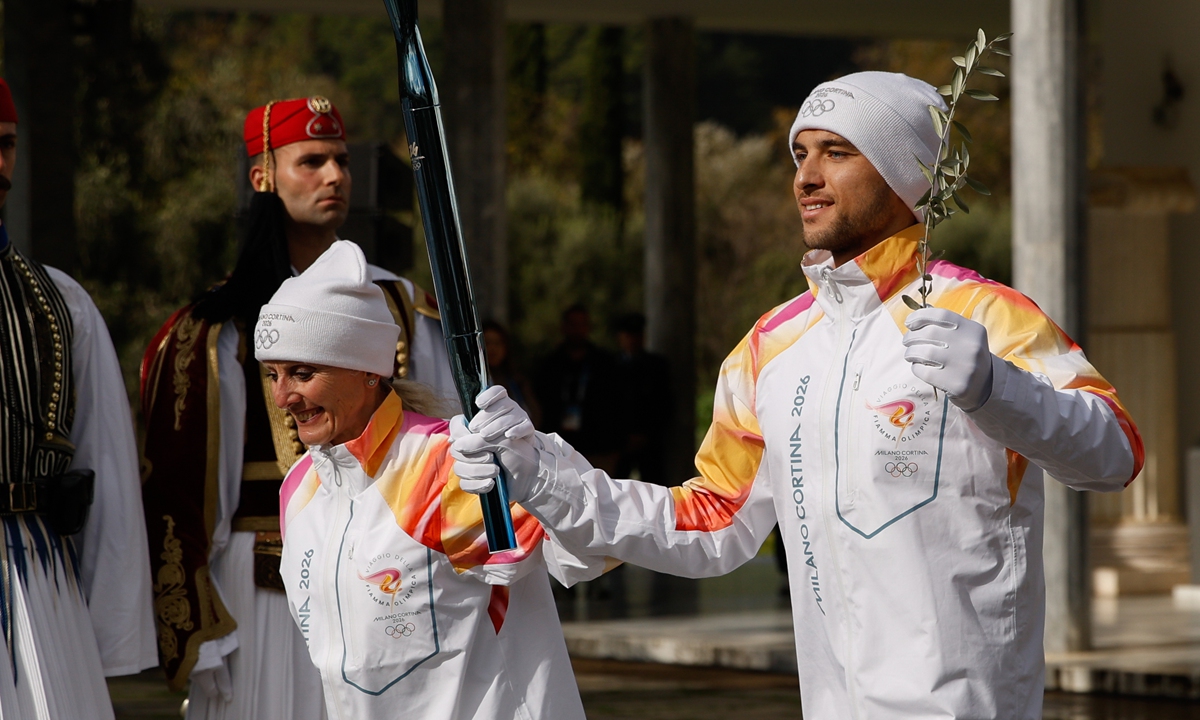
The first torchbearer, Greek rower Petros Gaidatzis (right) carries the torch during the lighting ceremony of the flame for the 2026 Winter Olympics on November 26, 2025. Photo: VCG
The flame for the 2026 Milano Cortina Winter Olympics was kindled on Wednesday in Olympia, Greece, with the traditional ceremony moved indoors due to unfavorable weather. Instead of the outdoor archaeological site of Ancient Olympia, the ritual took place inside the nearby Archaeological Museum of Olympia, according to CCTV Sports News.
Under normal circumstances, the ceremony begins before the Temple of Hera, where a high priestess offers a solemn invocation to Apollo, God of Light, before kindling the flame using a parabolic mirror to capture the sun's rays. With cloudy skies making ignition impossible, this time organizers relied on a backup flame lit during a rehearsal on Monday.
The Olympic flame, long regarded as a symbol of purity and peace, embodies the transmission of the Olympic spirit across generations. At the ceremony, it was placed in a ceremonial cauldron and escorted by the priestess of Hestia, guardian of the fire, to the site of the ancient stadium. There the priestess handed the flame and an olive branch to the first torchbearer of the 2026 relay: Greek rower Petros Gkaidatzis.
Following its journey across Greece, the flame will be formally handed over to the Milano Cortina 2026 Organizing Committee on December 4 in a ceremony at Athens' Panathenaic Stadium.
The flame lighting ceremony was held right before the flame travels to Italy for a 63-day relay across 110 provinces and involving over 10,000 torchbearers before reaching the opening ceremony at Milan's San Siro stadium on February 6, 2026, according to the official website of the Milano Cortina Games.
It's worth noting that though the torch used for the flame ceremony is different from the one for the relay, which has evolved into a showcase of culture, innovation and national pride. During the Beijing 2022 Winter Olympics, the relay produced widely shared moments, including an underwater robot segment that blended traditional ritual with advanced technology.
Carlo Ratti, chief designer of the Milano Cortina torch "Essential," said in a previous interview with the Global Times that sustainability remains central to the torch's concept, a theme aligned with the Beijing Games. Beijing 2022 drew global interest for adopting hydrogen fuel to produce a zero-emission flame. Ratti and his team took a different approach for 2026, using biofuel and recyclable metals such as aluminum and brass.
"Evolution and sustainability are not about relying on a single solution but exploring multiple approaches," Ratti said. "After Beijing, we felt it was interesting to pursue another path - equally sustainable - in this case, biofuel."
According to earlier announcements, the Milano Cortina torch relay will feature a diverse slate of torchbearers. Among them are Chinese Basketball Hall of Famer Gong Xiaobing, heavyweight boxer Zhang Zhilei, and freestyle skier Gu Ailing, according to media reports. On Tuesday evening, it was also revealed that Chinese gymnast Zhang Boheng and track-and-field athlete Chen Yujie will take part in the relay.
While attention turns to the unfolding relay in Europe, Chinese winter sports athletes are deep into preparations for the next Olympic cycle. The Big Air Shougang in Beijing, one of the world's first permanent big air facility preserved after the Winter Olympics, will soon host an FIS World Cup event featuring Chinese riders Su Yiming, Yang Wenlong and Liu Mengting, per the organizers.
Beijing-based sports commentator Guo Ai told the Global Times on Wednesday that China remains highly competitive in big air and slopestyle heading toward Milano Cortina.
"Su Yiming is still world-class. His performance's level of difficulty and execution remain outstanding. As long as his health stays stable, he has full potential to return to the Olympic podium and even contend for gold," Guo said.
On the ice, China's short-track speed skating team has just completed the third stop of the World Cup circuit and is preparing for the next event, with the immediate goal of securing points to qualify for full quota spots at the 2026 Games.
Guo noted that the team's form is trending upward.
"From the Gdansk stop, the men's squad showed they are stabilizing and pushing forward again. Lin Xiaojun's inside pass in the 500-meter final was especially impressive, it shows his rhythm and lane sense are returning to top level," he said.
The two silver medals in the men's 500 meters and 5,000-meter relay"carry significant weight and show that China remains highly competitive in men's events," he added. Young skaters such as Zhang Baihao are also emerging, strengthening the team's depth.
"The women's team is still chasing South Korea and the Netherlands, but Gong Li's reaching the A final was encouraging. Young skaters are closing in on the leading group. If they continue producing A-final results, earning full Olympic quota spots is very possible," Guo said.
"With one more winter season before the Milano Games, the Chinese delegation will make a final push. I believe they can deliver strong results," Guo added.
The Milano Cortina 2026 Winter Olympics is set to take place from February 6 to February 22, 2026.
RELATED ARTICLES