ARTS / CULTURE & LEISURE
Discovering Fujian’s cultural warmth through its local produce, Hakka architecture
Where heritage lives
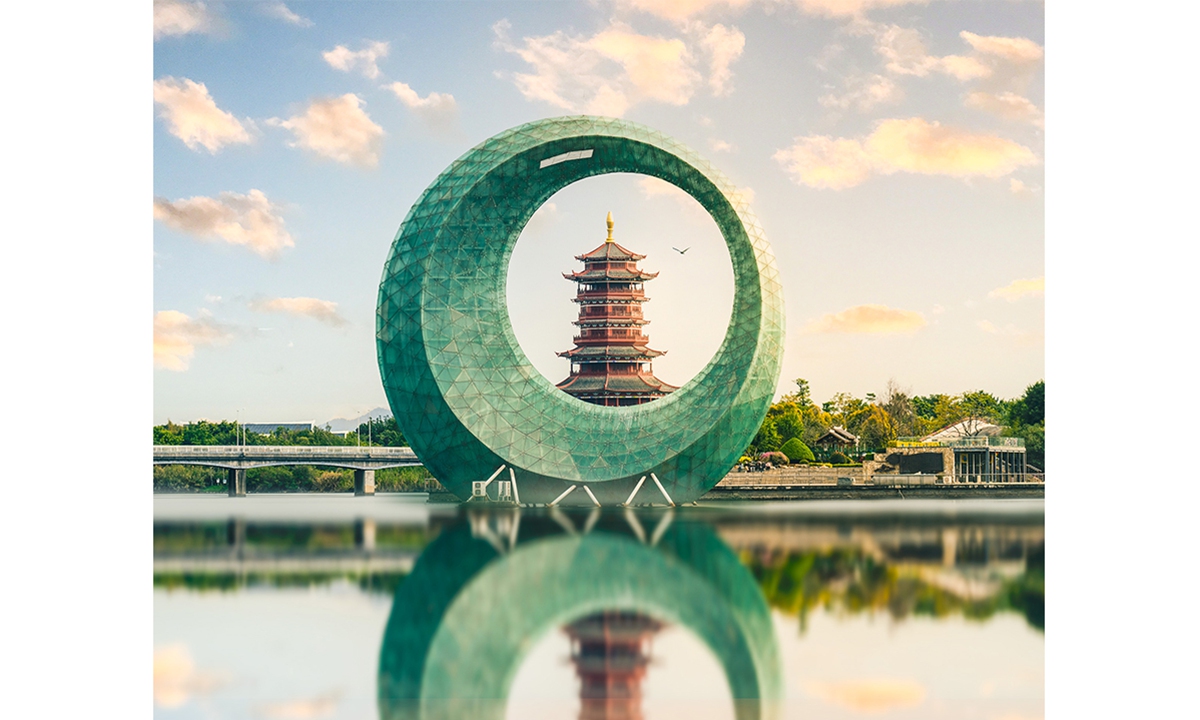
Urban landscape of Jimei district in Xiamen, Fujian Province Photos: VCG
Instead of saying "Nihao" (literally Hello in Chinese), people in East China's Fujian Province often break the ice with strangers by offering them a cup of tea.This welcoming-tea gesture is sometimes an invitation to sample a mellow black tea with a hint of sweetness, or the brisk and aromatic Chinese oolong teas with unique names like "Tieguanyin," a premium variety of Chinese oolong tea, or "Shuixian," a variety from the Wuyi Mountains in Fujian.
Beyond tea ceremonies, Fujian people's hospitality shows in many other ways. A friendly greeting like "Ah Mei" (literally younger sister) instantly makes an outsider feel a sense of belonging.
This warmth is deeply rooted in the province's Hakka tradition, especially in western Fujian, where Hakka culture is at its strongest, with the city of Longyan being one of its best examples.
We 'stay here forever'
Although not as urbanized as Fuzhou, the provincial capital of Fujian, Longyan holds the revered title of the "ancestral heartland" of Hakka culture.
Historically, the Hakka people migrated from China's Central Plains to Fujian, where they settled.
Taking Longyan as an example. Many of its Hakka residents can trace their ancestral origins to Xinxiang, Central China's Henan Province.
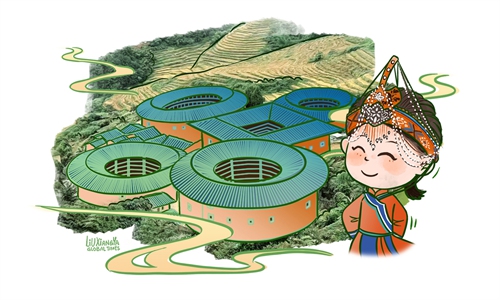
The Hakka lifestyle is ubiquitous in Longyan, and its most representative example is the Hakka communal dwelling known as the tulou.
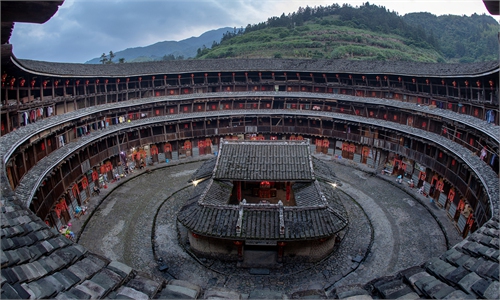
In the city's Yongding district, several circular and square tulou such as the "Zhencheng Building" and "Kuiju Building" rise from the earth like giant rings.
Stepping close to them, visitors can observe the most striking feature - the massive rammed-earth walls.
The plain, yellowish exterior may seem unremarkable, but the 1.6-meter thick walls are strong enough to withstand natural disasters while protecting Hakka residents from outside threats at the same time.
The 113-year-old Zhencheng Building features thick rammed-earth walls reinforced with an internal framework of bamboo and wood strips.
The entire structure is built with the traditional mortise-and-tenon technique, using nothing but Chinese fir timber, and not a single steel bar can be found throughout the building.
Its appearance is equally distinctive, featuring two symmetrical, crescent-shaped annexes on either side, which make the building resemble a hat traditionally used by ancient officials.
Lin Rigeng, a senior resident who has lived here for 75 years, told the Global Times that these two crescent-shaped rooms were where his ancestors processed tobacco leaves. It was through the tobacco trade that Lin's family prospered.
The interior of the tulou is exquisitely crafted, featuring iron railings adorned with intricate leaf and floral motifs.
The building's communal courtyard is graced with couplets, inscribed with Hakka family mottos. One of them reads, "Let words mirror actions, and blessings grow from good roots," imparting the Hakka wisdom that one's deeds must align with their words, and that virtue is the true source of reward.
Including the Zhencheng Building, in 2008, the Fujian tulou is inscribed as a UNESCO World Heritage Site. Despite residents here still needing to go outside to use toilet, and walking up and down stairs multiple times a day, the unique dwelling continues to uphold "the very spirit of Hakka traditions," Lin told the Global Times.
"Both my children, my grandchildren and I will stay here forever," Lin remarked.
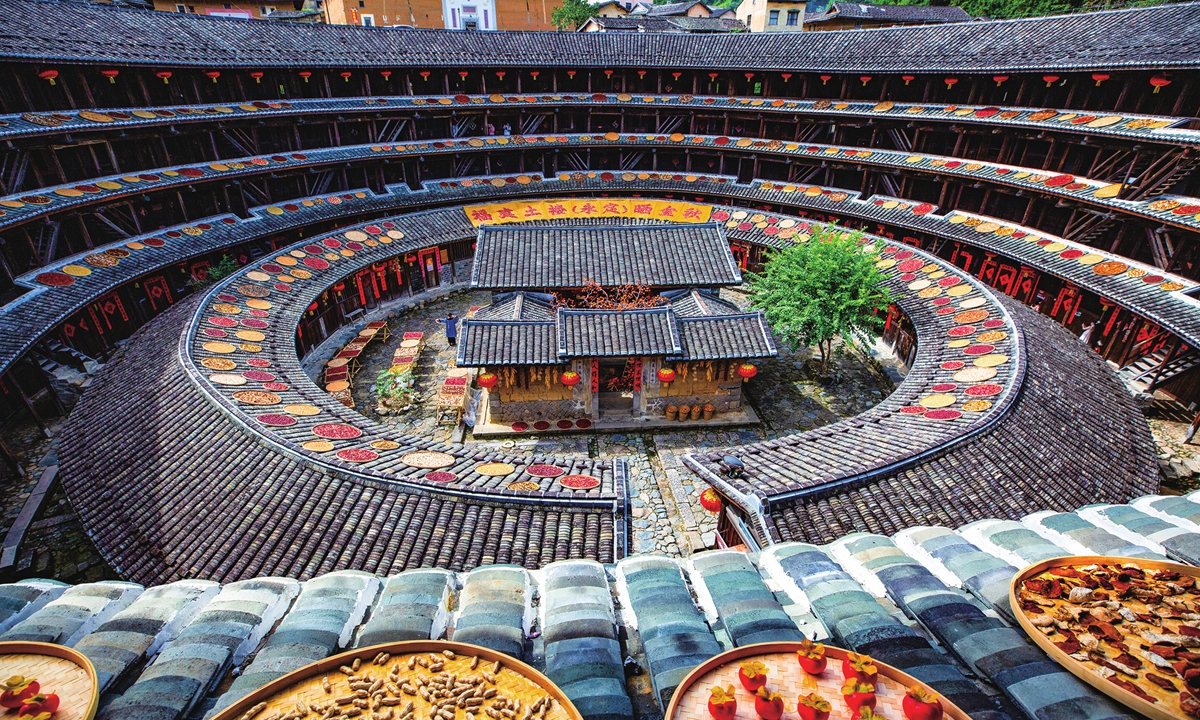
Tulou clusters in Chuxi Ancient Village in Longyan, Fujian Province, on September 27, 2025 Photos: VCG
HomecomingOn the mountains not far from the tulou, persimmon trees heavy with fruit line the slopes. The variety grown here, known as "Zaohong" or "Early Red," is distinct from its northern counterparts, prized for its early ripening and exceptionally sweet taste.
Each morning around the autumn-to-winter season, the fruit is harvested, and by the afternoon, it is skillfully peeled and laid out to dry in the sun, beginning its transformation into dried persimmons. Walking past, one can catch a faint, sweet fragrance lingering in the air.
"Our dried persimmons have a unique, sweet flavor with a subtle smoky note," Lin Weilong, a residential vendor, told the Global Times. "They've already become a hit, selling well both online and right here in our village."
The sweet air here is scented not only with persimmons but also with the aroma of Hakka rice wine. Unlike traditional rice wine, which is often translucent and white, the Hakka variety boasts a unique amber hue and it relies entirely on the natural fermentation of the grains.
Ah Bi, the maker of this wine, told the Global Times that drinking rice wine is their "way of conveying blessings," used for celebrating major life events like birthdays and marriages.
"Every time my daughter leaves home to go to work in Xiamen, I'll make sure to give her a bottle," said Ah Bi. "It's so she never forgets the taste of home."
Since it takes only around two hours by car to travel from Longyan to Xiamen, one of the province's most celebrated tourist cities, Ah Bi's daughter is just one of many local young people drawn to the opportunities in Xiamen, following a well-trodden path from their hometowns to the bustling city.
Blessed with a unique sea island landscape, many of Xiamen's tourist attractions are built along the coast. Beyond the world-renowned Gulangyu Island, the urban area itself possesses a distinct cultural charm.
At the Mazu cultural plaza, a stone statue of Mazu, the goddess of the seas, stands overlooking the Xiamen-Kinmen maritime area. Here visitors can take a boat to the sea or gaze into the distance toward the sea.
Chen Jiaxin, a tourist from the island of Taiwan, shared that whether it was the shared Mazu culture or simply walking the streets of Xiamen, "everything felt deeply familiar, like a homecoming," she told the Global Times. "I visited the Fujian tulou too. There it carries the memories of my ancestors, and I will bring my daughter back to Fujian to learn about our roots," said Chen.
RELATED ARTICLES