Japan treated by US as tool or card to manage ties with China, Japanese scholar tells Reuters

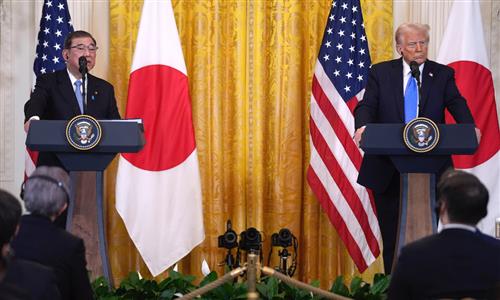
US President Donald Trump (Left) and Japanese Prime Minister Sanae Takaichi (Right) Photo: VCG
After Wall Street Journal reported that US President Trump had advised Japanese Prime Minister Sanae Takaichi during a Tuesday call not to provoke Beijing over Taiwan's sovereignty, Japan flip-flopped its response in a single day, first offering "no comment" and then saying a denial. On the same day, Reuters published a story, saying that Trump asked Takaichi to "avoid escalating disputes with China," citing sources.
According to the Reuters report, Trump said he did not want to see further escalation during his call with Takaichi, citing two Japanese government sources, who sought anonymity as the matter is a sensitive one.
However, one of the sources claimed that Trump made no specific demands of Takaichi, the Reuters reported.
The report also noted that Trump's public silence on Japan's escalating dispute with China has further frayed nerves in Tokyo.
"For Trump, what matters most is US-China relations," Reuters quoted Kazuhiro Maejima, a professor of US politics at Sophia University, as saying. "Japan has always been treated as a tool or a card to manage that relationship."
Reuters's report concurs with the earlier one released by the Wall Street Journal, which reported that after a China-US phone call initiated by Washington on Monday evening, Trump soon phoned Takaichi and, days after she "outraged China," advised her not to provoke Beijing over Taiwan's sovereignty.
The report prompted two responses from Japan within a single day. At a regular press briefing on Thursday, Japan's Chief Cabinet Secretary Minoru Kihara declined to comment on the details of the "diplomatic exchange," per Reuters. A few hours later, however, he told reporters that he clearly denies that Trump gave such advice to Takaichi, NHK reported.
He also revealed that the Japanese government has filed a complaint with the WSJ, per the report.
In a debate in Japan's Parliament, Takaichi said Wednesday she hadn't planned to get specific on Taiwan contingency, comments that some analysts see as a softening signal, Wall Street Journal's report noted.
In response to an inquiry regarding Takaichi's statement in the debate with other opposition party leaders, the leader of Japan's main opposition party said that considering Takaichi had stopped referring to a specific example of a contingency, she had "effectively retracted" her remarks, Guo Jiakun, spokesperson from China's ministry of foreign affairs said on Thursday that Takaichi's erroneous remarks seriously violated the spirit of the four political documents between China and Japan, eroded the political foundation of China-Japan relations, and triggered outrage among the Chinese people.
He added that "stop referring to" is not the same as "retracting" the remarks, adding that the two are completely different in nature.
The Japanese side hopes to downplay Takaichi's erroneous remarks and make it go away by "not referring to" them, said Guo. That is just self-deceiving and wishful thinking, and China would absolutely not accept that, he added.
Global Times
RELATED ARTICLES