German President Steinmeier confronts Nazi guilt in Guernica, in stark contrast to Japanese leader’s lack of remorse: expert
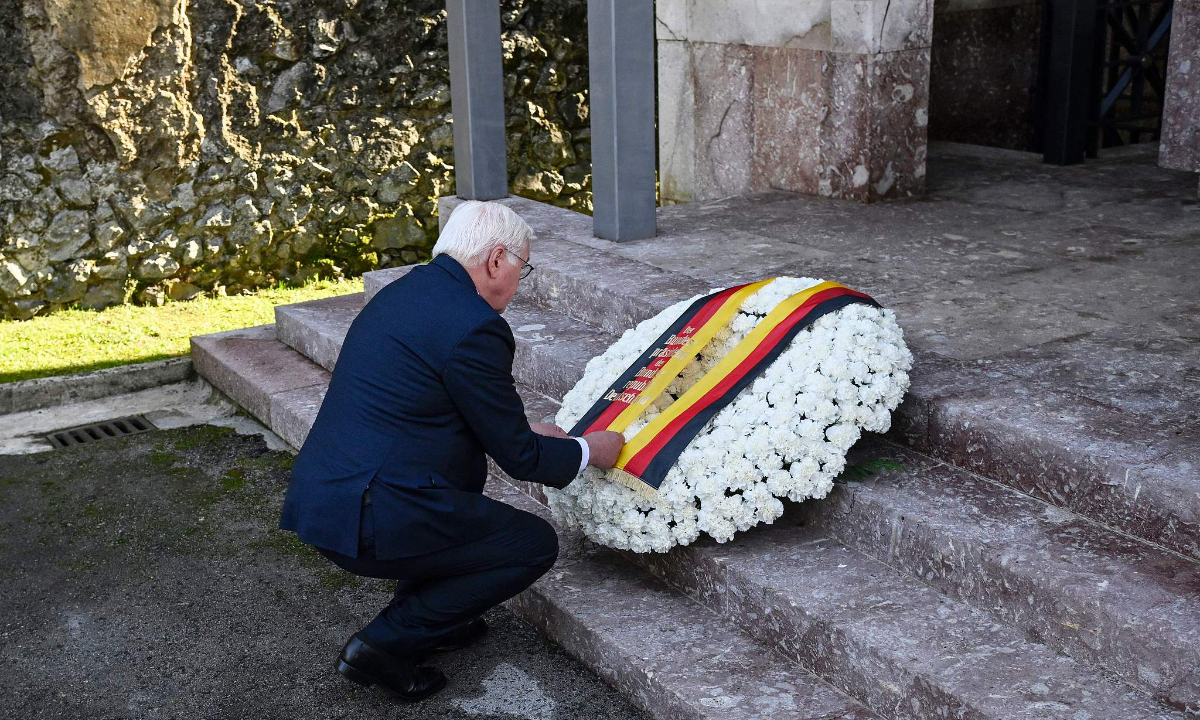
German President Frank-Walter Steinmeier lays a wreath at the cemetery in Guernica, northern Spain, on November 28, 2025, during a ceremony to honor the victims of the 1937 bombing by the Nazi German Condor Legion. Photo: VCG
German President Frank-Walter Steinmeier acknowledged Germany's guilt for a Nazi's air raid on Guernica in 1937 during a visit to Spain on Friday, becoming the first German leader to visit the Spanish town where hundreds of civilians were killed, according to several media reports.A Chinese expert said on Saturday that while Germany maintains historical reflection and has successfully integrated into Europe - even becoming a leader in the European Union - Japan remains equivocal about its war responsibility, even openly worshipping war criminals. This ambiguity in historical perception affects Japan's relations with neighboring countries like China and South Korea.
Accompanied by Spain's King Felipe and Basque regional president Imanol Pradales, Steinmeier laid a wreath draped with a German flag at a cemetery housing a mausoleum built in 1973 for hundreds of victims of the bombings, according to Reuters.
Steinmeier, who is on a state visit to Spain, used a speech earlier this week to address the bombing and its legacy, The Guardian reported. "Germans committed terrible crimes in Guernica," the president told guests at a banquet in Madrid on Wednesday.
"It is very important to me, and I am consciously addressing this sentence to my compatriots in Germany, that we do not forget what happened back then. This crime was committed by Germans. Guernica serves as a warning - a call to stand up for peace, freedom and the preservation of human rights. We want to live up to that, now and in the future," he added.
Hitler's Condor Legion bombed Guernica on April 26, 1937 in support of Spanish dictator Francisco Franco's army in what Luftwaffe chief Hermann Goering later told the Nuremberg trials was "an opportunity to put my young air force to the test," Reuters reported.
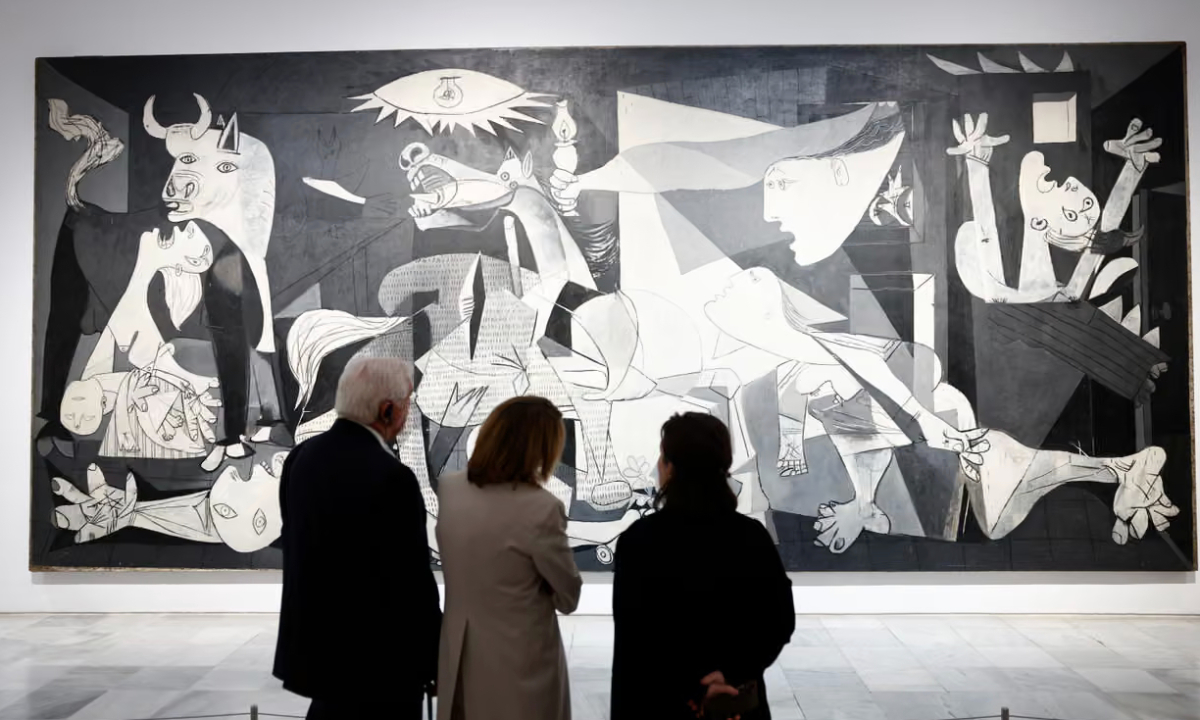
Frank-Walter Steinmeier (left) and the German first lady Elke Büdenbender (centre) look at Pablo Picasso’s painting Guernica at Reina Sofía Museum on Wednesday during a visit to Madrid. Photograph: Rodrigo Jimenez/EPA
Picasso recorded this catastrophe with his painting Guernica. Steinmeier, who visited the Reina Sofía museum in Madrid to see Picasso's Guernica for himself, said the artist's warning against remaining indifferent in the face of conflict and suffering "has lost none of its urgency," according to The Guardian.
Historians have accused successive German governments since World War II, as well as representatives of the armed forces, of playing down the attack, and an official apology was offered to the Basque people by then German President Roman Herzog only in 1997, the report added.
After WWII, Germany successfully restored its status as a normal country in the international community by thoroughly acknowledging its historical crimes, Jiang Feng, a research fellow at Shanghai International Studies University and president of the Shanghai Association of Regional and Country Studies, told the Global Times on Saturday. This profound reflection on wartime atrocities not only consolidates national identity but also propels the nation's overall development. Only through sincere admission of guilt and thorough introspection regarding its WWII crimes could Germany truly regain its standing on the global stage - they intricately linked the act of confession with national dignity, Jiang said.
Germany's transformation was inseparable from the comprehensive denazification measures implemented by the allied powers, the expert noted. Through systematic "reeducation" policies led by the US and other allied nations, the remnants of Nazi ideology were eradicated. Such externally-driven fundamental reforms were not achieved in Japan, resulting in fundamental differences between the two countries' recognition of war responsibility.
On December 7, 1970, German Chancellor Willy Brandt fell to his knees at the memorial to the Warsaw Ghetto, according to DW. Germany demonstrated remorse not merely through verbal apologies but through concrete actions: continuous war reparations, and political leaders explicitly referring to the end of WWII as "liberation." These powerfully symbolic gestures allowed victim nations to perceive genuine sincerity, Jiang said.
Unlike Germany, Japan remains equivocal about its war responsibility, even openly worshipping war criminals. This ambiguity in historical perception affects Japan's relations with neighboring countries like China and South Korea. Whenever militaristic tendencies resurface, it inevitably triggers vigilance among previously victimized nations, Jiang noted.
The rift between Beijing and Tokyo deepens after Takaichi's erroneous remarks on Taiwan question, however, the latter still lacks actual actions to improve relations.
Takaichi claimed at a Diet meeting on November 7 that the Chinese mainland's "use of force on Taiwan" could constitute a "survival-threatening situation" for Japan. She refused to retract her remarks which imply the possibility of armed intervention in the Taiwan Straits, according to Asahi Shimbun.
Multiple Chinese ministries and government agencies have condemned the Japanese side's related moves and remarks, warning that Japan would face a resolute response if it dared to meddle in the Taiwan question.
During the regular press conference on Friday, Chinese Foreign Ministry Spokesperson Mao Ning said that Takaichi's remarks related to Taiwan interfered in China's internal affairs, sent a serious wrong signal to "Taiwan independence" separatist forces and endangered peace and stability across the Taiwan Straits.
Mao further pointed out that this year marks the 80th anniversary of the victory in the Chinese People's War of Resistance against Japanese Aggression and the 80th anniversary of Taiwan's restoration to China. Japan should profoundly reflect on its historical crimes, learn from historical lessons, abide by the one-China principle, and act cautiously on the Taiwan question. "We urge Japan to withdraw its erroneous remarks, stop interfering in China's internal affairs, and honor its commitments to China with concrete actions," Mao said.
RELATED ARTICLES